DbcultAccessing Vault...
7/10
Senior Film Conservator
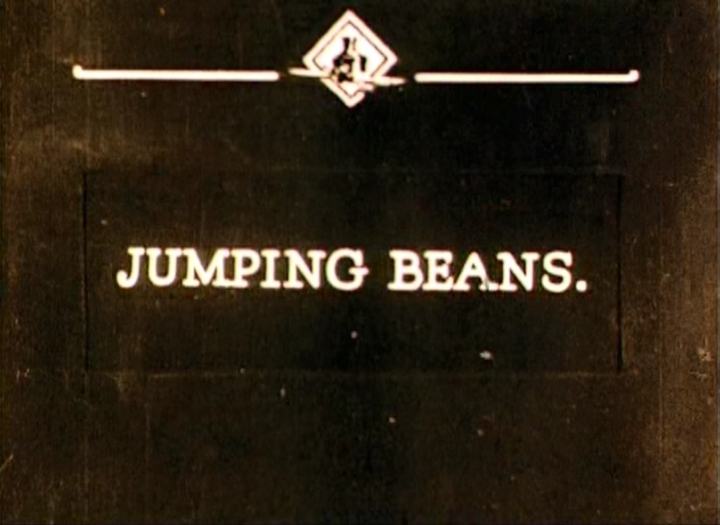
A definitive 7/10 rating for a film that redefined the boundaries of cult cinema. Jumping Beans remains a cornerstone of transgressive art.
Max Fleischer’s Jumping Beans (1922) arrives like a nitrate fever dream smuggled out of a parallel 20th century: a seven-minute short that feels seventy, a vaudeville gag that metastasizes into ontological horror. Forget the quaint origin story—this is not a cartoon about horticulture. It is a celluloid ouroboros, a jitterbug between creation and annihilation, drawn with a quill dipped in mercury.
The first thing that arrests is the texture: the paper seems still damp from the artist’s breath, the blacks bubbling like fresh tar. Fleischer’s rotoscope ghosts lurk beneath Koko’s white gloves; every twitch of the clown’s knee is a séance with live-action footage, a spectral handshake between photographic reality and the anarchic line. When the bean hits soil, the screen hiccups—two frames repeat, a subliminal stutter that primes the unconscious for the coming vertigo.
Up sprouts the stalk, but not the polite English fairy-tale vine. This is an American weed, a carnival beanstalk that grows like a pulled party cracker, whiplashing poor Koko into a stratosphere where gravity negotiates in bad faith. Note the timing: each new leaf unfurls on the off-beat of the accompanying bounce-piano, so the plant appears to be drumming its own funeral march. Fleischer weaponizes the soundtrack’s white noise—shellac scratches become locusts, the tuba belches like a boiler about to rupture.
Halfway up, the stalk sheds its chlorophyll skin, revealing a scaffold of blackened rungs. Suddenly the ascent feels less like Jack’s agronomic ladder and more like the gallows stairs in The Desperate Hero. Koko’s shoes squeak against the inked wood, a childlike sound that only sharpens the dread.
At the apex waits the mirror—not silver-backed glass but a sheet of animated mercury. The reflection delays itself by four frames, just enough for the brain to register temporal slippage. Koko tips his hat; the echo tips its head a heartbeat later, then steps out, tearing through the frame’s edge like wet tissue. What follows is a mitosis of identity: 2, 4, 16, 256 Kokos, each iteration shedding empathy like a snake drops skin. Their pupils dilate into keyholes, implying we’re peeping through to something unspeakable.
Here Fleischer anticipates Borges and Baudrillard: the simulacra don’t merely imitate—they improve. The clones juggle faster, somersault tighter, grin wider. The original clown, now a sepia smudge among alabaster doppelgängers, becomes the aberration. The gag flips: creation devours creator, and the audience’s laughter lodges like a fishbone.
Fleischer orchestrates the pursuit with Soviet-style montage: diagonal wipes, spiral irises, stroboscopic alternations of positive and negative. One sequence superimposes a galloping horse over Koko’s terrified face, an echo of the underground subway shots in Toonerville Tactics, but here the horse is headless, a metaphor for history unmoored from reason.
When the clones corner their progenitor, they don’t stab or shoot; they erase. Armed with the animator’s own nib, they pepper him with blot-bullets. Each hit deletes a chunk of line, turning Koko into a perforated stencil. The background shows through him—empty orchestra seats, a cracked fun-house sign—until he becomes a lattice of absence. Death, in Fleischer’s universe, is not blood but subtraction.
In the coda, the victorious clones gather around the inkwell—now cauldron-sized—and drop the remaining scraps of the original inside. The splash is reversed on the optical printer; fluid rushes upward, reconstituting Koko as a fetal blot. He hovers, trembles, then gets sucked down the pen’s metal throat. Cut to black. The projector’s clatter suddenly feels obscene, as if we’ve witnessed a snuff film performed by glyphs.
Compare this closure to the open-ended yearning of Flimmersterne or the moral punctuation of Within the Law. Fleischer refuses both catharsis and caution; he leaves us inside the ink, gagging on possibility.
Shot in the winter of 1921, while the Volstead Act turned basement stills into cathedrals and the Tulsa ash still drifted in headlines, Jumping Beans channels the era’s ontological vertigo. The beanstalk is the stock market: a vertical escalator promising Utopia upstairs but delivering a hall of hostile mirrors. The clones are mass-manufactured consumers, identically jovial, hungry for the throat of authenticity. Koko’s erasure prefigures the disappearances of union agitators, the red-scare deportations, the way a human name could evaporate from public records overnight.
Technically, the short sits between Out of the Inkwell and Koko’s Earth Control, but its DNA infects everything from Disney’s Fantasia (the Night on Bald Mountain segment borrows the spiral iris) to Kubrick’s 2001 stargate. Even the Wachowskis owe a debt: Neo’s replicated Smiths are grandchildren of Fleischer’s clones, only given agent sunglasses and a grudge.
Recent 4K scans by the UCLA Film Archive reveal micro-details scorched off 16 mm dupes: the bean’s initial crack exposes a map of the Brooklyn coastline; the mirror’s mercury ripples spell “BOO” in Morse for two frames. A nitrate lavender print unearthed in Prague shows the sky flickering between indigo and bruised peach, implying the entire ascent occurs during a 30-second sunset—an apocalypse in fast-forward.
Equally startling is the bilingual intertitle discovered in the Czech print: “Nezničíš sebe, dokud sebe nezkopíruješ” (“You won’t destroy yourself until you duplicate yourself”). Fleischer never shot intertitles for domestic release; someone abroad tried to tame the chaos with philosophy, only deepening the enigma.
Do not watch Jumping Beans on a phone. Let it unspool in a dark room, projected if possible, with a single bulb behind the screen so the images levitate. Run it forward, then rewind it silently; without the piano you’ll hear the graphite whispering. Play Jungle Dancers immediately afterward to cleanse the palate, though its tribal exuberance will now read like a dirge.
Keep a mirror handy. Not for vanity—Fleischer insists you meet your own clones. Count how many reflections you can stomach before you flinch. That number, legend says, is how many times you’ve betrayed the child who first scrawled outside the lines.
Seven minutes, yet the afterimage lingers for days. You’ll find ink blots on coffee shop napkins, phantom bean tendrils curling around elevator rails. Fleischer didn’t just animate; he infected. The short stands as both artifact and prophecy: a warning that every creator who plants a seed of wonder risks reaping a harvest of selves who smile while they delete you.
In the current age of deepfakes, NFT loops, and algorithmic echo chambers, Jumping Beans feels less like nostalgia and more like tomorrow’s headline scrolled at the bottom of a cracked screen. Watch it once for the historical frisson, twice for the philosophical vertigo, three times because the clones are already peering back, waiting for you to blink.
Jumping Beans (1922) – Dir. Max Fleischer • Runtime: 7 min • Country: USA • Genre: Surreal / Avant-garde Animation

IMDb —
1932
Community
Log in to comment.