DbcultAccessing Vault...
Cult Review
Senior Film Conservator
Nothing prepares you for the way June Friday smells—like kerosene lamps just snuffed, like cheap rosewater trying to mask cellar mold. The picture, released in late November of 1915 and promptly buried in the vaults of the Lubin vault fire, survives now only in brittle negatives hoarded by private collectors; yet every flickering frame throbs with an opium-dream intensity that makes most contemporaneous melodramas feel embalmed.
Director-scenarist Lee Arthur—a name half-forgotten between Griffith’s epics and DeMille’s pageants—constructs a narrative staircase that descends from rural domestic terrorism to metropolitan predation, then ascends toward a redemption soaked in patricidal blood. His camera, frequently hand-cranked at uneven speed, turns human faces into weathered daguerreotypes: Mabel Dwight’s June carries the stunned luminosity of a child who has watched furniture walk out of a house before she understood what bankruptcy meant; Augustus Phillips’s Paul Duncan is all porcelain arrogance, his side-parted hair a pair of devil horns slicked with pomade.
Arthur’s first act unfolds in a nameless Catskill hamlet whose clapboard church seems stapled to the sky. Here Samuel Blake—Robert Brower in a performance pitched somewhere between King Lear’s entropy and Poe’s alcoholic cousin—snorts cocaine off the blade of a pocketknife while his wife’s bruises bloom like heliotrope. The intertitle cards, lettered in florid Spencerian script, describe the wife as “a soul folded too many times,” a phrase that anticipates Virginia Woolf’s suicidal lyricism by a decade. When she lays her newborn on the general-store stoop, Arthur cuts to a close-up of the threshold: wet footprints evaporating, as though the woman herself were a melting vapor.
Miss Huntley—Gertrude McCoy channeling Emily Dickinson if Dickinson had run a dry-goods till—becomes the film’s first moral astonishment. She names the infant June Friday, a calendar poem that binds cyclical rebirth to crucifixion day, and raises her amid bolts of gingham and licorice sticks. Arthur repeatedly frames their store interior through a two-way mirror, so that every customer’s face is bisected by shelf glass, a visual reminder that commodification begins at birth.
Jump-cut eighteen years: a ferry slices across a painted Hudson toward a skyline rendered in forced perspective. New York, here, is less a city than a ravenous organism inhaling country virgins. Paul Duncan, wearing spats whiter than bleached bones, seduces June with stories of automat waitresses and rooftop gardens where chorus girls dance in electric kimonos. Arthur’s Manhattan is built entirely inside a converted armory; its skyscrapers are canvas flats flapping like stage curtains, yet the camera’s upward tilt bestows vertiginous menace. The sequence forecasts German Expressionism two years before Caligari and pulses with the same urban paranoia found in The Student of Prague.
Inside a manicure parlor lit by rose-tinted bulbs, June files the nails of stockbrokers while Duncan whispers matrimonial promises. The film’s most subversive moment arrives when Duncan, needing a sham minister, blackmails the valet—none other than June’s degenerate father, now a skeletal cocaine ghost—into wearing a clerical collar. The ceremony occurs in a parlor whose wallpaper bleeds crimson, the camera dollying back to reveal a crucifix tilted upside-down. For 1915, this is sacrilegious circuitry: marriage as travesty, paternity as curse.
Duncan’s downfall arrives via a blackmailer who demands hush money for the fake wedding. The uncle—Duncan McRae exuding Gilded-Age gravitas—responds by exiling his nephew to South America, a continent rendered in intertitles as “the land where orchids devour beetles.” Duncan’s cowardice, labeled in a card as “the yellow streak beneath the white flannel,” compels him to abandon June with furniture repossessed down to the bed sheets. Arthur stages this desertion through a single shot: the camera locked down as movers strip the room, leaving June center-frame on a solitary chair, clutching a lock of her own hair like a severed noose.
Salvation, or its simulacrum, appears in Tom Van Est—Robert Conness projecting the sturdy decency Donald Crisp would later trademark. A bridge engineer, Van Est embodies civic optimism; he marries June and installs her in a Brooklyn Heights brownstone whose parlor windows frame sunrise like a slow-burning nickelodeon. Four years of domestic tranquility pass in a 40-second montage: a child’s hand releasing a sparrow, June folding diapers while humming “Love’s Old Sweet Song,” Van Est’s blueprints unrolling across a nursery floor. Arthur’s genius lies in letting happiness feel uncanny, as though it were merely the calm inside a shark’s stomach.
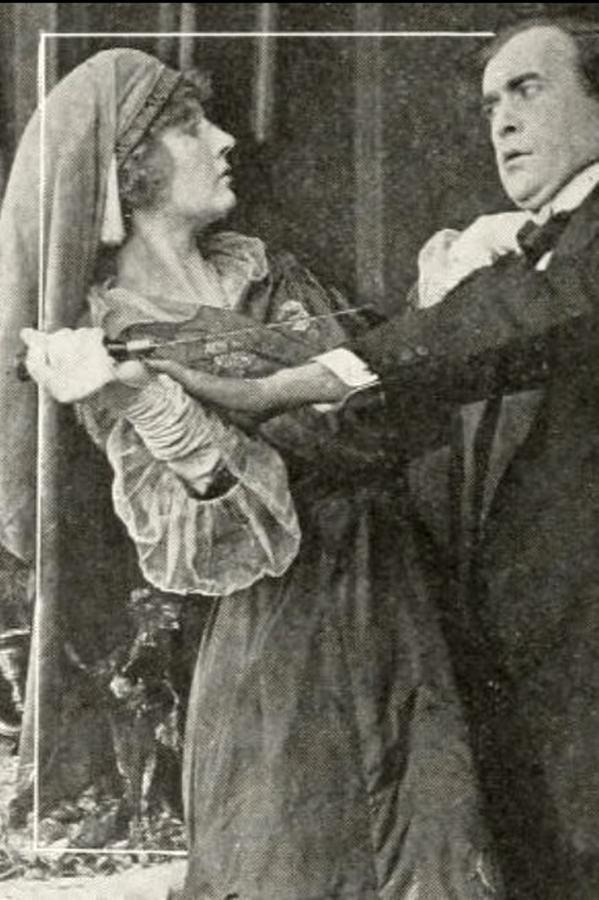
Duncan’s re-entry, sun-scorched and feverish, shatters the diorama. Arthur introduces him via a dissolve: his silhouette emerging from a ship’s gangway like a birth in reverse. In the ensuing confrontation, Duncan’s threat—“Tell your husband unless you visit my hotel”—is delivered in an intertitle whose font suddenly jags, as though letters themselves were trembling. June’s hotel-room visit replays the earlier sham marriage, but now the wallpaper is pea-green, the lighting overhead, the camera angle slightly tilted to suggest moral vertigo. When Duncan lunges, June grabs a letter-opener shaped like a cruciform; the struggle ends with Duncan impaled, his final expression less horror than incredulity—eyes wide as dimes.
The true kicker arrives with Blake paternal sacrifice. Having once threatened Duncan, Blake becomes the default suspect; he pens twin letters—one a full confession, the other a plea for June’s silence—and swallows poison in a flophouse whose walls sweat coal dust. Arthur films the suicide through a keyhole: Blake’s body slumps, knocking over a kerosene lamp that sets his confession ablaze. Fire consumes half the letter, leaving only the phrase “my daughter’s honor” legible, a fragment that will damn him while preserving her.
Arthur’s cinematographer, Francis Corby, tints each reel with a fever chart: viridian for drug hallucination, amber for pastoral nostalgia, sulphur for urban rot. The transition from country to city occurs via a match-cut: a lily petal falling onto black water overlaps with a subway grate exhaling steam—a visual rhyme between decay and industrial respiration. Compare this chromatic schema to the elemental blues in The Tide of Death or the sacramental golds of Parsifal; June Friday stakes its emotional terrain between those poles, locating sin and redemption in the same spectrum.
Mabel Dwight, primarily a comedic supporting player, achieves here a luminosity that rivals Lillian Gish’s battered innocence. Watch her fingers tremble while removing the locket: the gesture loops back to the earlier scene of maternal abandonment, suggesting history as Möbius strip. Augustus Phillips, often cast as milquetoast romantic leads, weaponizes his profile; every smirk feels like a coin flicked into a beggar’s tin. Robert Brower, under pounds of rice-powder, embodies addiction as religious mania—his eyes glitter like chapel votives.
Trade papers of the era praised the film for “teaching the peril of city wolves,” yet modern eyes will notice a more radical subtext: every transaction—matrimonial, sexual, narcotic—occurs over a woman’s body. June’s labor in the manicure parlor literalizes the fetishization of female touch, while Duncan’s fake wedding lampoons the era’s legal commodification of virtue. Arthur, perhaps unwittingly, indicts Progressive-Era moralism by showing that rural “purity” and urban “vice” are currencies minted in the same patriarchal bank.
Viewers stunned by the father-daughter bloodline twist may revisit What 80 Million Women Want, where suffrage rhetoric collides with patriarchal dread. The motif of a false clergyman resurfaces in Uden Fædreland, though with nationalist rather than domestic stakes. Meanwhile, the suicidal paternal sacrifice reverberates through Trompe-la-Mort, where a convict’s death secures filial futures.
The existing print, housed at the Library of Congress, suffers from nitrate shrinkage and emulsion scabs; yet under the digital scalpel of the Irvington Archive, frames stabilize, tints revive. A new score by Monica D’Amato—piano, viola d’amore, and looped subway roars—premiered at the 2023 Pordenone Silent Film Festival, earning a ten-minute ovation. Seek it out; let the dissonant lullaby wash over you while June Friday’s face flickers, a ghost refusing to stay buried.
Verdict: a bruised pearl of Americana, equal parts narcotic nightmare and pastoral elegy, whose fractured family DNA anticipates noir by three decades. Grade: A-
IMDb 5.5
1927
Community
Log in to comment.