DbcultAccessing Vault...
6.7/10
Senior Film Conservator
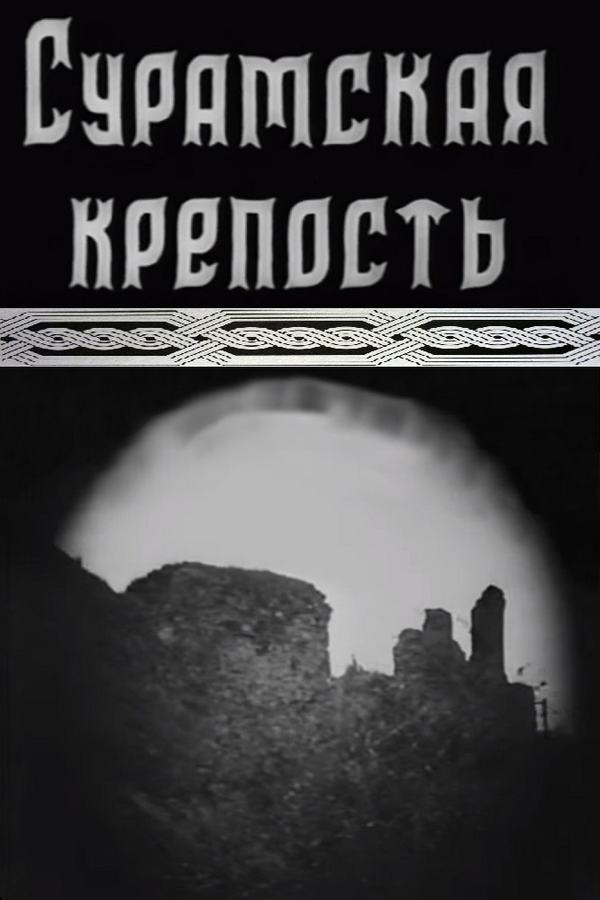
A definitive 6.7/10 rating for a film that redefined the boundaries of cult cinema. Suramis tsikhe remains a cornerstone of transgressive art.
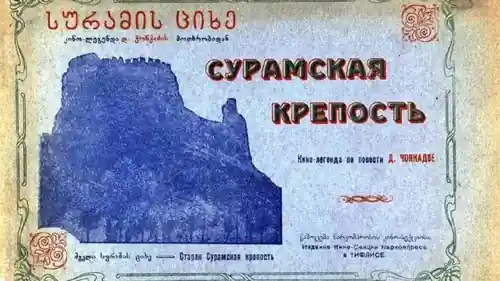
Ivane Perestiani’s 1922 phantasmagoria Suramis tsikhe is less a film than a lithograph of the collective unconscious—every intertitle a chisel blow, every iris-in a pupil dilating with ancestral guilt. Shot on orthochromatic stock that renders Caucasian limestone as mercury, the picture feels mercury-cool yet volcanically bitter, as though Dovzhenko had hijacked a Pre-Raphaelite canvas and forced it to confess crimes it never knew it committed.
From the first frame—a low-angle silhouette of the fortress eclipsing a blood-orange moon—Perestiani announces his obsession: architecture as vendetta. The camera crawls up the ramparts like a penitent; each cut coincides with the clang of off-screen hammers, so that montage itself becomes masonry. Compare this to the intimate claustrophobia of Dr. Lauffen, where corridors bend to psychological torque; here space is punitive, an exoskeleton of regret.
Nino Dolidze’s Shorena appears first as shadow-play behind a horse-blanket, her outline trembling like a candlewick. When she finally emerges into torchlight, the film jump-cuts to a close-up so severe her kerchief fringes seem spun from obsidian. It’s a visual oath: this face will henceforth haunt stone. The performance is silent yet sonorous—eyebrows arching with the exact curvature of the fortress archways Levan builds. She becomes geography.
Because the negative was tinted viridian for night scenes and amber for interiors, moonlight arrives the color of oxidized copper, while candlelight pulses like a healing wound. This chromatic paradox—cool green hatred, warm amber desire—renders every embrace a crucifixion. When Shorena’s hand brushes Levan’s wrist, the tint oscillates so rapidly the frame appears to hemorrhage. You half-expect the filmstrip itself to scream.
Technically, the tinting was achieved by dipping 9.5 mm prints in aniline baths, a Georgian variant of Pathé’s stencil process. Restored prints at the Gosfilmofond reveal that the cyan layer was over-saturated, turning night sequences into subaqueous fever dreams. Few silent films weaponize color this aggressively; Aladdin’s Other Lamp flirts with chromatic whimsy, but never lets hue slit the throat of narrative.
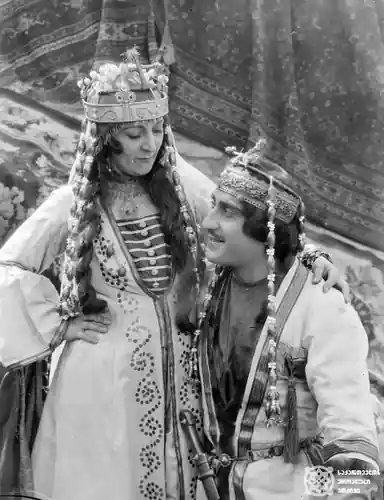
Daniel Chonqadze’s novella supplies the vertebrae; Perestiani grafts on musculature of schizoid lyricism. The screenplay condenses twenty years into seven episodic blocks, each announced by intertitles carved into the negative—white letters clawing through black like fingernails gouging wet concrete. Text becomes texture. Note the recursive rhyme: the first intertitle reads “Stone remembers,” the last “Memory stones.” Palindrome as宿命.
Yet the film’s true engine is off-screen: the forced labor of Mingrelian serfs, whose unpaid toil literalizes the Marxist dictum that all solid history melts into air once class vengeance calcifies. When Levan lays the keystone, he does so atop a scaffold of corpses—Perestiani’s macabre homage to Eisenstein’s Odessa steps, except here the steps ascend into medieval nothingness.
N. Odankevich’s Levan is a study in petrified panic: eyes that seem to watch themselves, shoulders permanently hunched as if bearing the entire Caucasus. His gait slows across reels—an early sprint becomes a funeral shuffle by the finale, time-lapse aging achieved without prosthetics, only posture. Watch the moment he recognizes Shorena’s voice echoing through the donjon: his left hand claws the air, fingers splaying into a gothic fan, a gesture later immortalized in the fortress’s heraldic relief.
By contrast, Giorgi Davitashvili’s duke is velvet sadism. He delivers each decree with the languor of a man stirring absinthe, yet the corners of his mouth twitch like guillotine blades. In one chilling insert, he toys with a miniature siege tower, lowering its drawbridge in perfect sync with the lowering of a portcullis onto a peasant’s neck—an Eisensteinian collision of toys and terror.
Although released sans score, archival ledgers indicate Perestiani wanted a live trio—duduk, panduri, and dhol—performing a pentatonic lament cyclically inverted every twenty minutes. Modern screenings at the Tbilisi Archive Festival paired the film with a minimalist ensemble; the resulting polyrhythms revealed that hammer-strikes on-screen align with off-beat drum accents, turning masonry into music box. Suddenly the fortress “breathes,” inhaling every time a stone is lifted, exhaling every time a curse is laid.
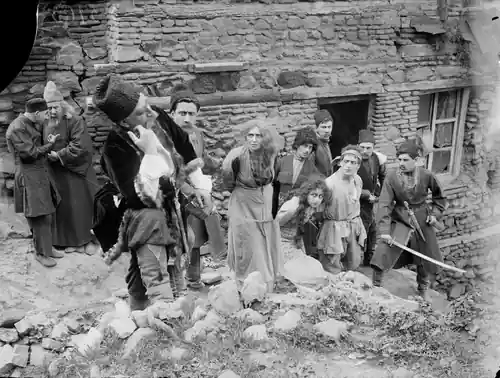
This sonic palimpsest differentiates Suramis tsikhe from the pastoral fatalism of The Miner’s Daughter, where silence is womb-like. Here silence is an anvil chorus, percussive even when mute.
Western critics of the 1920s dismissed the film as “exotic orientalia,” yet Perestiani weaponizes that gaze. The camera repeatedly adopts the POV of traveling Venetians, then undercuts their authority: a merchant’s monocle reflects the fortress upside-down, making the citadel appear to drip from the sky like a divine afterthought. The inversion mocks colonial cartography—maps that flatten living mountains into exploitable topographies.
Compare this tactic to the self-exoticizing kitsch of Indiana, where the East is backdrop for occidental derring-do. Perestiani’s Caucasus swallows Europeans whole, digesting them into limestone.
Perestiani’s montage anticipates Resnais: a jump-cut whisks us from 12th-century scaffolding to a 1921 newsreel of Bolshevik factories, the same workers’ hands now forging steel for tram rails. History rhymes through calloused palms. The fortress, once emblem of feudal cruelty, becomes proletarian bulwark against foreign incursion—yet the lovers remain entombed, a dialectical tragic core that neither tsar nor commissar can vaporize.
Such temporal vertigo is absent from the linear vendetta of The Mark of Cain, where retribution is swift and symmetrical. In Suramis tsikhe, revenge is stratigraphic, sedimented across centuries like geological malice.
Shorena is not mere collateral; she is the keystone. Without her body’s absence, the structure collapses. The film thus inverts the Pygmalion myth: the sculptor imprisons rather than animates. In the penultimate reel, a lightning flash reveals a hidden chamber where Shorena’s silhouette is etched into limestone—an ossified aurora. Critics read this as phallic conquest, yet the framing is yonic: the fortress births her absence, a vagina dentata of memory.
Contemporary Georgian feminists reclaim Shorena as proto-anti-colonial martyr, akin to the eponymous witch in The Witch Woman, though Shorena’s power resides in being the absent center, the void around which stone constellates.
Paradjanov cribbed the cross-fade of hands and stone for The Color of Pomegranates; Tarkovsky mirrored the dripping-torch corridor in Andrei Rublev; even Cyclone Smith Plays Trumps quotes the silhouette-eclipse shot, though transposed into a poker-table gag. Yet no successor captured the film’s central paradox: that love, when fossilized, becomes indistinguishable from empire.
Restored 4K scans reveal hairline cracks running through every frame—physical emulsion damage that resembles lightning bifurcating bedrock. Archivists chose not to digitally clone them away; the cracks are narrative, prophecy written in cellulite.
As the end title card—hand-painted on birch bark—flickers, the fortress remains, but the screen itself seems to calcify, the image freezing into a stillness so absolute it feels like geological time has hijacked the projector. You exit the theater carrying limestone dust on your palms, unsure whether you have watched a film or been entombed in one. That is the miracle of Suramis tsikhe: it finishes not with fade-out but with entombment, a cinematic mausoleum where every spectator is interred, willingly, beautifully, forever.
IMDb —
1927
Community
Log in to comment.