DbcultAccessing Vault...
6.7/10
Senior Film Conservator
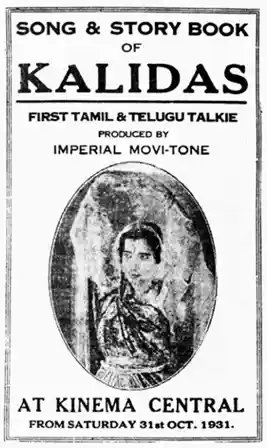
A definitive 6.7/10 rating for a film that redefined the boundaries of cult cinema. Kalidas remains a cornerstone of transgressive art.
“Kalidas” is... well, it's an experience. If you're a film history buff, especially into early Indian cinema, this is absolutely essential viewing. For everyone else, it’s a bit of a tough sit, honestly. It moves at its own pace, a really old pace. You need patience.
The plot is pretty straightforward: a princess gets tricked into marrying this young guy who's not exactly, shall we say, educated. Like, really not educated. The film shows this with such a directness that it’s almost jarring.
There's a scene where... *gosh*, it just sticks with you. The princess, played by T.P. Rajalakshmi, her face when she realizes the depth of the deception. It's not a dramatic scream or anything. Just this slow, sinking look. You can almost feel the movie trying to convey her internal world without a lot of dialogue. Which, for the time, is pretty neat.
The pacing is interesting. It's not slow in a “contemplative” way, more like a “this is how long it took to get the camera set up for the next shot” way. There are moments that feel like they could have been cut short by, oh, a good twenty seconds. But then you remember *when* this was made. It's a snapshot, almost.
I kept thinking about the sound in this film. Or the *lack* of it in some stretches. It’s not quite a silent film, but the dialogue, when it comes, feels like an event. It’s not flowing conversation. More like pronouncements.
The character of the youth, the one who's tricked into marriage, he’s played by P.G. Venkatesan. He does this wide-eyed, almost bewildered thing that really sells the “naive” part. *Bless his heart*, he really commits. When he's supposed to be illiterate, he just... looks illiterate. No big performance, just a kind of quiet blankness.
There are these musical numbers too, often featuring Thevaram Rajambal. They break up the story in a way that feels very much of its era. Not integrated like a modern musical, but more like, “Okay, pause the plot, here's a song!” 🎶 Some of the singing, especially, just *hits* differently. It's raw.
You can tell they were experimenting with what a “talkie” even *was*. The camera often feels very static. Like a stage play being filmed. And then, every so often, there's a shot that makes you go, “Oh, they *did* think about composition there!” It's these little glimpses of artistic intent trying to push through technical limitations.
One particular shot, I can’t quite place it now, but it was just a wide shot of a crowd. And it had this oddly sparse feeling. Like, they gathered everyone they could find, but it still looked a bit empty. Or maybe it was just the framing. It makes you wonder about the logistics back then. 🤔
The storyline is simple, sure. But it carries this weight of early storytelling. It's not trying to be clever with twists. It's just telling a tale. And you feel that. It’s like a really old fable brought to life.
There’s a part where the princess is just *so* clearly unhappy. And the film doesn't really dwell on it with grand gestures. It just... shows her. Her silence speaks volumes, honestly. It’s a very *internal* kind of suffering portrayed.
It’s easy to critique older films with modern eyes, but with “Kalidas,” you really have to appreciate it for what it *is*. A very early step. A kind of cinematic fossil. You see the rough edges, the moments where they were figuring things out.
The ending, without giving too much away, ties things up in a way that feels right for a story of this type. It's not a big surprise, but a satisfying conclusion to its own narrative logic.
You know, for a film that's almost a century old, it holds up as a document. Not necessarily as a blockbuster entertainment. But as a window. A real peek into a different time for movies.
IMDb 4.6
1917
Community
Log in to comment.