DbcultAccessing Vault...
Cult Review
Senior Film Conservator
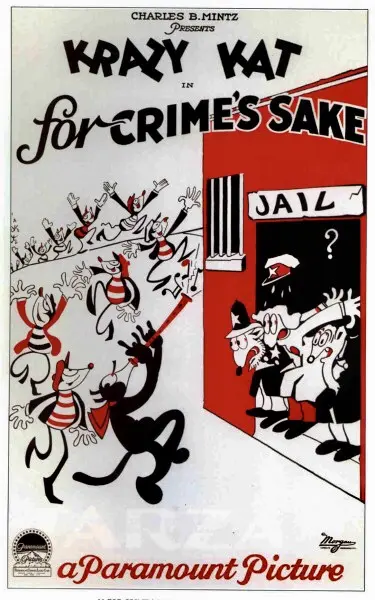
For Crime's Sake is not a film for the casual viewer. It is a frantic, jittery, and often exhausting piece of early animation that will likely frustrate anyone accustomed to the fluid storytelling of the modern era. If you are looking for a coherent plot or emotional stakes, look elsewhere. However, if you want to see the raw, unpolished origins of American surrealism, this short offers a blunt look at a medium still trying to find its feet.
This film is strictly for animation historians and George Herriman devotees. Most modern audiences will find the repetitive gags and shaky frame rates more annoying than charming. It lacks the polish of later silent-era animation and feels more like a series of sketches than a finished product. Watch it if you want to see where Krazy Kat began, but don't expect to be entertained in the traditional sense.
This film works because: It captures the anarchic, lawless spirit of early comic strips, where the logic of the world can change from one frame to the next without explanation.
This film fails because: The technical limitations of 1916 animation stifle Herriman’s intricate line work, turning his delicate art into a muddy, vibrating mess.
You should watch it if: You are researching the evolution of the slapstick genre or want to see a rare example of the detective trope being satirized at the very dawn of cinema.
The biggest problem with For Crime's Sake is that it attempts to translate George Herriman’s genius into a medium that wasn't ready for him. Herriman’s comic strips were defined by their philosophical weight and their shifting, desert landscapes. In this short, those elements are stripped away in favor of basic physical comedy. The backgrounds don't just shift; they wobble. The characters don't just move; they vibrate with an intensity that makes the eyes ache after five minutes.
There is a specific scene involving a brick—because there is always a brick with Ignatz—where the timing feels completely off. In the comics, the arc of the brick is poetic. Here, it’s just a clump of pixels moving across a screen with no weight. It highlights the fact that early animation often struggled to replicate the comic timing that worked so well on the printed page. Unlike The Draw-Back, which manages a more consistent tone, For Crime's Sake feels like it’s constantly tripping over its own feet.
The humor in this short is aggressive. It’s a loud film for being silent. The characters are constantly in motion, even when they don't need to be. This was a common trait of early International Film Service productions, where the goal was quantity over quality. Manny Gould and Ben Harrison were clearly working under tight deadlines, and it shows in the lack of detail. Compared to the more deliberate pacing found in The Spy, this short feels like it was made in a fever dream.
One debatable opinion I hold is that Krazy Kat actually lost his soul when he moved to the screen. In the strips, Krazy is a gender-fluid, philosophical dreamer. In For Crime's Sake, he is just another cartoon cat getting hit in the head. The nuance is gone. The animation isn't an expansion of the character; it's a simplification. It’s the 1916 equivalent of a cheap Saturday morning cartoon spin-off of a high-brow graphic novel.
The pacing is the film's worst enemy. It moves at a breakneck speed that doesn't allow any of the visual gags to land. You see a character enter, a crime occurs, and a chase ensues, but there is no sense of space or geography. Characters pop in and out of frame with the grace of a glitching video game. While some might call this 'experimental,' it feels more like a lack of fundamental understanding of how to guide the viewer’s eye.
The visual style is stark, almost ugly. The lines are thick and lack the elegance of Herriman’s hand. There is a total absence of the desert atmosphere that made Coconino County so iconic. Instead, we get generic rooms and nondescript streets that could belong to any cartoon from that year. It’s a far cry from the more visually ambitious work seen in films like The Firm of Girdlestone, which at least attempted a sense of place.
Pros:
- A raw look at early 20th-century animation techniques.
- Short runtime ensures it doesn't overstay its welcome.
- Features the original character designs before they were streamlined in the 20s.
Cons:
- Extremely repetitive gags.
- Poorly preserved visual quality makes it difficult to watch.
- Lacks the intelligence of George Herriman’s writing.
For Crime's Sake is a rough watch. It’s a chaotic, unpolished relic that serves as a reminder of how much animation had to evolve before it could truly tell a story. It isn't a hidden gem; it’s a dusty rock. If you aren't an academic or a die-hard fan of the comic strip, you can safely skip this one. It’s a loud, vibrating mess that manages to be both too fast and incredibly boring at the same time.
IMDb 3.9
1921
Community
Log in to comment.