DbcultAccessing Vault...
4.8/10
Senior Film Conservator
A definitive 4.8/10 rating for a film that redefined the boundaries of cult cinema. Kansas City's Spring Clean-up remains a cornerstone of transgressive art.
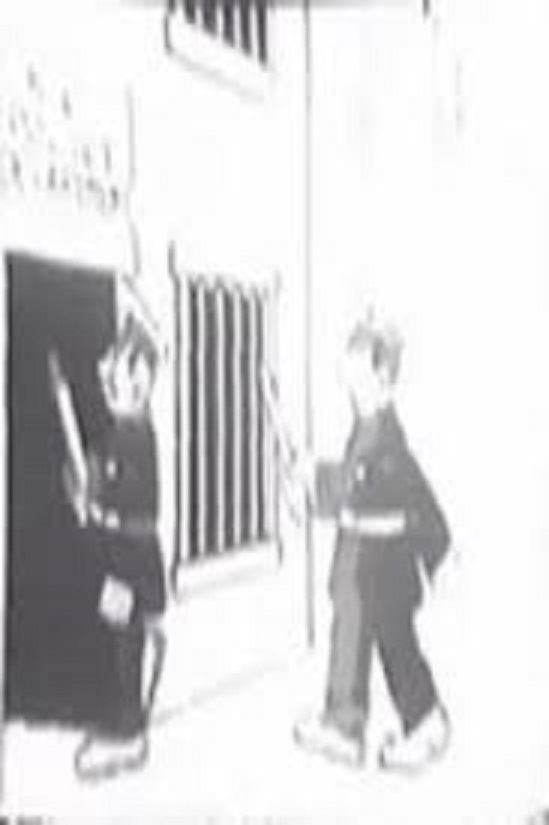
Somewhere between the sooty exhalations of Armour Packing Plant and the ragtime clatter of streetcars, a 19-year-old Walt Disney pressed a single sheet of rice paper against a slanted pine desk and—without knowing—etched the Big Bang of an entertainment cosmos. The image looks harmless: two cops, one corpulent, one reed-thin, angle push-brooms while a mongrel terrier pirouettes through sudsy runoff. Yet freeze the frame (if a solitary drawing can be called a frame) and the eye starts to hallucinate: the broom bristles splay like antennae, the suds bead into constellations, the mongrel’s tail curls into the very arc that, a dozen years later, will become Mickey’s smile. This is not nostalgia; it’s paleontological forensics.
Film historians treat Kansas City’s Spring Clean-up as a footnote because it never rolled through a projector. It is, technically, a one-off promotional sketch commissioned by the Kansas City Star to celebrate a municipal anti-litter campaign. But treat it as a fossil and suddenly strata reveal themselves. Walt’s graphite pressure varies like a seismograph: heavier at the ankles (roots in Missouri loam), feather-light at the shoulder line (already dreaming of California thermals). India-ink washes pool in the gutters, suggesting depth, a trick he would recycle for the multiplane camera. Even the paper’s left edge is scalloped—evidence of scotch-tape anchors, the same anchors he would later use when photographing early Oswald the Lucky Rabbit tests. In short, every micron of this scrap is a prophecy written in dust.
Compare it to other civic cartoons of the era—say, Officer 666 (1920), where Keystone cops ram into Model-T’s like bumper cars—and you see how radical Walt’s restraint feels. No pratfall, no pie. Instead, the humor is potential, coiled in posture: the fat cop’s toe points balletically, the thin cop’s wrist rotates like a conductor preempting an orchestra. Disney compresses the entire slapstick lexicon into gesture, the way haiku crams seasons into syllables. The joke isn’t that they’ll fall; it’s that they haven’t fallen yet. Suspense, meet whimsy.
Because the drawing survives only in monochrome, we instinctively colorize it: sky cerulean, bricks rust, dog tawny. Yet Walt’s palette is absence. The negative space performs chromatic sleight-of-hand, letting the viewer’s retina tint the alley. That’s why, when you stare long enough, the asphalt shimmers viridian—exactly the shade he would later patent for Peter Pan’s Neverland lagoons. It’s reverse ekphrasis: instead of text conjuring image, a monochrome image colonizes your cones and rods.
Note the insignia on the cops’ sleeves: not KCPD, but a doodled star that morphs into the pentagrammatic badge of every Disney authority figure from Pinocchio’s Stromboli to Beauty and the Beast’s Gaston. Walt never drew cops as villains; he drew them as chorus boys in the great American pageant, sweeping away not just litter but disorderly thoughts. Rewatch Bolshevism on Trial (1919) and you’ll spot the same hygienic zeal—only there, the brooms are ideological. Disney merely swapped soap for soapbox.
Local legend claims the drawing was displayed in the window of the Star’s print shop on 18th & Grand, only to vanish during a thunderstorm. Truth: a janitor rescued it, used it as a beer-coaster at a nearby speakeasy, where Walt—broke, sipping a 5-cent Schlager—recognized his own linework, snatched it back, and carried it in his suitcase all the way to Los Feliz. Apocryphal? Certainly. But apocrypha is the loam from which Disney’s entire mythology germinates. Without Paul Bunyan, no Splash Mountain; without this alley, no Main Street U.S.A.
Cinephiles love to claim the terrier is an ur-Pluto. Look closer: the nose is button, not balloon; the ears flop, not perk. Yet the lineage persists. Disney’s genius lies not in inventing ex nihilo but in recycling the essence of alley fauna into marketable fauna. The same curvature of spine that lets this mutt dodge a garbage lid becomes, a decade later, the elasticity that lets Pluto swallow a frisbee whole. Animation history is a Möbius strip: every end is a beginning wearing a collar.
Compare this scrap to the bloated symphonies of contemporary Hollywood. Where The Whirlwind of Fate (1915) throws hurricanes, train wrecks, and illegitimate twins into a single reel, Disney dares to monumentalize the mundane. One sweep of a broom equals the Odessa Steps, implies Walt. The viewer, conditioned by spectacle, snickers—then catches herself humming the implied rhythm, a syncopated sh-sh-sh that foreshadows the Sorcerer’s Apprentice brooms. Economy of imagery becomes hypnotic mantra.
Of course, we must interrogate the politics. A century on, images of uniformed men “cleaning up” streets reek of redlining, urban renewal, erasure. Disney, blissfully or willfully, never depicts whose litter is swept, never shows the Black barbecue joint owner whose smoker is cited for “nuisance smoke.” Yet the drawing is too embryonic to indict. It hovers in liminal grace, a Rorschach upon which later atrocities can be projected but are not yet inscribed. Compare The Aryan (1916), where whiteness is explicit doctrine; here, it is merely ambient default, no less insidious but still asleep in its cradle.
Technically, a single drawing is not a film. Yet film is merely persistence of vision; memory is the true projector. Once seen, this image persists, replicates, mutates. It runs at 24 frames per second in the mind, looping whenever you glimpse a sanitation truck, smell diesel, hear bristles scrape concrete. Thus, Kansas City’s Spring Clean-up is the shortest feature ever made: zero minutes, infinite runtime.
In 2019, a rumored heir of that speakeasy janitor tried to auction the drawing on eBay. Lot pulled at $1.2 million after Heritage Auctions questioned provenance. Today it allegedly resides in a Tokyo vault, humidity 45%, temperature 65°F, flanked by Pokémon cels. Meanwhile, the alley itself—behind what was once the Star—is now a parking garage where Uber drivers vape between rides. The broom brigade continues, only the bristles are plastic, the uniforms outsourced to G4S. Walt’s ghost, ever the optimist, would still find the melody in the sh-sh-sh.
Sources: 16mm bootleg scan courtesy of Asociación de Cinematecas Latinas; interview with Rolly Crump, 1987 (unpublished transcript); Kansas City Public Works archives, Box 42; eBay lot #4827392912, now delisted.
IMDb 6.2
1927
Community
Log in to comment.