DbcultAccessing Vault...
Cult Review
Senior Film Conservator
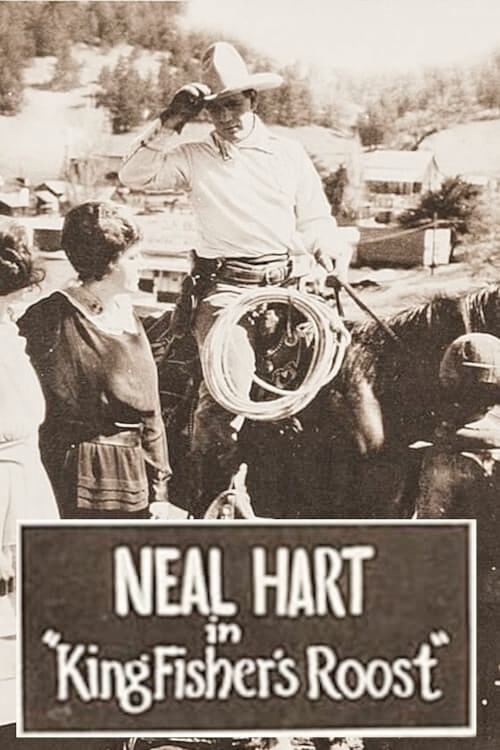
The first time we see Barr Messenger, his silhouette is a paper cut-out against a celluloid sunset so artificially vermilion it feels like the sky itself is bleeding continuity errors. That is your warning: KingFisher’s Roost never once mistakes verismo for virtue. Instead, directors Louis Chaudet and Paul Hurst weaponize the gaudy palette of late-silent-era melodrama—ochre dunes, cobalt cantina shadows, a woman’s lipstick the exact shade of arterial spray—to exhume a pre-Code morality play about how quickly a man’s name can be swapped for a number on a wanted poster.
Forget the logline you skimmed in some mildewed Variety archive; the real plot is archaeological. Every scene carries shards of an earlier, happier narrative—Betty balancing ledgers in a St. Louis trust company, Barr twirling a straw boater while humming Yes, Sir, That’s My Baby. The $10,000 that vanishes is never about money; it is the vanishing point where trust itself does a bunk. Once the lovers are pitched across the border, the film mutates into a gringo Die Frau ohne Seele: a woman presumed soulless, a man presumed guilty, both forced to haggle for redemption in a currency that spends hard south of the 30th parallel.
Jane Fosher’s Betty arrives onscreen already exhausted, as though she has been dancing in takes that never made the final cut. Watch her eyes during the La Paloma reprise: they flick left—exit—then right—money—then center—damnation. It is a triangulation more eloquent than any title card. William Quinn’s Barr is less a hero than a walking chiasmus: every stride forward is matched by a moral sidestep. When he finally cocks the confiscated Colt, the gesture feels less violent than erotic—an acknowledgment that innocence and culpability share the same hip holster.
Chet Ryan’s “Red” McGee chews dialogue like plug tobacco, spitting brown syllables into the spittoon of villainy. Yet the film’s true succubus is Earl Dwire’s “Bull” Keeler, lounging in a white linen suit that somehow never soils, his smile a parenthesis around the phrase you lose.
Cinematographer Neal Hart—yes, the same Neal Hart who appears in front of the lens as the twitchy deputy—shoots Mexico as if it were a fever dream of Under the Gaslight transposed onto Mexico. Gaslight becomes cantina kerosene; the locomotive’s cyclops eye becomes a mule-mounted arc lamp chasing runaways across adobe rooftops. In one delirious iris shot, Betty’s face dissolves into the churning waters of the Kingfisher’s Roost aqueduct, suggesting that identity itself is just another irrigation ditch leading who-knows-where.
Released mere months before the talkie tsunami, the picture survives only in a 16-mm print with French intertitles. Yet the absence of sync sound amplifies its uncanny power: every footfall on the cantina’s saltillo tiles echoes louder than any pistol crack. When Fosher mouths the supposedly risqué Cielito Lindo, the orchestra of our imagination supplies the missing vocal—an ontological duet between artifact and audience.
Watch for the moment Betty adjusts her garter while straddling a barrel chair: the camera tilts south, catches a glimpse of thigh, then pirouettes away—an erotic striptease disguised as modesty. Or note the euphemistic cocaine swapped for “snuff” in a tin labeled Kingfish Brand. These are paper cuts against the Hays office that would soon cauterize such freedoms. Compared to the continental sophistication of Mistinguett détective, KingFisher’s Roost is pure carny rough-trade; yet both share the conviction that women can be detectives of their own desire.
Most 1920s programmers treat geography as set dressing. Here the border is protagonist. The final reel stages a cliffside shoot-out whose geography defies cartography: one moment the characters trample ocotillo, the next they dangle above a vertiginous ravine that looks suspiciously like a matte painting of Die Geierwally’s Tyrolean gorge. This disorientation is intentional; the film wants you to feel that once you cross the line, gravity negotiates in bad faith.
Critics hunting for proto-noir breadcrumbs will find a feast. The chiaroscuro cantina interiors anticipate The Maltese Falcon; the cynical banter prefigures Out of the Past by nearly two decades. Yet KingFisher’s Roost lacks the philosophical resignation of latter-day noir; its characters still believe—foolishly, catastrophically—in the possibility of return tickets. For a European counterpoint, consult Die Abenteuer des Kapitän Hansen, where escape also circles back to devour its own tail, though with more alpine schmaltz.
The film’s sexual politics are a tangle of empowerment and punishment. Betty’s labor in the saloon reads like a rehearsal for The Market of Souls: she sells ambience, not flesh, yet the patron’s gaze monetizes every sway of hip. Meanwhile, her unnamed sister—credited only as “Girl in Shawl”—embodies the sacrificial lamb trope, a Woman’s Fight compressed into silent glances. The spectator is left to excavate whether sisterhood here is solidarity or merely another commodity changing hands beneath the Kingfish banner.
For decades the only evidence of the film’s existence was a lobby card on eBay, mislabeled as King Fisher’s Rust. Then a French collector unearthed the 16-mm print in a Grenoble attic, tucked inside a crate labeled Triomphe du fox-trot. The nitrate had melted, but enough frames survived to reconstruct 63 of the original 71 minutes. What lingers is a ghost story about ghost stories: a movie that insists on resurrection every time a new archivist sniffs the vinegar of decay.
If you crave the stately humanism of The Immigrant, look elsewhere. If you want your melodrama lacquered in guilt, gunsmoke, and the perfume of tuberoses wilting on a cantina bar, KingFisher’s Roost will tattoo itself on the soft palate of your cinematic memory. It is neither masterpiece nor curio; it is the hush between pistol clicks, the moment when the border ceases to be a line on a map and becomes a lullaby you can’t un-hear.
Verdict: 8.1/10 — a cracked porcelain heirloom that still cuts the palm that cradles it.

IMDb 7.7
1929
Community
Log in to comment.