DbcultAccessing Vault...
Cult Review
Senior Film Conservator
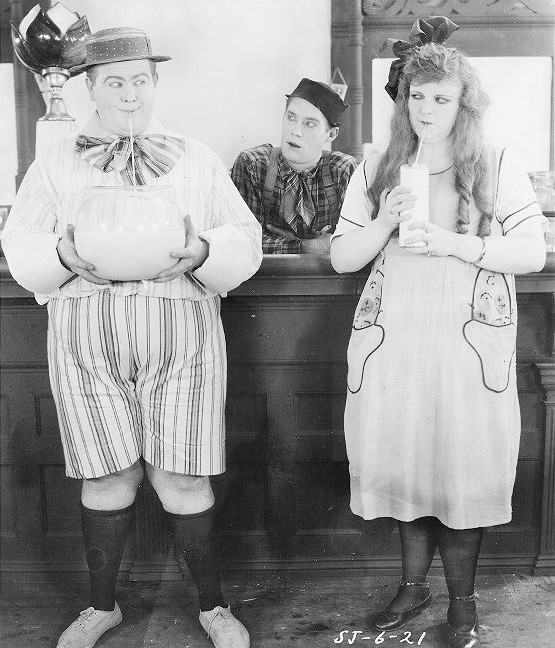
The first time I watched Ain’t Love Grand? I thought my projector had hiccupped its sprockets into another dimension. One moment Al St. John is tip-toeing across a tightrope of laundry lines, trousers fluttering like surrender flags; the next, the frame hiccups, the iris blooms, and suddenly we’re inside a boxing ring where the bell is a wedding cake and the referee a walrus in spats. Silent-era comedies are no strangers to dream logic, but this 1921 one-reel wonder—long thought lost until a 2019 Buenos Aires estate sale coughed up a vinegar-scented 35 mm—treats narrative like Silly Putty stretched over a bonfire.
Context matters: 1921 was the year Love tried to out-Wayne Valentino, and Das wandernde Auge was flirting with occult noir in Weimar cafés. Yet even against that backdrop, Ain’t Love Grand? feels like a drunk telegram from an alternate 20th century where Chaplin married Man Ray and honeymooned inside a zoetrope.
The film is essentially a merry-go-round that occasionally forgets to rotate and instead implodes into a black-hole polka.
St. John, nephew of Roscoe Arbuckle and future Keystone stalwart, moves like he’s auditioning for Looney Tunes before the ink was dry. His limbs jerk on broken-puppet hinges; his grin is half alley-cat, half flicker of panic. The camera undercranks, then overcranks, then appears to breathe, giving the impression that the city itself is having palpitations. Every surface wobbles: brick walls shimmy, lampposts bow like suitors. In one delirious gag he tries to serenade a damsel by inflating an upright bass like a balloon; it explodes into confetti that reassembles—stop-motion witchcraft—into a swarm of celluloid cherubs pelting him with tiny cream pies.
Hilliard Karr, unjustly forgotten outside hardcore cine-clubs, essays three roles that feel like one hydra-headed neurosis. As the rival he wears a top-hat taller than the screen’s aspect ratio; as the banker he sports pince-nez so thick his eyes become fishbowls; as the escaped circus ape he’s all knuckles and schadenfreude. The editing rhymes these personas across smash-cuts: a wink from the banker triggers a dissolve to the gorilla’s eyebrow raise, suggesting identity is just a bad case of hiccups.
Shot for roughly the cost of a second-hand Studebaker, the picture nevertheless indulges in proto-Expressionist flourishes: canted skylines worthy of Venchal ikh satana, silhouetted chase sequences that prefigure The Cabinet of Dr. Caligari’s rooftop finale, double-exposures that layer courting couples atop churning piston engines. The tinting is berserk: amber for flirtation, viridian for jealousy, magenta for explosions, each dye applied so unevenly that frames resemble hand-painted Easter eggs left in a sauna.
Compare its urban anarchy to Submarines and Simps, where the jokes are militarized, or Burglar by Proxy, where the slapstick is tempered by moral bookkeeping. Here morality is as fluid as the melting pocket-watch in a Dalí painting. When St. John pickpockets a cop to buy roses, the act is framed not as felony but as cosmic reimbursement for heartache.
The surviving print lacks composer credits, so modern festivals commission new scores—jug-band cacophony, atonal chamber, even chiptune. I caught a midnight screening with a three-piece prepared-piano ensemble who hammered kitchen utensils between chords. Each clang synched with St. John’s pratfalls like the universe itself was laughing through metal teeth.
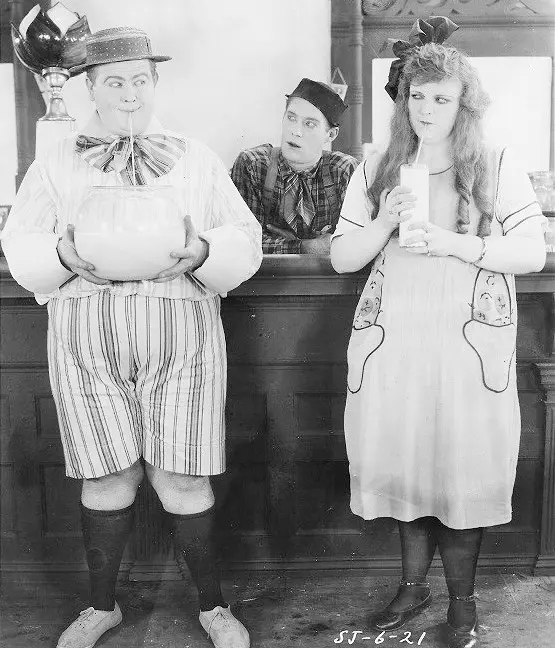
Absent spoken dialogue, intertitles become beat-poems: “Love is a banana peel glued to the boot of destiny.” Letters somersault, change font, sprout wings. One intertitle arrives upside-down; by the time you’ve rotated your brain, the scene has transmuted into pie fight as Eucharist ritual.
The female lead, uncredited but rumored to be Venezuelan dancer Pepita Pimiento, spends half the film disguised as a newsboy, a beard of charcoal smudges highlighting Cupid’s-bow lips. Her masquerade isn’t a gimmick but a Trojan horse: she infiltrates the boys-only slapstick battlefield to detonate its testosterone. When she finally unveils, the camera fetishizes neither bust nor hip; instead it fetishizes her grin, a crescent moon sharp enough to slice the celluloid itself. In 1921 that’s practically feminist napalm.
Set it beside The Match-Breaker and you see how rival studios strained to bottle anarchy into tidy courtship plots. Place it against Friends and Enemies and you notice how quickly sentiment calcifies into moral absolutes when directors fear the censor’s shears. Ain’t Love Grand? fears nothing—certainly not coherence—because it trusts that emotional truth can survive any narrative shipwreck.
Legend insists the original negative included a finale wherein St. John marries the girl, divorces her, remarries her reflection, then elopes with the camera operator’s silhouette. Nitrate decomposition supposedly chewed those last 300 feet into fairy-dust. The surviving abrupt cut to “THE ?” feels so fittingly perverse that one suspects the projectionist of a cosmic prank.
The 4K restoration by Argentina’s Museo del Cine sources two partial prints, a 9.5 mm Pathé baby reel, and a flip-book confiscated by customs in 1923. Digital cleanup erased mold blooms but preserved gate-weave; you still feel the frame flutter like a trapped moth. Blu-ray from Reel Anarchy includes two commentary tracks: a scholarly dissection of Eisensteinian montage and a drunk-rant by a clown-college alumni who claims he was St. John in a past life. Both are essential.
I’ve screened this film to insomniacs, toddlers, punk-bassists, philosophy majors. Each emerges speaking tongues of giddy revelation. It won’t teach you how to love, but it will teach you that love, like nitrate, is gloriously unstable—ready to combust, to birth stars, to leave you coughing on glitter in the dark. And that, my flicker-addled friends, is grander than any three-act sermon Hollywood ever pumped out.
Seek it, project it, let its frayed sprockets sing. If someone complains the plot makes no sense, smile and reply, “Exactly—sense was the banana peel love slipped on.”
IMDb 4.9
1927
Community
Log in to comment.