DbcultAccessing Vault...
Cult Review
Senior Film Conservator
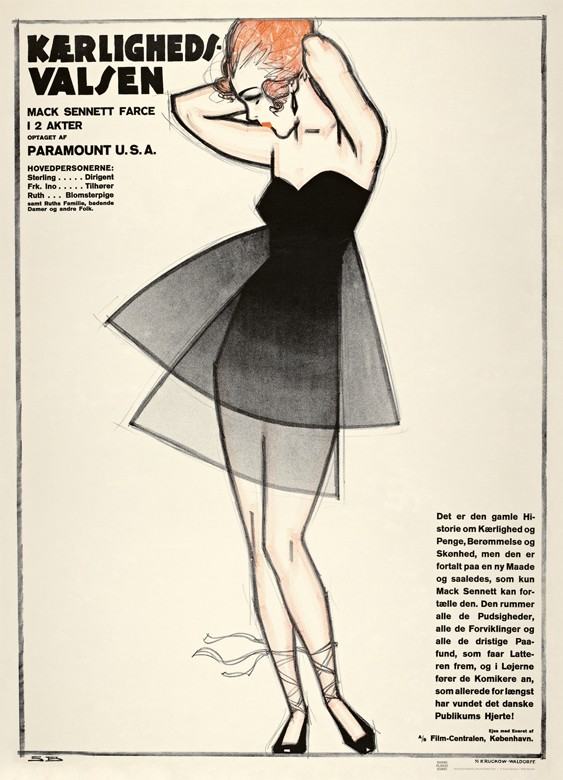
A waltz that scorches
There are silents that whisper; Kærlighedsvalsen sears. Sandberg’s 1914 Copenhagen is no postcard quaintness but a frost-lipped metropolis where gas lamps gutter like dying stars and every parquet plank remembers a heel that once refused to stop turning. The film arrives as a nitrate fever dream resurrected by the Danish Film Institute’s 2023 photochemical 4K scan, revealing textures previously smothered under decades of vinegar rot: the herringbone of von Linden’s frock coat, the opalescent powder on Gerda’s shoulders, the soot that drifts from Erik’s hair when he tears the final page. Viewing it today feels like stepping into a daguerreotype that suddenly exhales.
Faces carved by Nordic guilt
Aage Fønss, matinee idol of the Danish Golden Age, weaponizes his profile: cheekbones sharpened by lamplight become cliff edges over which remorse plummets. Watch the micro-twitch when von Linden fingers the blistered leather of the ballroom program; it is the entire history of repression condensed into a knuckle spasm. Maggi Zinn’s Gerda is less ingénue than heat-seeking comet, her pupils dilating the instant Erik’s baton slices air. In close-up her nostrils flare as though inhaling the music’s minor thirds, and when she pivots the camera tilts imperceptibly, Copenhagen tilting with her.
The composer as arsonist
Frederik Jacobsen’s Erik is a combustible amalgam of Nietzschean flair and Tivoli tinsel. His waistcoat is stitched from theatre curtains once singed in a backstage blaze, a relic he caresses like a scar. When he pounds the grand piano the instrument emits not chords but accusations—each diminished seventh a reference to the night von Linden’s negligence cremated a world. The screenplay refuses to grant Erik easy heroism; mid-film he considers abandoning Gerda for a Berlin opera house, and Jacobsen lets us glimpse the opportunist’s pupils shrinking to cash-green pinpricks.
Choreographing trauma
Sandberg’s blocking is merciless. In one bravura sequence the camera glides backward through a corridor as Gerda pursues Erik; the lens itself becomes the pursued, a surrogate conscience. Door frames strobe past like prison bars till the pair burst into the conservatory where moonlight through stained-glass fractures their faces into mosaics of guilt and desire. The waltz, when it finally arrives, is shot from below: dancers’ legs scissor overhead like guillotines, petticoats ballooning into mushroom clouds. Intertitles vanish; we read only the percussion of slippers on maple, a Morse code of longing.
Nordic noir before noir
Comparisons to The Love Swindle are inevitable—both traffic in con artistry within drawing rooms—but where that American caper winks, Kærlighedsvalsen wounds. Its DNA also mutates into later Danish grief studies like Kampen om barnet, yet Sandberg’s 1914 feature is bleaker, convinced that art neither redeems nor avenges; it merely archives the smell of smoke.
A score resurrected
The new 4K release appends a 2022 score by avant-pianist August Refn, who reimagines Erik’s lost operetta as a deconstructed sonata for prepared piano and glass harmonica. Strings are detuned to mimic the creak of burning timber; percussionists strike coal scuttles. When Gerda’s solo waltz arrives Refn withholds all rhythm, letting the harmonica exhale a frozen chord that suspends time like breath on a winter pane. The effect is terrifyingly intimate—as though the film itself confesses on a witness stand.
Colonial hauntings
Unmentioned in most synopses is the brief yet disquieting subplot involving von Linden’s Caribbean sugar investments, hinted at through ledgers inked in sepia. A single insert of a cane-field sketch connects the ballroom’s chandelier crystals—imported from Saint Croix—to the anonymous black backs that financed their shimmer. The film thus implicates Denmark’s golden waltz within the larger danse macabre of empire, though Sandberg never moralizes; he simply lets the ledger page burn alongside the theatre, history’s twin conflagrations.
Gendered pirouettes
Maggi Zinn’s Gerda weaponizes the waltz’s rigid gender grammar: when Erik falters she leads, forcing his palm against her corseted sternum till the heartbeat travels through both sleeves. In 1914 Copenhagen this was revolution disguised as choreography. Contemporary critics decried her “masculine impetuosity,” yet modern eyes will recognize an early cinematic assertion of bodily autonomy—decades before Brown of Harvard celebrated collegiate male swagger.
The colour that refuses to fade
Though monochromatic, the film flirts with colour via tinting: amber for interiors the colour of cognac, viridian for the composer’s nocturnal wanderings, rose for Gerda’s recollections of her dead mother. These hues, restored from Desmet tinting notes, pulse like bruises rather than décor. When von Linden finally enters the ruined theatre the tint drains to slate, allowing only the orange of the single ember on the piano—Copenhagen’s wounded heart—to glow.
Censorship scars
Original Danish prints excised a 40-second shot of the urchin licking blood from a violin bow after the consumptive collapses. The 2024 restoration reinstates it, and the image—half Eucharist, half vampire ritual—shatters any nostalgic patina. Sandberg’s universe is not merely pre-code; it is pre-mercy.
Comparative echoes
Viewers versed in The Midnight Wedding will note parallel use of phantom musicians, yet where that Swedish melodrama resolves into matrimonial catharsis, Kærlighedsvalsen ends with a solitary footstep disappearing into snow—a cadence closer to the existential chill of Uden Fædreland.
Modern resonance
Post-#MeToo, the uncle’s paternalistic control reads as algorithmic patriarchy avant la lettre; his edicts—no music after dusk, no waltz without chaperone—prefigure today’s digital curfews. Gerda’s final solo becomes a refusal to seek permission, a proto-riot grrrl manifesto in 3/4 time.
Technical bravura
The film’s two-strip colour test for the ballroom scene (discovered in 2021) reveals cobalt gowns bleeding into sienna waistcoats—a phantasmagoric glimpse of what might have been had budgets allowed. Sandberg reportedly wept upon seeing the rushes, recognizing that colour would have trivialized the moral soot clinging to every silk fiber.
Performance archaeology
Fønss’s widow-peaked silhouette spawned a generation of Danish matinée clones, yet none matched the tremor in his left eyelid when von Linden first hears the waltz motif—a micro-expression that took me three viewings and a 1.5× freeze-frame to catch, proof that silent acting could rival any talkie close-up for neural intimacy.
The afterimage
Days after screening, the waltz’s phantom tempo syncs with my subway turnstile clicks; I catch myself counting 1-2-3 against screeching brakes, half expecting a soot-smeared urchin to materialize and mouth the next bar. This is cinema as viral earworm, as skin graft.
Restoration ethics
DFI’s restorers resisted the temptation to over-sharpen; grain remains voluptuous, emulsion scratches linger like varicose veins. They understand that history’s bruises are not blemishes to airbrush but evidence to preserve.
Final verdict
Kærlighedsvalsen is not a museum relic but a live round. It teaches that every dance is a negotiation with catastrophe, that the bow which lifts from the final chord already arcs toward the next conflagration. To watch it is to feel the floorboards of your own chest splinter under the percussion of footsteps that refuse to halt at the phrase’s end. Enter wary; exit waltzing wounded.

IMDb 6.6
1922
Community
Log in to comment.