DbcultAccessing Vault...
Cult Review
Senior Film Conservator
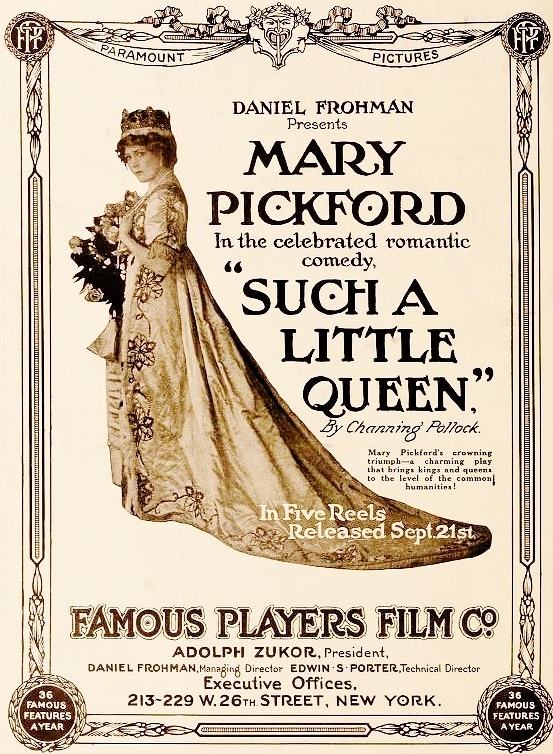
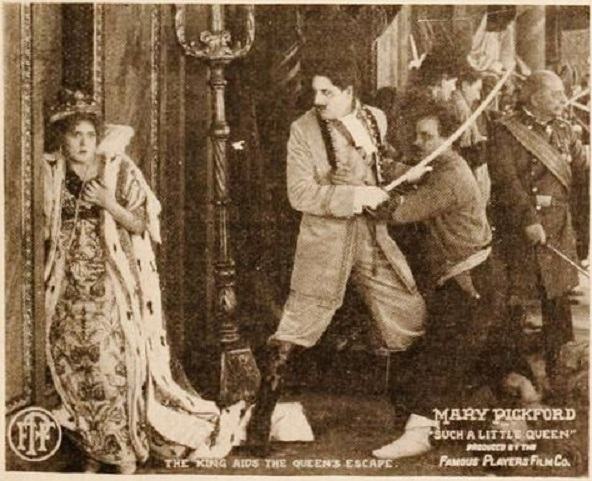
A nitrate whisper that somehow slipped the cultural inferno of the twentieth century, Such a Little Queen survives like pressed heather between the pages of a forgotten diplomatic ledger. Viewed today, its very fragility feels conspiratorial: here is a 1914 coup de théâtre in which Mary Pickford, already America’s definitive ingénue, incarnates a monarch whose power is measured in trembling lips rather than battalions. The film’s producers trumpeted it as “a romance of the smoking-room and the throne”; a century later, the smoke has cleared, the throne is rubble, yet the romance—reckless, adolescent, and radioactive—still throbs.
Director Hugh Ford, usually chained to Broadway footlights, treats the Herzegovinian court as though it were a diorama designed by Aubrey Beardsley and lit by lightning. Every set drips with Orientalist excess: peacock-feather fans, Circassian walnut paneling, artillery shells repurposed as candelabra. Yet Ford’s camera refuses to genuflect before spectacle; instead, it glides, sometimes even recoils, as if embarrassed by such opulence. The result is an aristocratic aquarium where viewers both covet and fear the gilded captives inside.
Compare this tactile delirium to the barren snowscapes of Nankyoku tanken katsudô shashin, whose minimalist whiteouts yearn for imperial grandeur through absence rather than excess. Both films—released the same year—understand that geopolitical anxiety is best measured in textures: one accumulates, the other strips bare.
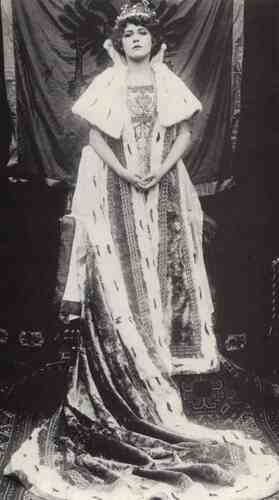
At twenty-two, Pickford had already played every shade of orphan, waif, and woodland sprite. To watch her ascend the throne here is to witness alchemy: the freckled Canadian becomes a queen whose authority is indistinguishable from panic. Notice how she enters a frame—chin lifted, eyes scanning for escape routes. The regalia weighs on her skeleton like a costume borrowed from a taller sister. In close-up (and Ford grants her merciless proximity), her pupils oscillate between sovereign command and infant terror, sometimes within the same second.
Acting manuals of the era preached broad semaphore; Pickford instead cultivates micro-gestures: a thumbnail scraping the velvet armrest, a breath held so long the viewer forgets to exhale. This interiority is why her performance predates, and perhaps predicts, the psychological realism that would not fully bloom on screen until the 1950s.
As Robert Trainor, Lockwood embodies the New World’s fantasy of itself: pragmatic, gum-chewing, allergic to heraldry. Yet Ford and screenwriter Channing Pollock complicate the archetype. Trainor’s utility lies not in muscle or money but in narrative disruption: he is a walking plot hole punched through the parchment of Old Europe. Every time he loiters in a courtyard, the ancien régime senses the draft of modernity.
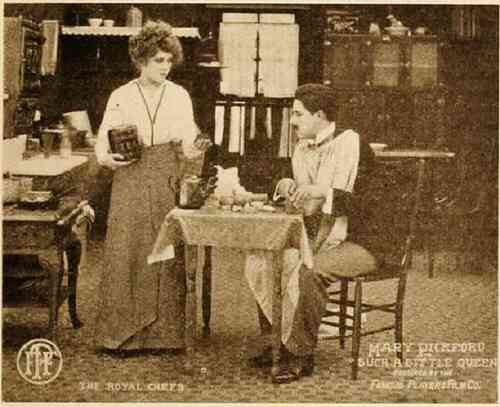
Lockwood’s chemistry with Pickford is less courtship than collaborative sabotage. Their scenes unfold in stolen staircases and moonlit conservatories where dialogue titles feel almost redundant; the flicker of a match, the shrug of a shoulder—this is their true lingua franca. When Trainor ultimately engineers the royal elopement, he is not rescuing a damsel but liberating a narrative that no longer believes in its own mythology.
Channing Pollock’s intertitles read like encrypted sonnets: “Love, in the Balkans, wears a uniform and carries a side-arm.” Each card arrives on-screen with the brevity of a telegram and the sting of epigram. Pollock, later celebrated as the ‘priest of Broadway,’ understood that silent-film language must be lapidary; words, when they appear, should bruise.
Contrast this linguistic austerity with the florid title cards of Les amours de la reine Élisabeth, where every sentence curtsies in velvet. Pollock instead opts for shrapnel, and the film’s pacing profits from that concision.
Cinematographer Carlyle Blackwell (also the film’s co-star) treats candle flame as both source and subject. Watch the coronation sequence: instead of majestic wide shots, he crowds the lens with tapers, their halos bleeding into the emulsion until royalty dissolves into luminous vapor. The camera’s iris opens and closes like a nervous eyelid, simulating the Queen’s own hyperventilation. Such subjectivity anticipates German Expressionism by at least half a decade.
When compared to the stark chiaroscuro of In the Python’s Den, Such a Little Queen feels almost impressionist—its politics smuggled inside bokeh and shadow play rather than stark moral binaries.
Archival prints screened at Pordenone in 2019 featured a new accompaniment built from Bartók fragments and field recordings of Sarajevo streetcars. The dissonance—folk drone against urban clatter—mirrors the film’s own DNA: a Balkan fairy tale co-written by Broadway hucksters. Those chords haunt long after the fade-out, proof that silents were never silent; they merely outsourced their voice to whatever future was willing to listen.
One cannot overstate the film’s ideological frisson: a Queen’s body traded as surety for territorial integrity, yet the narrative sides with elopement—a radical endorsement of personal happiness over dynastic duty. In 1914, on the eve of assassination and trench warfare, such fantasy doubled as prophecy. Europe’s old orders would soon collapse, not through romance but artillery, yet Ford’s pre-lapsarian fairy tale insists that individual desire can reroute history as decisively as any treaty.
This stance differentiates the picture from contemporaneous pageants like The Life of General Villa, where political power is masculine, photographic, and ultimately lethal. Pickford’s sovereignty, by contrast, is performative and porous; her crown never quite fits, and that misfit becomes the film’s true protagonist.
Released mere weeks before Europe’s lights went out, the film grossed a respectable but unremarkable $180,000 domesticate—roughly half of what Pickford’s Tess of the Storm Country harvested that same year. Within a decade, most prints were lost or recycled for their silver. Its survival in a Portuguese archive (mis-labeled Pequena Rainha) feels like a prank staged by time.
Yet cinephiles keep rediscovering it: in 1978 MoMA screened a dupe with live balalaika; in 2003 a Béla Tarr retrospective cited it as “the first political lullaby”; Twitter threads in 2021 memed Pickford’s sideways glance into omnipresent reaction-GIF currency. Obscurity, paradoxically, has kept the film alive—untarnished by over-exposure, reborn each time a curious soul stumbles upon its glow.
As of this month, a 2K restoration circulates via the European Film Gateway (geo-blocked outside the EU, so fire up your VPN). Silent Cinema Society’s Blu-ray offers the Bartók-score version plus a commentary by Balkan historian Maria Jovanović. For the streaming-averse, occasional 16 mm prints tour repertory houses—keep an eye on @nitrate_nebula for booking alerts.
Great films sometimes arrive too early to be duly feted; others, too late to be useful. Such a Little Queen is that rare temporal stowaway—a 1914 political daydream that lands in every era with the freshness of outlawed news. It cautions that kingdoms end not with treaties but with a woman’s decision to close a bedroom door. It whispers that Americans, for all their bluster, are merely tourists in other people’s tragedies until the moment they choose to care.
Watch it for Pickford’s face, for Blackwell’s molten candlelight, for Pollock’s razor epigrams. But mostly watch it because history, as we keep forgetting, is just another screenplay waiting for someone reckless enough to rewrite the final reel.
IMDb 5.1
1934
Community
Log in to comment.