Summary
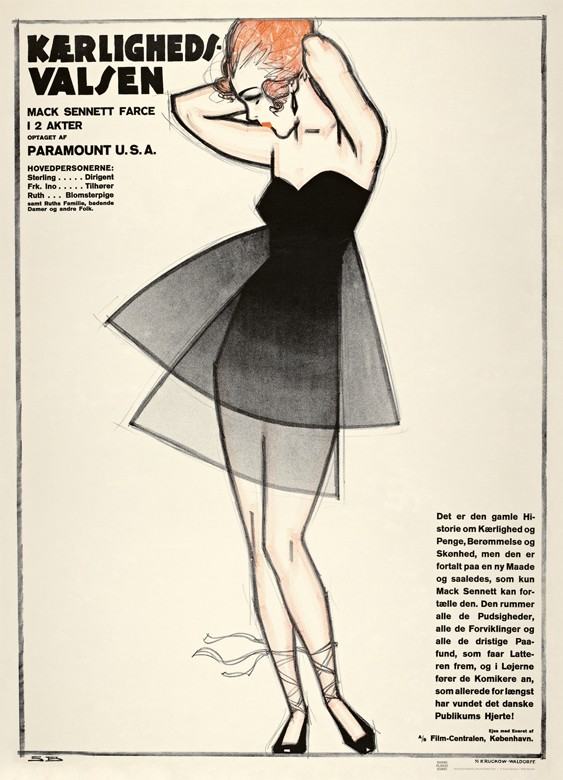
Copenhagen’s gaslit avenues exhale a milky fog as Kærlighedsvalsen pirouettes through the brittle salons of 1914, tracing a choreography of hearts that slip between waltz beats like polished pearls escaping a snapped necklace. The widowed banker von Linden, portrayed by Aage Fønss with marble cheekbones that seem carved by Nordic moonlight, returns from a decade of self-exile clutching a fortune minted abroad yet haunted by the chill of an unspoken scandal: his wife’s death in a ballroom blaze for which village tongues still blame him. His daughter Gerda—Maggi Zinn’s eyes flicker with lambent mischief—has flowered into adulthood under the guardianship of her puritanical uncle, a Lutheran lawyer who drapes every banister of their townhouse with black crepe and forbids music after dusk. Into this hush barges the prodigal composer Erik Valdemar, Frederik Jacobsen’s rangy frame vibrating like a cello string, brandishing a daring operetta that scandalizes burghers by wedding Viennese lilt to Danish sorrow. Erik once pledged Gerda a waltz beneath the linden blossoms; now he seeks patronage from the very uncle who deems him decadent. When von Linden discovers that Erik’s score encodes the night of the fatal fire—its crescendo matching the exact moment chandeliers crashed—guilt and longing fuse. Gerda, torn between filial duty and the pulse that syncs her ankle to Erik’s every bar, proposes a wager: if the composer’s work can fill the Royal Theatre for seven consecutive nights, her hand—and the banker’s frozen fortune—will be his. Cue a swirl of clandestine rehearsals in candle-strewn attics, a violinist with consumptive cough who bleeds onto his strings, a ballet mistress who blackmails von Linden with letters proving the fire started in his negligently stored ether bottles, and a mute street urchin who pirouettes on cobblestones for coins yet hears every conspiratorial whisper. As opening night nears, Erik’s score mutates: pages vanish, replaced by hymns that damn dancing itself. Suspicions ricochet—uncle, banker, even Gerda—until the urchin, clutching a soot-stained page, reveals the true saboteur: the ballet mistress, once von Linden’s mistress, seeking restitution for a child buried in pauper’s ground. The climactic performance becomes a danse macabre: von Linden steps onstage to confess, flames painted on scrims flicker like memory, and Erik conducts while tears freeze on his collar. Gerda dances the waltz alone, her partner a ghost of smoke, until father and composer join hands in a final three-step that resolves grief into acceptance. Curtains fall on a snowy dawn; von Linden enters the still-smouldering theatre, places his wedding ring on the charred piano, and exits as street urchins hum the waltz’s refrain, their small boots tapping the first thaw of spring.
Review Excerpt
"
::selection{background:#EAB308;color:#000;}
A waltz that scorches
There are silents that whisper; Kærlighedsvalsen sears. Sandberg’s 1914 Copenhagen is no postcard quaintness but a frost-lipped metropolis where gas lamps gutter like dying stars and every parquet plank remembers a heel that once refused to stop turning. The film arrives as a nitrate fever dream resurrected by the Danish Film Institute’s 2023 photochemical 4K scan, revealing textures previously smothered under decades of vinega..."