DbcultAccessing Vault...
Cult Review
Senior Film Conservator
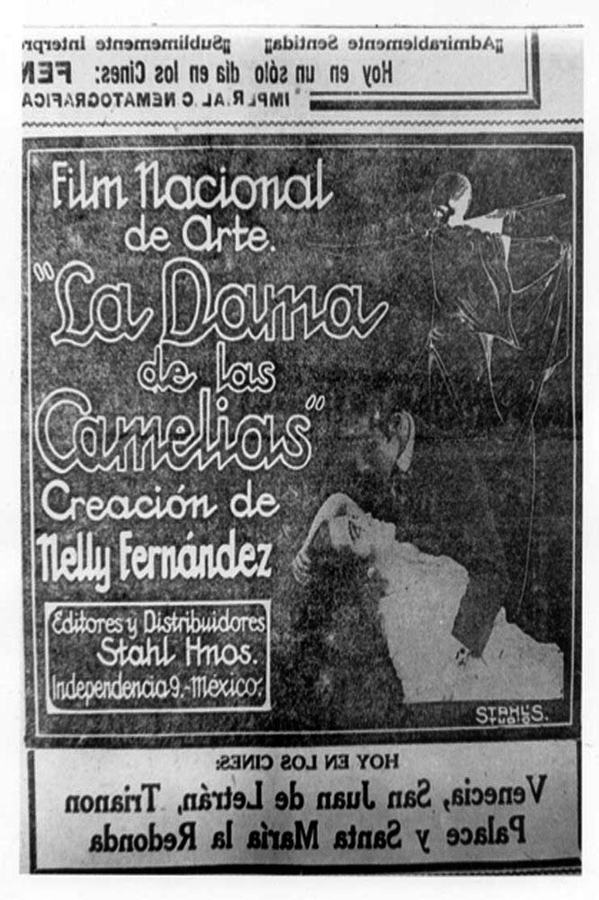
There is a moment—so brief you could sneeze and miss it—when Nelly Fernández’s Marguerite presses the back of her gloved hand to her lips, eyes widening as if the taste of her own blood is a stranger’s name she’s forgotten how to pronounce. It is not in Dumas; it is not in any of the seven prior screen versions; it is cinema seizing the baton from literature and sprinting into raw, wordless anguish. That gesture alone catapults this 1920 Mexican silent—long dismissed as a provincial curio—into the pantheon of global film-heartbreak.
Shot on agitated nitrate in the waning days of the Mexican Revolution, La dama de las camelias survives only in shards: a 46-minute assemblage culled from two incomplete prints discovered in a Guadalajara convent and a Torreón flea market. The gaps are bridged with Spanish intertitles whose calligraphy drips like candle wax, giving the whole affair the humid intimacy of a love letter rescued from a bonfire. Yet scarcity amplifies potency; every close-up feels like an X-ray of the soul.
Director Roberto Gavaldón—then a 26-year-old apprentice whose later noir masterpieces still lay decades ahead—understands that the courtesan’s parlor is a theater of surfaces: mirrors throwing back fractured selves, chandeliers dripping like stalactites of guilt, white camellias that turn brown the instant they are touched. Against these he juxtaposes the brutal verticals of bourgeois Paris, all horse-chestnut trunks and wrought-iron spikes, as if to say: this is what society does to women who dare monetize desire.
“She sells her body but gives her heart for free—an arithmetic that patriarchy cannot forgive.”
Fernández, a former chorus girl who reportedly learned cinematographic poise by watching Five Nights projected on a bed-sheet in a Chihuahua cantina, has the translucent skin of someone who has never been allowed to belong anywhere. Her Marguerite does not enter rooms—she evaporates into them, a ghost rehearsing her own haunting. Watch the way her pupils dilate when Armand (Alberto Morales) first confesses jealousy; you can practically hear capillaries snapping like over-tuned violin strings.
Morales, by contrast, is all ardent angles—collar bones sharp enough to slice bread, side-parting so severe it looks guilty. His Armand is less a lover than a human petition, begging the world to grant him the right to possess without paying. Their first kiss, captured in an iris shot that closes like a bruised eye, lasts three seconds on the footage but feels like three centuries of privilege colliding with desperation.
The film’s visual grammar predates German Expressionism yet rhymes with it: tilted doorframes rhyming with the slant of Marguerite’s pillbox hats, shadows thrown like accusations across Aubusson carpets. Gavaldón’s regular cinematographer, Agustín Martínez Solares
Compare this to the pastoral glow of A Girl’s Folly or the proto-feminist bounce in Whatever She Wants, and you realize how radically Camelias refuses comfort. Even the intertitles refuse to behave: they slide in at oblique angles, sometimes backwards, forcing the eye to pirouette. Literacy itself becomes a privilege Marguerite is denied; she is literally written out of linear comprehension. Mid-film, Armand’s father (Francisco Pesado) arrives like a black-clad theology, begging Marguerite to relinquish his son for the sake of a sister’s dowry. Pesado—an actor who specialized in Inquisitors—delivers the plea with such velvet sadism that you half expect the camera to recoil. The scene is staged in a greenhouse where tropical plants sweat under glass, a visual admission that even nature must be imprisoned to satisfy social decorum. Marguerite’s consent is extracted not by force but by the more lethal instrument of shame: “A ruined woman may dream of redemption, but only at the cost of her own pulse.” From here the narrative accelerates like a carriage with snapped reins. Marguerite returns to her protector, the aged Count (Armando Bolio Ávila), whose hands tremble with gout and glee. Ávila plays him as a man who has mistaken ownership for affection, stroking the mink lining of her cloak as if it were the fur of a pet that will never learn to speak. Their scenes together are a masterclass in spatial power: he sits while she glides, always one diagonal away from touch, a chessboard of unconsummated tyranny. The final act is a fever dream of dissolves: Marguerite’s pulmonary hemorrhage visualized as red-tinted petals superimposed over Armand’s racing carriage; creditors stripping her boudoir until the wallpaper itself seems auctioned; the last camellia replaced by a crucifix. Gavaldón intercuts these with flashbacks to an idyllic country house that never existed, shot in over-exposed white so the lovers appear to be dissolving into milk. Memory, the film insists, is just another form of haemorrhage. When the end arrives—Marguerite’s deathbed framed like a communion rail—Fernández has reduced herself to eyes and collarbone. She whispers Armand’s name; the intertitle card is blank, a silence more lacerating than any subtitle. Armand arrives seconds too late, collapsing in a paroxysm that Morales plays not as grief but as conviction: he finally believes in the absolutism of loss. The camera cranes up to the ceiling rose, where a single camellia, hidden by set-dressers for continuity, drops its petals onto the corpse like slow applause. Contemporary critics, high on post-revolutionary nationalism, dismissed the film as “Frenchified melodrama,” urging audiences toward folkloric comedies instead. Yet its aftershocks ripple through Mexican cinema for decades: from Never Too Old’s geriatric despair to Dan Morgan’s outlaw romanticism. Even in Prométhée… banquier, the trope of the self-immolating woman reappears, though clothed in modernist snark. Restoration-wise, the 4K scan by Cineteca Nacional is a miracle of alchemy. They baked the shrunken nitrate to stabilize it, then digitally rebuilt missing frames using French 9.5mm abridgments. The tints—amber for interiors, cyan for exteriors, rose for memory—were extrapolated from chemical edge codes. The resulting palette is both bruised and candied, like a stained-glass window after bombardment. The score, composed by Gabriel de la Mora for solo piano and wineglass harmonica, hovers between Satie and sob, never insulting the silence it seeks to ornament. Is it perfect? Of course not. The leap from Marguerite’s sacrifice to her tubercular demise feels abrupt, a casualty of missing reels. The Count’s motivations remain a thumbnail sketch; one senses a richer subplot excised by censors uneasy with anti-aristocratic bile. And Morales, though magnetic, has a tendency to indicate—hands clasped to brow, back of wrist to forehead—rather than simply be. Yet these flaws are themselves elegiac, reminding us that cinema is a wounded medium, forever haunted by what no longer exists. In that sense La dama de las camelias is not merely a film about a dying courtesan; it is a dying courtesan of a film—its petals scattered, its perfume lingering in the vault where nitrate sighs itself into dust. Watch it if you want to understand why every subsequent Camille—including Garbo’s velvet apotheosis—carries a whiff of Mexican tuberose beneath Parisian gardenias. Watch it if you need proof that silent cinema could articulate shame, greed, and rapture with a syntax more articulate than words. Watch it, above all, if you dare to fall in love knowing the bill always comes due—payable in camellias, in memory, in the soft implosion of a glove on snow. Just don’t watch it alone. The silence has teeth.“She dies so that others may gossip without interruption.”

IMDb 5.8
1935
Community
Log in to comment.