DbcultAccessing Vault...
Cult Review
Senior Film Conservator
I. The Ledger of Contempt
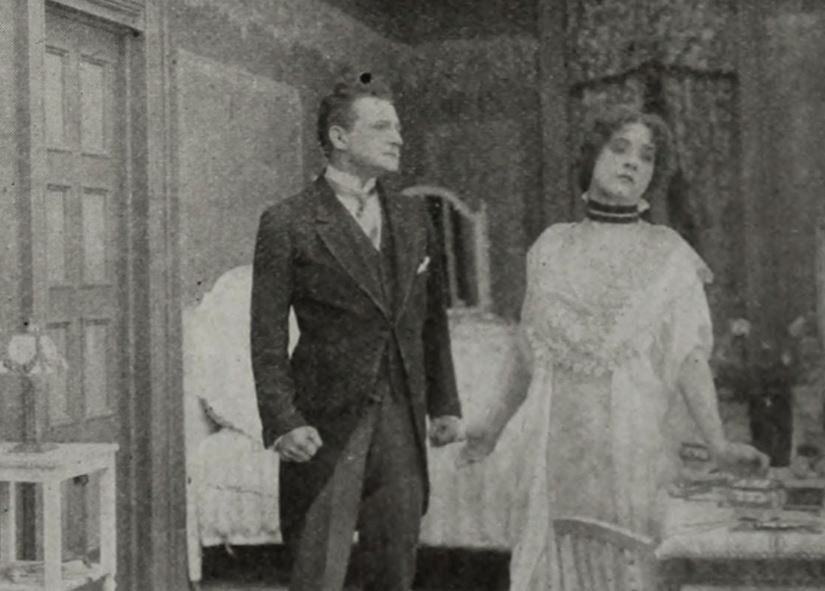
Picture, if you can, a parlour wallpapered in arsenic-green damask where every repeat in the pattern feels like a bar in Norma’s invisible cell. Edwin August—actor turned hyphenate writer—lets the camera loiter on Maude Fealy’s gloved fingers as they tally grocery receipts with the exactitude of a bookkeeper in Dickens. Those fingers, porcelain under nitrate, quiver not from arithmetic fatigue but from the slow recognition that five years of marriage have reduced her to a bonded serf whose wages are measured in derision. Hugh Ellis—played by Harmon MacGregor with the self-satisfied smirk of a man who believes stethoscopes confer moral infallibility—enters frame left, coat collar up, murmuring that “household finance is neurosurgery without anaesthesia” for the fair sex. The intertitle, lettered in florid Art-Nouveau font, might as well be stamped in sealing wax: Women are ornamental, not instrumental.
Here the film announces its thesis: American wedlock is not a partnership but a repackaged form of indenture, the dowry replaced by disenfranchisement.
Norma’s rebellion arrives not with sabres but with syntax. She unfurls a speech—half Susan B. Anthony, half Salvation-Army firebrand—declaring that every wife from Bangor to Sacramento wears manacles masquerading as wedding rings. August refuses a close-up; instead he keeps Fealy in medium-shot, surrounded by the detritus of domesticity: a child’s porcelain duck, a half-knitted sock, a Sears catalogue open to nursery furniture. The refusal to isolate her face paradoxically magnifies her militancy; we witness not a diva’s soliloquy but a domestic insurrection staged amid antimacassars.
II. The Parable of the Acid-Slinging Flapper
Just when you fear the narrative will ossify into tract, August pivots to Grand-Guignol. Ned Ellis—Frederic Sumner channeling every jittery energy of an early-talkie cokehead—stumbles into a den where opium smoke coils like ectoplasm. Enter the unnamed “drug-crazed girl,” a bit player listed only as “the Valkyrie” in the continuity script. She brandishes a vial of acid as though it were Eucharistic wine, hurling it toward Ned’s eyes in an explosion of white nitrate flare. The violence is not gratuitous; it externalizes the corrosive domestic acid Hugh has been dripping onto Norma’s self-worth for half a decade. August cross-cuts between Ned’s agony on a blood-spattered chaise and Norma’s quiet epiphany in the parlour: two forms of blindness, two forms of exposure.
The surgery sequence—filmed in a haze of cigarette smoke and magnesium flash—feels plucked from The Avenging Conscience era of Griffith’s paranoid gothic. Hugh’s scalpel hovers above his brother’s cornea while Norma, in the corridor, learns that a long-forgotten stock-option payment is due at noon. Time dilates; intertitles stutter like fibrillating hearts. The film’s proto-feminist manifesto crystallizes: while men perform heroic gore, women perform heroic finance.
III. The Creditor as Redeemer
David Power—John St. Polis in pince-nez and moral rectitude—enters as the deus ex machina of 1915 progressivism: a physician devoted to curing “the morphia evil.” His clinic, bathed in sea-blue skylight, resembles a Quaker meetinghouse more than a sanitarium. When Norma petitions him for a loan, August frames the transaction in chiaroscuro: Power’s face half-illuminated, half-shadowed, suggesting both saint and speculator. The handshake that seals the deal is shot from below, as though we’re witnessing a pact in a cathedral. Yet the film cannily withholds hagiography; Power’s later intervention—snatching Ned from the talons of withdrawal—repositions him as catalyst rather than savior.
The false-affair subplot arrives like a spasm of Victorian morality. Ned, detoxed and delirious, plants the seed of suspicion, a narrative device recycled from Alone with the Devil and countless sensation novels. Hugh’s instantaneous credulity exposes the brittle trust beneath medical hubris. His vehicular exile of Norma and infant—shot on a process screen of pelting rain—owes its visual grammar to the storm sequence in The Colleen Bawn, yet August infuses it with modern torque: the automobile skids through puddles that reflect electric globes, turning the city into a circuit board of blame.
IV. Reconciliation via Routing Number
Redemption, when it lands, is startlingly bureaucratic. No deathbed conversions, no sabre-duels—just a bank foyer smelling of brass polish and wet wool. Norma and Hugh, rain-soaked and chiaroscuro-lit, approach the marble counter. The teller—an unbilled extra with the mien of a church deacon—slides a joint-account form between them. August cuts to an insert shot: two pens aligned like duelling pistols. When they sign, the camera tilts up to the gilded lettering: Deposits insured by the State of New York. It is the most quietly radical image in silent cinema: a woman’s signature acquiring the legal gravitas of her husband’s.
The film ends not with a clinch but with a balance sheet—an audacious subversion of melodramatic convention that prefigures the socioeconomic candor of The Spender and even late-century domestic dramas.
Visually, August and cinematographer Harry W. Gerstad (later Oscar-winner for Heaven Knows, Mr. Allison) exploit nitrate’s spectral latitude. Interiors glow the color of whiskey when lamplight strikes varnish; exteriors bleach to the pallor of overexposed newsprint. The palette—what survives of the 35mm anyway—oscillates between umber and wan cyan, as though the film itself is negotiating between hearth and marketplace. Fealy’s performance is a masterclass in micro-gesture: the fractional tightening of her jaw when Hugh dismisses her budget, the half-blink that conveys a decade of swallowed replies. MacGregor, saddled with a role that could slide into caricature, threads his arrogance with a physician’s genuine terror of chaos; when he botches a soufflé in Norma’s absence, his rueful glance at the cookbook is Chaplinesque in its humility.
V. Historical Resonance & Contemporary Reverberations
Viewed today, Bondwomen feels eerily prescient. The joint-bank-account climax predates the 1974 U.S. Equal Credit Opportunity Act by six decades; Norma’s insistence on fiscal visibility anticipates second-wave feminism’s rallying cry: the personal is financial. August’s depiction of drug addiction sidesteps the moralistic hysteria of The Marked Woman, treating Ned’s dependency as pathology rather than perdition. The acid attack—graphic for 1915—functions as a pre-Hays-Code cautionary tableau about the collateral damage of untreated trauma.
Yet the film is not without fissures. Its racial homogeneity—every speaking character is white, Protestant, upper-middle—underscores the exclusivity of early feminist agitation. The working-class women who scrub Norma’s floors when she strikes are nameless, their faces blurred by shallow depth of field. August’s screenplay, for all its daring, cannot imagine liberation beyond bourgeois banking.
Still, in an era when Les Misérables, Part 2: Fantine traffics in sacrificial motherhood and Ivonne, la bella danzatrice equates female worth with terpsichorean allure, Bondwomen dares to argue that emancipation begins with a signature on a checking ledger. That the film survives only in a 9.5mm Pathescope condensation—scarcely 42 minutes—feels like a synecdoche for the historical erasure of women’s fiscal narratives.
VI. Final Appraisal
Is Bondwomen a rediscovered masterpiece? Not quite. Its third-act reliance on coincidence feels creaky even by 1915 standards, and the intertitles sometimes sermonize where silence would suffice. Yet its formal bravery—cross-cutting surgical gore with fiduciary suspense, staging domestic revolt as economic thriller—renders it indispensable. In the taxonomy of suffrage-era cinema, it occupies a liminal shelf between The Other Girl’s comedic gender-bending and Sumerki zhenskoy dushi’s Slavic melancholia.
Watch it for Fealy’s eyes—two emeralds flickering with the dawning realization that money is memory made liquid. Watch it for the acid attack, a jolt of expressionist horror in a domestic melodrama. Watch it, above all, for the final shot: a pan across a bank lobby where Norma’s skirt brushes the marble like a painter’s last stroke. The camera lingers on the clock above the teller: 3:00 PM, the precise hour when housewives across the nation once balanced grocery pennies against butcher bills. Somewhere in that moment, a century collapses and cinema’s first feminist fiscal thriller achieves its quiet apotheosis.
Verdict: 8.7/10 — Essential for silent-film scholars, gender-studies syllabi, and anyone who suspects that love means nothing without equitable overdraft protection.
IMDb 5.5
1935
Community
Log in to comment.