DbcultAccessing Vault...
5.8/10
Senior Film Conservator
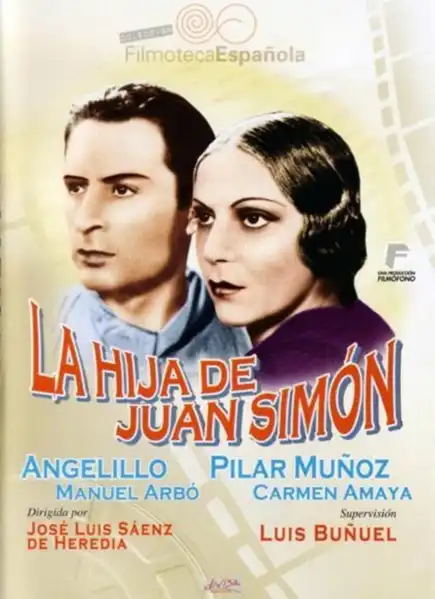
A definitive 5.8/10 rating for a film that redefined the boundaries of cult cinema. La hija de Juan Simón remains a cornerstone of transgressive art.
If you have a soft spot for dusty, tragic Spanish melodramas from before the civil war, La hija de Juan Simón is absolutely worth your seventy minutes.
But if you can't stand old-school singing or plots where everyone is endlessly miserable, please stay far away. 😭
It is basically a 1935 soap opera with some incredible flamenco sprinkled on top.
The story kicks off with Angelillo, who is this handsome singer with hair slicked back so tight it looks painted on.
He is madly in love with Carmen, the daughter of the local undertaker.
Of course, things go bad immediately because this is a tragedy.
There is this incredibly chaotic tavern fight that looks like everyone is just waving their arms around.
Suddenly, some guy dies, and Angelillo gets blamed and thrown in jail.
It's one of those classic movie setups where the police apparently do zero detective work. They just grab the loudest guy in the room. 👮♂️
Meanwhile, Carmen is pregnant and runs away because of the massive shame.
This isn't a slick modern mystery like Dangerous Lies; it's pure, unfiltered melodrama where people make the worst possible choices.
The film is famous because Luis Buñuel had his hands all over it, even if his name isn't officially on the director credit.
You can almost feel his weird, dark humor poking through the edges of this very traditional Spanish story.
Like, the undertaker Juan Simón is actually kind of a funny character, which is a bit twisted when you think about it.
He spends so much time talking about coffins like they are comfortable beds.
But the real reason to watch this is the music.
Ángel Sampedro (Angelillo) has this voice that just cuts right through the crackly 1930s audio track.
It is incredibly high-pitched and emotional.
Some of his long notes go on so long you wonder if he's going to pass out on screen.
And then we get Carmen Amaya dancing.
She is an absolute force of nature here.
Her feet move so fast the old camera can barely capture them without blurring. 💃
Seriously, her brief scene has more energy than the rest of the entire movie combined.
The second half gets incredibly gloomy, though.
Carmen dies giving birth, and a lady just shows up with the baby to deliver the bad news.
It is such a sudden, brutal way to handle a main character's death.
No big dramatic death scene, just "hey, she's dead, here is a kid."
The lighting in the prison scenes is surprisingly beautiful.
There are these heavy shadows on the walls that feel almost like an old silent film, like The White Circle.
It feels way too artistic for a cheap musical.
That is probably Buñuel's influence working behind the scenes.
Sometimes the movie gets a bit tedious when Angelillo isn't singing.
The comedy bits with the side characters feel very dated and screechy.
There is this one guy who keeps making goofy faces that made me cringe a little.
But when the guitar starts playing, everything else just fades away.
It is a messy, imperfect relic of Spanish cinema.
But it has got real soul.
IMDb —
1919
Community
Log in to comment.