DbcultAccessing Vault...
Cult Review
Senior Film Conservator
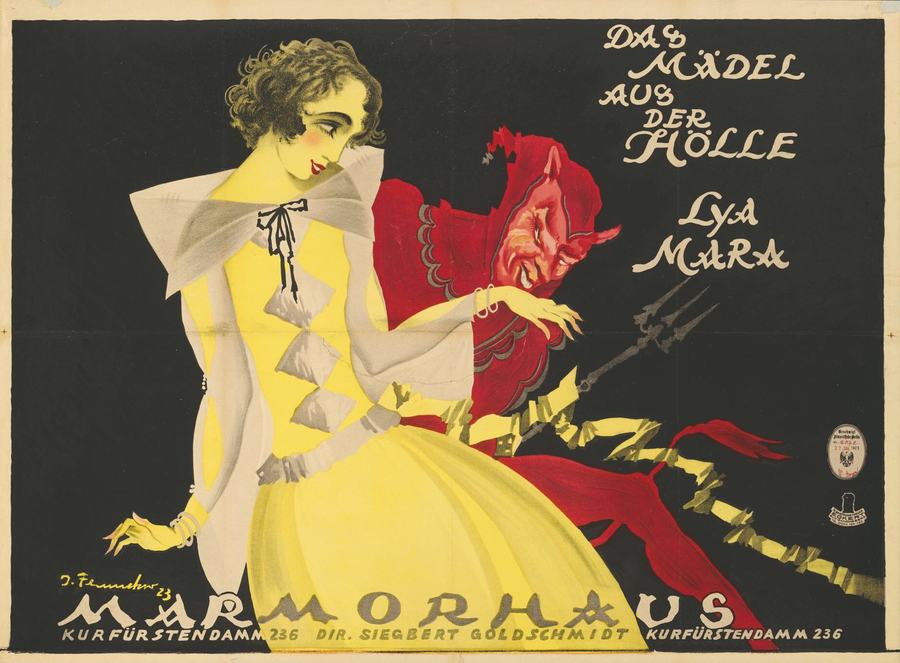
The spectral glow of the silver screen, even a century removed, retains an uncanny ability to resurrect forgotten narratives, to breathe life into the celluloid ghosts of yesteryear. Among these spectral resurrections, few possess the raw, unvarnished power of Das Mädel aus der Hölle. A film whose very title, 'The Girl from Hell,' immediately conjures images of a defiant spirit forged in the crucible of urban despair, it stands as a testament to the visceral storytelling prowess of the Weimar Republic's cinematic output. This is not merely a historical artifact; it is a pulsating, vital piece of art that speaks to the enduring human struggle against societal strictures and personal demons.
From its opening frames, the film plunges the viewer into a meticulously crafted world, a Berlin that is both glittering and grim, a city of stark contrasts where the opulent ballrooms of the elite cast long, disquieting shadows over the squalid tenements of the working class. This visual dichotomy is not merely aesthetic; it is the very bedrock upon which Liesl's story is built. Lya Mara, in a performance that can only be described as incandescent, embodies Liesl with a fierce grace that transcends the limitations of silent acting. Her eyes, often shadowed by a life of hardship, nonetheless blaze with an indomitable will, communicating volumes without a single spoken word. Mara's portrayal is a masterclass in nuanced expression, a complex tapestry woven from vulnerability, defiance, and a desperate yearning for something more.
Fanny Carlsen's screenplay, a work of remarkable psychological insight, refuses to simplify Liesl into a mere archetype. Instead, she is presented as a multi-faceted individual, a product of her environment yet possessing an innate dignity that societal judgment cannot entirely extinguish. The narrative skillfully avoids the pitfalls of melodrama, opting instead for a gritty realism that resonates deeply. Liesl's journey, from the shadowy corners of the city's underbelly to the precarious precipice of potential salvation, is fraught with moral ambiguities. She is not a saint, nor is she a villain; she is, rather, a survivor, making choices dictated by necessity rather than virtue. This commitment to portraying the messy, often uncomfortable truth of human existence is one of the film's greatest strengths, aligning it with the more unflinching social commentaries of its era.
The supporting cast provides a sturdy framework for Mara's central performance. Carl Auen, as the conflicted industrialist Herr von Stein, delivers a portrayal marked by a quiet desperation, a man trapped by his own societal expectations and moral compromises. His interactions with Liesl are charged with a tension that speaks volumes about the class divide and the yearning for connection across seemingly insurmountable barriers. Gustav May, Harry Gondi, and Albert Patry, among others, etch memorable characters into the narrative, each contributing to the rich tapestry of Weimar society depicted on screen. Emmy Wyda, in particular, offers a memorable turn, her presence often injecting a poignant realism into the proceedings, highlighting the varied human responses to hardship.
The cinematography, though often uncredited in the historical records of the silent era, is nothing short of breathtaking. The use of light and shadow, a hallmark of German Expressionism, is employed here not for mere stylistic flourish, but as a potent narrative tool. Shadows stretch long and menacingly, engulfing characters in moments of despair or moral quandary, while shafts of light occasionally pierce the gloom, offering fleeting glimpses of hope. This visual poetry elevates the film beyond a simple story, transforming it into a profound meditation on the human condition. The bustling street scenes, the claustrophobic interiors, and the stark contrast between the haves and have-nots are all rendered with an unflinching eye, creating a world that feels both distant and eerily familiar.
The thematic resonance of Das Mädel aus der Hölle extends far beyond its immediate narrative. It is a searing indictment of societal hypocrisy, a poignant exploration of the arbitrary nature of moral judgment, and a powerful testament to the resilience of the human spirit. The film dares to ask: who truly resides in 'hell'? Is it the 'mädel' struggling for survival, or the society that condemns her without understanding her plight? These questions, posed silently through the interplay of character and environment, linger long after the final fade to black. The film's nuanced approach to morality, its refusal to paint characters in simplistic black and white, aligns it with other progressive works of the period that sought to challenge conventional wisdom.
To truly appreciate the depth of Das Mädel aus der Hölle, one must contextualize it within the tumultuous landscape of the Weimar Republic. This was a period of immense social and political upheaval, a time when traditional values were clashing violently with burgeoning modernities. Cinema, as a burgeoning art form, became a powerful mirror reflecting these societal anxieties and transformations. Films like this one, with their focus on the marginalized and their critique of societal norms, were not merely entertainment; they were vital social commentaries, challenging audiences to confront uncomfortable truths about their own world.
Comparing it to contemporaries, one might draw parallels with the raw social realism found in films such as East Side - West Side, which similarly delved into the stark realities of urban life and class divisions, albeit from an American perspective. However, Das Mädel aus der Hölle possesses a uniquely German sensibility, a blend of expressionistic visual flair and a deep-seated philosophical inquiry into human nature. While not as overtly fantastical as some of its Expressionist brethren, it harnesses the movement's aesthetic principles to amplify its emotional and thematic impact. The film's exploration of a woman's struggle against a restrictive society also finds echoes in works like Gigolette or The Ballet Girl, though Das Mädel aus der Hölle carves its own distinct path with its unflinching portrayal of survival.
The film's impact, though perhaps not as widely celebrated today as some of its more canonical counterparts, is nonetheless significant. It represents a crucial voice in the chorus of Weimar cinema, a testament to the era's willingness to tackle complex social issues with artistic courage. The performances, particularly Lya Mara's, are a stark reminder of the profound emotional power that silent cinema could wield. The film's refusal to offer easy answers, its embrace of ambiguity, marks it as a work ahead of its time, a precursor to the more psychologically complex narratives that would emerge in later decades.
Fanny Carlsen's contribution as the writer cannot be overstated. Her script is the beating heart of the film, providing the intricate characterizations and compelling narrative arcs that elevate it beyond mere entertainment. Carlsen's keen observation of human behavior and societal dynamics is evident in every scene, particularly in the nuanced portrayal of Liesl's internal struggles and her interactions with the various strata of Berlin society. Her ability to craft a story that is both deeply personal and broadly resonant speaks volumes about her talent. The dialogue, though unseen, is palpably present in the actors' expressions and gestures, hinting at a sharp, incisive wit and a profound understanding of the human condition. It is through Carlsen's lens that the audience is invited to empathize with characters who might otherwise be dismissed, challenging preconceived notions and fostering a deeper understanding of the complexities of life in a rapidly changing world.
The detailed character development, especially of Liesl, is a testament to Carlsen's skill. Liesl is not simply a victim; she is an agent, albeit one constrained by her circumstances. Her choices, her defiance, her moments of despair and hope are all meticulously crafted, making her a truly believable and compelling figure. This depth of characterization is a hallmark of strong dramatic writing, and it allows the actors, especially Mara, to fully inhabit their roles, bringing a rich emotional texture to the silent screen. The film's exploration of morality and survival, seen through Carlsen's narrative framework, feels incredibly modern, a testament to the timelessness of her thematic concerns.
Even without the benefit of synchronized sound, Das Mädel aus der Hölle communicates with an intensity that few modern films achieve. The accompanying musical score, which would have been performed live, would have undoubtedly amplified the emotional impact, guiding the audience through the film's peaks and valleys of despair and triumph. One can only imagine the orchestral swells punctuating Liesl's moments of quiet defiance or the somber melodies underscoring her deepest anxieties. The film's reliance on visual storytelling, however, ensures that its core message remains potent even in a silent viewing, a testament to its intrinsic artistic merit.
In an era where cinema often sought escapism, Das Mädel aus der Hölle dared to confront reality head-on. It forced its audience to look beyond the glittering facades of urban life and into the shadowed lives of those struggling at its margins. It is a film that challenges preconceptions, dismantles stereotypes, and ultimately celebrates the enduring strength of the human spirit in the face of overwhelming adversity. Its continued relevance lies in its timeless themes: the struggle for dignity, the search for belonging, and the relentless pursuit of self-definition in a world that constantly seeks to define us. It is a cinematic experience that resonates deeply, a powerful reminder of the enduring power of silent film to provoke thought and stir the soul.
The film's impact, particularly its exploration of social stratification and the plight of the urban poor, places it firmly within the tradition of socially conscious cinema. It doesn't merely observe; it critiques, it questions, and it invites the audience to consider their own roles within the societal structures it depicts. This critical gaze, combined with its artistic excellence, ensures that Das Mädel aus der Hölle remains a compelling and vital piece of cinematic history, deserving of renewed attention and appreciation. Its legacy is not just in its individual narrative, but in its contribution to a broader movement of films that dared to speak truth to power, even in the most challenging of times. It is a testament to the vision of Fanny Carlsen and the unforgettable performance of Lya Mara, cementing its place as a powerful echo from Weimar's complex and captivating abyss.
Final analysis reveals Das Mädel aus der Hölle as more than just a period piece; it is a profound human drama, masterfully executed, that continues to speak to contemporary audiences about themes of identity, class, and the eternal quest for acceptance. Its stark beauty and emotional depth make it a truly unforgettable cinematic journey. The nuanced portrayals by Carl Auen, Gustav May, and the entire ensemble cast further enrich this intricate narrative, creating a truly immersive experience that transcends the passage of time. The film is a poignant reminder of the rich artistic output of German silent cinema and its enduring capacity to capture the complexities of the human spirit.
IMDb 6.2
1936
Community
Log in to comment.