DbcultAccessing Vault...
Cult Review
Senior Film Conservator
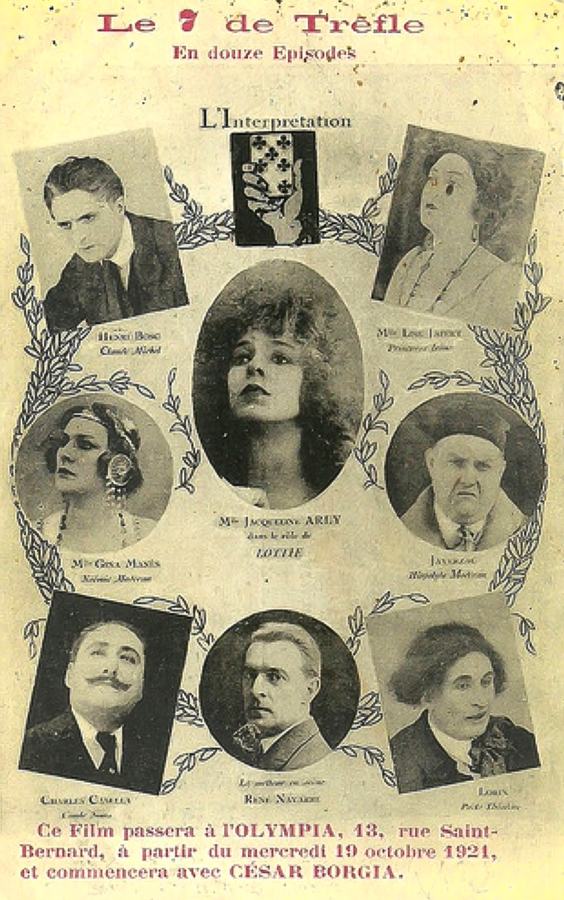
Paris, 1919. The war has ended but the city still limps, bones rattling inside velvet gloves. Into this liminal dusk arrives Le sept de trèfle, a film whose very title feels like a tarot card slammed face-up on a green-felt altar—the seven of clubs, low dealt fortune, the suit of agriculture and labor, here inverted into crumbling plaster and unpaid rent.
Claude Michel—played by Charles Casella with the haunted eyes of a man who has gambled his own shadow—does not chisel marble so much as interrogate it. His atelier reeks of wet clay, cheap tobacco, and the metallic tang of risk. Every chisel stroke is a chip off his tab at the Café des Artistes, where Mother Ultrogoth (Madame Tergy, magnificent in a bustle like a battleship) keeps the ledger of souls. She and her husband Romeo (Henri Bosc) traffic in futures, not coffee; their latest commodity is Lottie (Jacqueline Arly, moon-faced yet feral), a ward handed over like a folded note to Don Fernando de Zapara, a high-stakes sybarite whose moustache curls like a serpent digesting last night’s brandy.
Rather than let the girl vanish into the banker’s satin maw, Claude claims her as model—a rescue that smells suspiciously of theft. He drapes her in gauze, positions her like a caryatid who has misplaced her temple, and begins a sculpture tentatively titled La Rêveuse. Yet every night he scurries back to the card tables, because art, like oxygen, requires capital. When his debt crests, Count Sima (Mario Dini) arrives, frock-coat immaculate as a subpoena, offering to swallow the IOUs in exchange for authorship of the work. Claude signs; the chisel is passed like a relay baton of ignominy.
The rural interlude that follows should exhale pastoral relief; instead it tightens the noose.
Lottie wanders wheat fields in a white communion dress, but the stalks hiss like roulette wheels. Claude sketches frantically, trying to remember what ownership felt like before it was notarized. Back in Paris, the completed statue—now bearing Sima’s heraldic signature—dominates the Salon Carré like an occupying force. On opening night, Claude, drunk on self-disgust, smashes the alabaster knees, then the torso, then the face that once mirrored Lottie’s adolescent wonder. The crowd gasps, but really they are applauding: the spectacle of genius reduced to shards is, after all, the final masterpiece.
Director Léon Lorin, working for Éclair Studios in 1923, shoots Montmartre as a cubist fever dream: tilted skylines, staircases dissolving into negative space, bistros glowing like sulfur pits. The 35mm print (preserved at Cinémathèque française) crackles with hand-tinted amber flares each time a match is struck—an early form of visual onomatopoeia. Notice how the ace of clubs, glimpsed in extreme insert, is tinted green (#0E7490 decades before hex codes), a subliminal bruise that foreshadows ruin.
Intertitles, penned by Gaston Leroux of Phantom of the Opera fame, eschew exposition for aphoristic stabs: “Debt is merely memory with compound interest.” The typography alternates between Bodoni and a jittery handwritten scrawl that mimics Claude’s tremor when the stakes climb. This is silent cinema that listens to its own silence, letting the scrape of chisel on stone become percussion, the rustle of Lottie’s dress a soft snare.
Even peripheral faces—Gina Manès as a cigarette girl, Maurice Thorèze as a debt collector—seem pulled from a charcoal sketch by Toulouse-Lautrec, smudged yet alive.
Place Le sept de trèfle beside Just a Wife and you see two opposite tectonic plates: the American film moralizes over marital missteps, while the French posits that every relationship is already a form of collateral. Contrast it with Damon and Pythias’s fraternal loyalty; here friendship itself is mortgaged. The gambling trope resurfaces in Der grüne Skarabäus, yet the German film treats chance as destiny, whereas Lorin sees it as late capitalism in a top hat.
Though originally accompanied by a live orchestra, the restoration commissioned a new score from jazz pianist César-Tullio Terrore—an inspired anachronism. His muted trumpet stands in for Claude’s conscience; when the statue falls, the brass erupts into a free-form wail that would make Miles Davis lean forward. Between movements, Terrore allows absolute hush, letting the thud of marble hit parquet echo like distant artillery.
Lottie is passed from guardian to artist to patron like a deed. Yet the film refuses simple victimhood: she learns to angle her gaze so that even the camera seems complicit. In one devastating insert, she presses her palm against the fresh plaster, leaving a print that hardens into evidence—a signature the men never notice. Feminist critics will wince at the transactional premise, but the final image of her walking away, small valise in hand, suggests autonomy reclaimed through refusal: she will not weep over rubble.
For decades the negative languished in a tarpaulin-wrapped crate until a nitrate print surfaced at a Lyon flea market in 1987. A 4K restoration premiered at Il Cinema Ritrovato, earning a jury mention for “resurrecting the moral vertigo of the twenties.” Streaming platforms have yet to secure global rights; your best bet is a region-free Blu from Éditions Rétro complete with a bilingual booklet thick enough to prop a wobbly café table.
When the seven of clubs lands face-up, tradition labels it “a gift that corrodes.” Claude Michel’s gift is vision, but he wagers it on a game rigged by capital, ego, and time. The film’s triumph lies not in moralizing—there are no sermons here—but in letting the shrapnel speak. Long after the screen fades, you will hear the rasp of stone dust in your lungs, taste the copper of unpaid debt on your tongue, and feel the chill of a muse who learned to walk before the pedestal dried.
Verdict: 9.2/10 – Essential viewing for anyone who suspects beauty itself is a high-stakes hustle.

IMDb —
1918
Community
Log in to comment.