DbcultAccessing Vault...
Cult Review
Senior Film Conservator
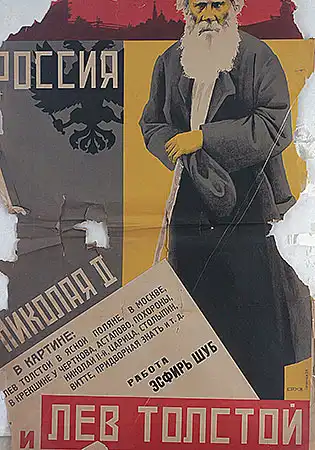
If you have an hour to kill and you don’t mind looking at black-and-white footage that looks like it was dragged through a hedge, this is worth it. It’s for people who like to look at the backgrounds of shots—the way a person in the crowd stands, or how a horse looks slightly annoyed. If you need a narrator to tell you how to feel or a plot to keep you awake, you’re going to hate this. It’s a silent compilation of newsreels, and it doesn't care if you're bored.
There is something inherently creepy and cool about seeing Leo Tolstoy actually moving. We’re so used to that one famous photo of him looking like a grumpy wizard that seeing him walk—sort of a brisk, determined shuffle—makes him feel like a real person who probably had bad breath and complained about the weather. There’s a shot of him sitting on a porch, and he looks like he’s waiting for the cameraman to just go away already. It’s not the 'grand author' vibe; it’s the 'leave me alone' vibe.
Esfir Shub, the woman who put this together, didn't actually shoot any of this. She found it in old cellars and government basements. You can tell. Some of the film is so scratched it looks like it’s raining inside the room. But that’s part of the charm. It feels like you’re watching something you weren’t supposed to see, especially the footage of the Tsar, Nicolai II.
The Tsar comes across as... well, a bit of a dork. There’s a scene where he’s reviewing troops, and he’s just walking back and forth, looking small in a very large hat. Then Shub cuts to a shot of peasants who look like they haven't eaten a solid meal in a month. It’s not subtle. It’s about as subtle as a brick to the face. But seeing the actual faces of those soldiers—kids, mostly—knowing what was coming for them in a few years gives the whole thing a heavy feeling that a modern historical drama just can't fake. Even a fictional mystery like The Master Mystery feels more grounded in reality than the weirdly staged life of the Russian royals seen here.
The pacing is all over the place. Some shots of people standing around in uniforms go on for way too long. You start counting the buttons on their coats because nothing is happening. Then, suddenly, there’s a shot of Tolstoy’s funeral, and the sheer scale of the crowd is staggering. It’s a sea of black hats and desperate faces. It’s one of the few moments where the movie stops being a historical curiosity and starts feeling like a punch in the gut.
I noticed this one guy in the background of a parade scene. He’s just staring directly into the lens with this expression of pure confusion. He has no idea what a movie is, probably. He’s just looking at this box on a tripod. Those are the moments I like. The movie is supposed to be about 'The Russia of Nicolai II,' but it’s really about the people who were just standing there while history happened to them.
The editing is where you see Shub’s hand. She’ll show the Tsar’s daughters playing on a boat, looking very clean and happy, and then immediately cut to a shot of a dusty, miserable factory. It’s a very 'Look at this, now look at that' style of filmmaking. It’s effective, but after the fifth or sixth time, you kind of get the point. We get it, Esfir. The rich were rich and the poor were poor.
One thing that bugged me: the intertitles are a bit dry. They’re very functional. 'Tolstoy at Yasnaya Polyana.' 'The Tsar visits a church.' I wish they had a bit more personality, but I guess in 1928, the footage itself was the shock. People back then hadn't spent decades watching History Channel marathons.
It’s a weird experience watching this today. It’s like browsing someone’s very old, very political scrapbooks. It’s not 'entertaining' in the way we usually mean it. It’s more like an exercise in observation. If you watch the way Tolstoy handles a pen or the way he looks at his wife, you see more than any biography could tell you. He looks tired. Not just 'I need a nap' tired, but 'I am carrying the soul of Russia and it’s heavy' tired.
Is it a masterpiece? I don't know. It’s a great piece of recycling. Shub took trash—old, discarded newsreels that people thought were useless—and made something that actually captures a ghost. It’s much more interesting than the stiff, staged acting you find in something like Eyes of the Soul from around the same era. There, people are trying to look like they have souls; here, you’re just seeing them live.
Don't expect a smooth ride. Expect to squint at the screen a lot. Expect some parts to drag until you’re checking your phone. But every now and then, the film clears up for a second, and you’re looking right into the eyes of a man who died over a century ago, and it’s genuinely unsettling.
Community
Log in to comment.