DbcultAccessing Vault...
Cult Review
Senior Film Conservator
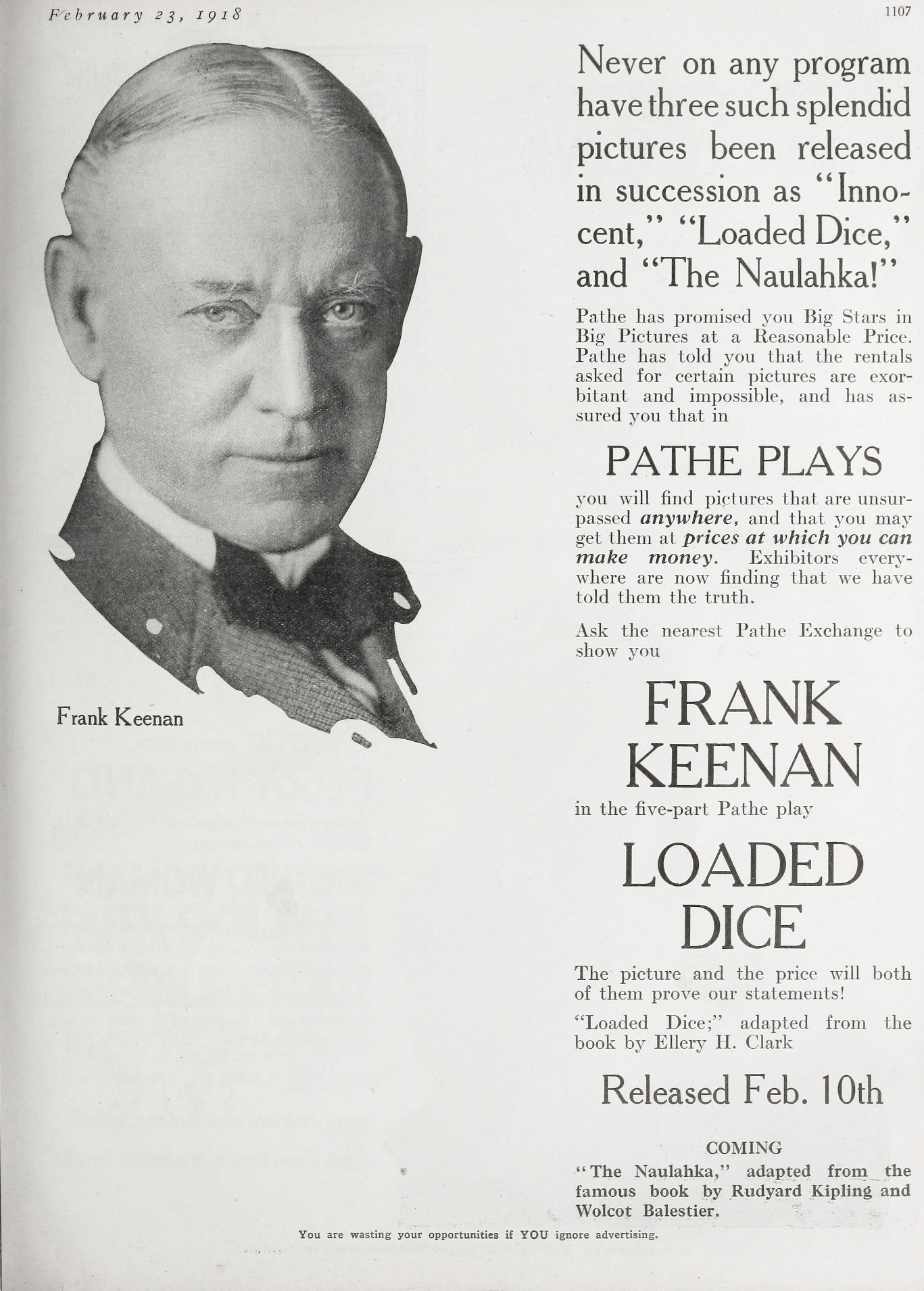
Stepping back into the nascent years of cinematic storytelling, Loaded Dice (1918) emerges not merely as a relic of its era but as a potent, if often overlooked, testament to the enduring human struggle against the corrupting allure of power. Directed with a keen eye for dramatic tension and penned by the collaborative vision of Ellery H. Clark and Gilson Willets, this silent feature plunges viewers into a narrative tapestry woven with threads of ambition, moral decay, and the ultimate, inescapable reckoning. It's a film that, even a century later, resonates with a profound understanding of character-driven tragedy, illustrating how the pursuit of societal influence can irrevocably warp the human spirit.
The film introduces us to a protagonist whose trajectory is as chilling as it is compelling: a crooked promoter, portrayed with a nuanced blend of charm and ruthlessness by Guy Coombs. Coombs, a stalwart of early cinema, imbues his character with an almost magnetic quality, making his eventual descent into depravity all the more poignant. His initial machinations, designed to accrue wealth and establish a formidable sphere of influence, are depicted not as isolated acts but as a gradual, insidious erosion of his moral core. This isn't merely a villain's tale; it's a cautionary exploration of how a man, once perhaps merely opportunistic, can slide inexorably into outright criminality when ambition becomes an unbridled master. The screen, despite its lack of spoken dialogue, practically crackles with the unspoken tension of his calculated maneuvers, each gesture and facial expression a window into his increasingly compromised psyche.
Central to the promoter's escalating transgressions are two murders, acts of desperation that serve as the narrative's grim turning points. These aren't random violent outbursts but rather cold, premeditated eliminations of individuals who stand as inconvenient impediments to his grand design. The writers, Clark and Willets, demonstrate an adeptness at crafting a plot that, while perhaps melodramatic by modern standards, possesses an undeniable psychological weight. The murders themselves are handled with a certain degree of cinematic restraint typical of the era, relying on implication and the reactions of other characters to convey their gravity, rather than explicit gore. Yet, their impact on the protagonist's soul, and on the audience's perception of him, is profound. Each act of violence further cements his isolation, even as he appears to gain more power, creating a palpable sense of foreboding that hangs heavy over the proceedings.
The supporting cast, though perhaps less prominently featured, plays crucial roles in delineating the protagonist's world and the consequences of his actions. Alice Hollister, with her often expressive portrayal, likely embodies a character who either suffers from or unwittingly enables the promoter's schemes, providing a moral compass or a victim against which his villainy is measured. Frank Keenan, known for his formidable stage presence, could have brought a gravitas to a character of authority or opposition, perhaps a detective or a political rival, whose very existence threatens the promoter's carefully constructed edifice of lies. Florence Billings and Madeline Marshall round out the ensemble, contributing to the rich tapestry of human interaction that defines the promoter's environment, whether as allies, adversaries, or innocent bystanders caught in the crosscurrents of his ambition. The silent film era demanded a heightened sense of gestural communication, and it is in the interplay of these performances that the film’s emotional depth is truly forged.
The thematic resonance of Loaded Dice is particularly striking when viewed through the lens of other contemporary silent dramas. One might draw parallels to films exploring the darker side of human nature and societal corruption, such as The Fatal Wedding, where illicit affairs and their tragic repercussions underscore a similar breakdown of moral order. Both films, in their unique ways, delve into the destructive power of unchecked desires and the ultimate price exacted by deceit. The promoter's relentless drive for status and wealth, even at the cost of human life, echoes the ruthless social climbing sometimes depicted in films like The Girl from Rector's, though Loaded Dice elevates the stakes to a far more sinister degree. The ambition here is not merely social but deeply criminal, demonstrating a profound moral vacuum at its core.
The narrative arc culminates in a dramatic crescendo on the very night of the promoter's political apotheosis—his election as governor. It is here, at the zenith of his illicitly gained power, that fate, or perhaps a manifestation of karmic justice, intervenes. He is shot, a sudden and brutal interruption to his carefully orchestrated triumph. This moment serves as a powerful narrative device, denying him the satisfaction of his ill-gotten gains and forcing a confrontation with his mortality. The film's final act, depicting his deathbed repentance, is where the true profundity of the story lies. This isn't a mere plot convenience but a deeply human moment of reckoning. Stripped of his power, his influence, and his very life, the promoter is forced to confront the spectral weight of his crimes. This penitence, offered in extremis, suggests a glimmer of humanity, a final, desperate attempt to reclaim some shred of moral integrity before the ultimate judgment. It's a conclusion that, while offering a form of redemption, doesn't diminish the gravity of his actions, rather it underscores the heavy burden of guilt.
The writers, Ellery H. Clark and Gilson Willets, deserve commendation for crafting a story that, despite its relatively simple premise, delves into complex moral territory. Their screenplay avoids simplistic black-and-white characterizations, instead presenting a protagonist whose evil is born of ambition rather than innate malice, making his fall all the more tragic. The evolution of silent film screenwriting often saw a transition from theatrical adaptations to original stories tailored for the screen, and Loaded Dice appears to benefit from this maturation, showcasing a narrative structure built for cinematic impact. The pacing, the dramatic reveals, and the emotional beats are all carefully orchestrated to maximize audience engagement, a testament to their understanding of the medium's unique expressive capabilities.
Comparing the film's exploration of societal corruption and its impact on individual morality, one might consider A Factory Magdalen, which, while focusing on social injustice and the plight of working-class women, similarly examines the pressures that can push individuals to moral compromise. While the specific circumstances differ, the underlying theme of external forces shaping internal choices remains a powerful connection. Furthermore, the political machinations and the ruthless climb to power in Loaded Dice could be seen as a precursor to more elaborate political dramas, even if not directly comparable in scope to epics like Quo Vadis?, which deals with power and corruption on an imperial scale. The common thread is the corrupting nature of power and the moral compromises individuals make to attain or maintain it.
Guy Coombs' performance is arguably the linchpin of the film's success. His ability to convey a spectrum of emotions—from cunning ambition to desperate fear and, ultimately, profound regret—without the aid of spoken dialogue is a masterclass in silent film acting. The subtle shifts in his gaze, the clenching of his jaw, the slumped posture of defeat—all contribute to a character who feels remarkably real, despite the heightened reality of early cinema. This level of expressive acting was crucial in an era where visual storytelling carried the entire weight of the narrative, and Coombs rises to the challenge with aplomb. His portrayal elevates the film beyond a simple crime story, transforming it into a character study of a man's devastating journey from aspiration to abject moral failure.
The film’s examination of the consequences of criminal acts, particularly those driven by a hunger for societal standing, is a timeless one. The promoter's relentless pursuit of influence, culminating in a governorship, serves as a stark reminder that power can be a double-edged sword, offering immense control while simultaneously inviting an equally immense fall. The irony of his demise—shot down on the very night he achieves his ultimate goal—is a narrative flourish that underscores the film's moralistic undertones. It suggests that true success is not measured by external accolades but by internal integrity, a lesson that resonates across all eras of human endeavor.
Furthermore, the film's title itself, Loaded Dice, is a brilliant metaphorical stroke. It encapsulates the core theme: a game rigged from the start, where the protagonist believes he controls the odds, only to find that the universe, or a higher moral order, has its own immutable rules. He may manipulate the dice of fate for a time, but the true game is played on a larger, more ethical board, where genuine consequences cannot be evaded indefinitely. This imagery of a rigged game also subtly critiques the perceived fairness of the political and social systems of the time, suggesting that beneath a veneer of legitimacy, corruption often thrives.
In its broader context, Loaded Dice contributes to a rich cinematic tradition of exploring individual morality against the backdrop of societal pressures. It joins a lineage of films that, through various lenses, question the nature of ambition and the price of success. One could even consider its place alongside narratives that depict internal moral battles, such as those found in The Bottle Imp, where characters grapple with supernatural temptations and their soul-crushing costs. While the promoter's temptations are entirely human and material, the internal struggle for his soul, and his eventual, albeit terminal, repentance, aligns with these narratives of profound moral choice.
Ultimately, Loaded Dice stands as a compelling example of early American cinema's capacity for complex dramatic storytelling. It's a film that asks profound questions about human nature, the corrupting influence of power, and the possibility of redemption, even in the face of grave transgression. Its legacy lies not just in its historical significance, but in its enduring power to provoke thought and reflection on the choices we make and the indelible marks they leave upon our lives. For cinephiles and historians alike, it offers a fascinating glimpse into the moral preoccupations of a bygone era, rendered with a dramatic urgency that transcends the silence of its form.
IMDb —
1918
Community
Log in to comment.