DbcultAccessing Vault...
6.8/10
Senior Film Conservator
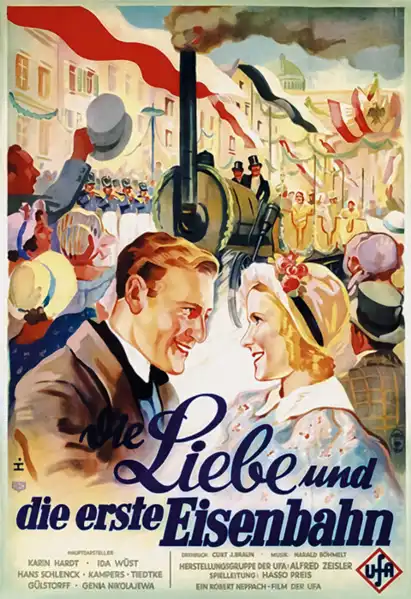
A definitive 6.8/10 rating for a film that redefined the boundaries of cult cinema. Love and the First Railroad remains a cornerstone of transgressive art.
Alright, let’s talk about Love and the First Railroad. If you’re a history buff, especially into 19th-century European societal shifts or early German cinema, you might find something charming here. If you prefer your movies fast-paced and action-packed, you'll probably find it a bit of a snooze. It's an old film, from 1938, but it feels even older, like a postcard from a forgotten era. 🚂
The whole thing hinges on this central conflict: the charmingly grumpy postmaster, Herr Wöhler, who runs his stagecoach business with a stern hand and a deep distrust of anything new. Then there's the railroad, this monster of progress, snaking its way through his peaceful, horse-drawn world. And of course, his daughter, Liesel, has gone and fallen for the foreman, Erich. It’s a classic setup.
Wöhler, played by Gustav Püttjer, is really the heart of the film. He’s not a villain, just a man clinging to what he knows. You see it in his eyes every time he watches the steam engine puffing by, a mix of fascination and absolute dread. His frustration feels very real, almost palpable, especially when he’s trying to get his old horses to just *deal* with the noise.
The romance between Liesel (Elisabeth von Ruets) and Erich (Emil Biron) is pretty standard for the time. They meet, they glance, they eventually hold hands. It's all very chaste. You can almost feel the movie trying to convince you this moment matters, especially when they're gazing wistfully at the tracks.
What really sticks with me are the visuals of the railroad construction itself. They did a decent job, considering. You get these shots of workers, all muddy and grimy, really laying down track. The sheer scale of it, even on a modest budget, comes across. It’s a nice contrast to the quaint village scenes, like the little bakery and the busy inn.
One scene, early on, shows Wöhler’s stagecoach trying to share the road with a very early, very loud steam engine. The horses are spooked, of course. It goes on about 20 seconds too long, and the silence from the passengers starts to feel awkward rather than emotional. You just know Wöhler is thinking, “See? I told you so!” 😠
There’s a small subplot about a competing stagecoach driver, who is surprisingly supportive of the railroad. He’s almost too nice, like a foil to Wöhler’s stubbornness. It felt a little tacked on, honestly, but it adds to the sense of a world changing, even for those who profit from the old ways.
The crowd scenes have this oddly empty feeling sometimes. Like half the extras wandered off for a coffee break, or maybe they just didn’t have many extras. When the first train finally pulls into the station, you expect this huge outpouring of excitement, but it’s a bit subdued. A few scattered cheers. It’s charming in its own way, like a small town's big event.
I appreciated how the film didn't make the railroad out to be a purely evil thing, even through Wöhler's eyes. It was just different. A new way. And that’s a pretty nuanced take for a film of its era, not just black and white. It gets noticeably better once it stops taking itself too seriously about the 'progress is bad' angle and leans into the personal drama.
Elisabeth von Ruets as Liesel has this certain quiet dignity. She’s not overly dramatic, which is a relief. Her decision to stand by Erich, despite her father's disapproval, feels earned, not just a plot point. You can see her wrestling with it. 💔
The pacing is… deliberate. Very deliberate. You could probably read a small novel during some of the longer landscape shots. But for some reason, it works. It lets you soak in the atmosphere of this historical moment. It feels like a historical document, almost.
One reaction shot lingers so long on a villager watching a train pass, his mouth slightly ajar, that it becomes funny. Like, what is he thinking? Is it awe? Is it fear? Or did he just forget his line? Hard to tell, but it adds to the slightly quirky charm.
All in all, Love and the First Railroad is a quaint little film. It’s not going to blow anyone away with its storytelling or technical prowess. But it offers a gentle, sometimes slow, glimpse into a very specific moment in history. For those who enjoy a peek into the past, it’s a perfectly pleasant way to spend an afternoon. Others might want to stick to faster trains. 🚄
IMDb 6.5
1926
Community
Log in to comment.