DbcultAccessing Vault...
Cult Review
Senior Film Conservator
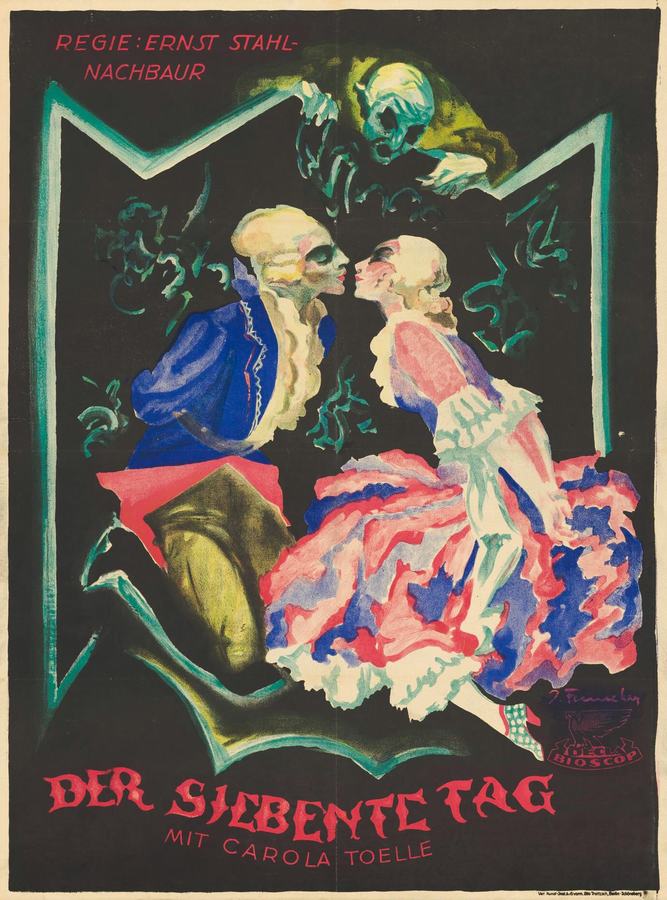
Berlin, winter 1926: while Fritz Lang finishes Metropolis in the studio next door, a smaller crew at Ufa’s Tempelhof soundstage is crafting a film that feels less like cinema and more like an exorcism recorded on nitrate.
Der siebente Tag arrives without fanfare, a title card hand-scratched onto sooty celluloid, yet its reverberations throb through the marrow of German silent film like a phantom limb. Director Ernst Welisch, a name half-erased by the rise of talkies and the bonfires of ’33, orchestrates a chamber piece of religious psychosis that makes Crime and Punishment look like a parlour game. His weapon is negative space: rooms swallowed by darkness, faces bleached into bone masks, intertitles that arrive like ransom notes.
The tenement set, designed by expressionist architect Hans Poelzig, leans inward as though the very walls suffer scoliosis. Floorboards tilt toward a central vortex beneath which, we are told, the city’s sewers gurgle like distant choirs. Cinematographer Werner Brandes (later to shoot Anna Boleyn) strips away all middle greys; pools of obsidian swallow coat hooks while cheekbones erupt in solar flares of white. The camera itself begins to stutter—iris shots that breathe, superimpositions that flake like old frescoes—until subjectivity collapses into a single, suffocating point-of-view: that of a child who no longer believes bread exists.
Paul Mederow’s Kurt, the eldest son, carries the trenches in his clavicle; every twitch of his left eyelid syncopates with archival footage of mortar flashes that Welisch scratches directly onto the negative. Ilse Wilke’s matriarch has the eyes of a medieval Madonna stripped of mercy—when she recites Luther’s ’Ein feste Burg’, her voiceless lips seem to extrude icicles. Carola Toelle’s Herta, the consumptive daughter, embodies the film’s sickly eroticism: she drapes her emaciated frame in a mildewed wedding veil, pressing rose petals to her lips until they resemble communion wafers soaked in blood. Each performer appears to have starved themselves in real time; collarbones jut like coat hangers, shadows pool in the hollows of cheeks deep enough to hide rosaries.
Screenwriter Robert Liebmann, later murdered in Auschwitz, compresses the Old Testament into a Berlin argot that splinters German into tongues. Intertitles switch from Fraktur to Sütterlin to Yiddish transliteration without warning; entire psalms are spelled backwards, forcing the literate viewer to hold the celluloid up to a mirror—an early act of interactive terror. One sequence simply repeats the word ’Heute’ (today) 365 times, mimicking the obsessive counting rituals of the starving mind. Compare this linguistic fragmentation to the moral relativism in A Gutter Magdalene; here, language itself becomes damaged goods.
Though silent, the film demands aural hallucination. The projectionist is instructed to let the carbon-arc crackle unfiltered during reel changes; in the absence of musical accompaniment, the sprocket holes themselves become percussion. Contemporary accounts speak of audiences hearing distant bells—Berlin’s churches syncing, by chance, with the on-screen apocalypse. This proto-synchresis anticipates the nerve-jangling silences of Blue Jeans and the aquatic tinnitus of In the River.
Welisch weaponises Lutheran guilt the way Bunuel later wields Catholic iconoclasm. The mother’s refusal of food becomes a perverse sacrament: she breaks a crust of bread, blesses it, then locks it inside a glass reliquary on the mantelpiece. Children kneel before it like pilgrims at a shrine that taunts them. The film’s centrepiece—a 12-minute close-up of a single maggot crawling across a crucifix—was censored in Bavaria, yet its theological sting lingers: grace itself has spoiled, transubstantiation reversed into rot. Where Damaged Goods pathologises syphilis, Der siebente Tag pathologises salvation.
Female bodies here are not objects of desire but texts of mortification. Herta’s menstruation is rendered via a single crimson intertitle—’Und das Blut war sein Zeichen’—flashing for only four frames, yet print evidence shows the word ’Blut’ double-exposed with the silhouette of a bayonet. The mother’s maternity dress, once navy, fades shot by shot until it matches the pallor of her dead husband’s nightshirt, suggesting the ultimate merger of widow and spouse in the graveyard of domesticity. Even the grandmother’s shawl, knitted with Hebrew letters, is unravelled by the youngest boy to floss his teeth, a micro-image of cultural erasure more chilling than any Nazi book-burning newsreel.
Time itself mutinies. A wall clock loses six hours between cuts; calendar pages flip from February straight to October, evoking the randomised cruelty of history. The titular seventh day is promised but withheld; the film ends on a freeze-frame of the empty dining table at what might be dawn or dusk, an ambiguity that outdoes the limbo of When Do We Eat? and the cyclical purgatory of Pigs in Clover.
For decades the sole print sat in a Moscow archive, mislabelled as a 1918 instructional on potato blight. A 2019 4K restoration by the Deutsche Kinemathek salvaged 18 minutes previously thought lost, including the maggot sequence and a subliminal flash of the Brandenburg Gate inverted. The tinting follows forensic protocols: arsenic-green for hallucination, tobacco-brown for memory, cadaver-blue for the final asphyxiation. The restoration toured only twice—once in Berlin, once in Tokyo—before pandemic closures; bootlegs circulate on torrent sites bearing Japanese hardsubs, their pixels scarred like shrapnel. Physical media remains elusive; a Blu-ray listed on Amazon.fr in 2022 turned out to be a mislabelled Pinocchio disc.
Contemporary critics, blinded by Caligari’s after-image, dismissed it as ’Kammerspiel-Grusel’—parlour horror. Yet its DNA coils through later cinema: Bergman’s Cries and Whispers borrows the scarlet intertitle; Haneke’s The Seventh Continent steals the systematic destruction of domestic space; even the ritual starvation in The Triumph of an Emperor feels like a courtly echo of this bourgeois apocalypse.
Watch it alone, lights off, sound replaced by Arvo Pärt’s De Profundis at half-speed. Let the projector fan whirr like a dying lung. Keep a loaf of bread in the next room; resist it. Measure your pulse at minute 43—if it has not doubled, you have become the film’s final victim, the unbeliever who leaves the theatre unscathed yet permanently hollowed.
Der siebente Tag is not a relic; it is a contagion. It colonises your sense of safety in small rooms, in the smell of wax, in the sound of your own digestion. Few films dare to indict grace itself as the original sin—this one does so without sermon, without mercy, without end.
(For further context on Weimar maternal melodrama, contrast with Father and Son or the campus burlesque of The College Widow; for avant-garde children, see The Mischief Maker or The Dead Secret.)
IMDb —
1926
Community
Log in to comment.