DbcultAccessing Vault...
Cult Review
Senior Film Conservator
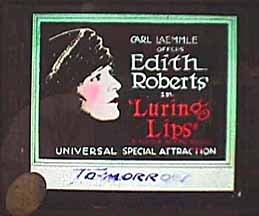
If you crave pre-code cynicism wrapped in the gossamer of 1921 cinematography, Luring Lips is your poisoned bonbon—an unjustly forgotten jewel humming with the electric tension of cash registers and broken promises.
Picture the Roaring Twenties still in the bassinet: Wall Street’s temples shoot higher than steeples, yet every ledger hides a potential graveyard. Within this cathedral of numbers, director John A. Moroso and scenarist George Hively spin a triangular web whose silken threads soon gleam like razor wire. Dave Martin, played by a doe-eyed yet steel-jawed Ramsey Wallace, embodies the era’s faith in self-improvement: a receiving teller who believes arithmetic is scripture and the bank vault a holy of holies. His marriage to Adele (Edith Roberts) should be the stuff of Saturday Evening Post adverts—sweet, modest, scented of fresh biscuits. Enter Frederick Vibart, the office manager incarnate of Gatsby-era swagger, performed with velvet-gloved menace by William Welsh. Vibart’s continued visits to the Martins’ cramped but lovingly papered flat feel like inspections, not social calls, each smile a probe for weakness.
The inciting rupture—fifty thousand evaporating from Dave’s till—lands with the metallic clang of a jail door. The film, however, is less interested in the mechanics of embezzlement than in the emotional chemistry of distrust. Hively’s script withholds the theft itself; we only witness its fallout, an elegant elision that forces the viewer to sleuth alongside Adele. Because we never glimpse the snatch, every character becomes equally suspect, a gambit that prefigures Hitchcock’s fondness for the wrong-man motif by a full decade.
Conviction follows with the swiftness of a banker’s signature, and Dave’s incarceration sequence is a master-class in visual shorthand. Bars bisect his face; a shaft of light stripes the cell wall like a balance sheet. Meanwhile, Adele’s daily grind morphs into an undercover operation. Cinematographer Mortimer E. Stinson drapes her in chiaroscuro each time she loiters near the company safe, her shadow a noir signature before noir had a name. The marriage becomes a long-distance chess match played through letters redacted by wardens, each clipped sentence a move toward either absolution or divorce.
The newsreel reveal—Dave spotting Adele and Vibart on a luxury liner—arrives like a nickelodeon sledgehammer. In 1921, newsreels were the TikTok of their day: flickers of glamour projected between Pathé serials. Moroso leverages their ubiquity, letting a five-second snippet detonate his protagonist’s last vestige of trust. Wallace’s face, usually a placid ledger of industry, curdles into something feral. The editing rhythm accelerates—intercut between Dave’s clenched fists and the celluloid lovers—until time itself seems to yodel with jealousy.
Upon release, Dave’s dash to the dock is staged like a Keystone chase dipped in arsenic. Trolleys clang, newspapers swirl, and the Brooklyn Bridge’s girders loom like the ribs of a colossal beast. Yet the frenzy is internal: a man sprinting to outpace his own dread of cuckoldry. When he finally corners the pair, the expected confrontation implodes into reversal: Adele brandishes a folio of carbon copies that indict Vibart. The true theft was not of currency but of narrative agency—Vibart presumed himself the puppeteer, yet Adele has been scripting the third act all along.
Edith Roberts, too often relegated to flapper arm-candy, here commands the frame with calculated vulnerability. Watch her pupils in the penultimate close-up: they tremble between contrition and triumph, confessing both the strategic flirtation and the marital fealty that motivated it. The performance flirts with melodrama but lands in the terrain of proto-feminist strategy. Adele’s body was bait; her mind, the trap. For 1921, that’s revolutionary.
Ramsey Wallace shoulders the unenviable task of aging from optimistic clerk to embittered convict without benefit of spoken monologue. He maps the arc onto posture: shoulders once squared to the customer window gradually curve inward like a parenthesis around shame. Even his gait evolves—the spring of a man with a paycheck becomes the shuffle of one who’s learned that time, not money, is the real currency.
William Welsh’s Vibart is silk draped over rot. He never twirls a mustache; instead he lets charm ooze until it sickens. Notice how he fingers coins—stroking rims as if assessing a woman’s waist—an embodied metaphor for capital as erotic fuel. When cuffs finally cinch his wrists, the shock isn’t legal but existential: a predator learning he was prey.
Compared to Moroso’s earlier morality yarn The Rent Collector, Luring Lips eschews sanctimonious sermon for corrosive ambiguity. Where the 1920 film dispenses charity as holy balm, here charity itself is suspect—every gift an IOU. Likewise, the maritime finale rhymes tonally with Sirens of the Sea, though Moroso replaces mythical fatalism with the banal brutality of ledgers.
Stylistically, the picture flirts with German Expressionism without abandoning American realism. Note the bank’s façade at twilight: windows become black rectangles, a proto-Borgesian void. Interiors tilt toward cluttered authenticity—inkwells, blotters, pneumatic tubes—yet a single arc lamp throws elongated silhouettes worthy of Das Cabinet des Dr. Caligari, released merely a year prior. Moroso synthesizes both schools, crafting a visual dialect that whispers: every realist surface secretes an expressionist abyss.
Themes ricochet beyond adultery and fraud into an interrogation of visibility itself. Who sees whom, and through what peephole? Dave watches his wife on a flickering screen; Adele watches Vibart across office desks; we watch them all through the peephole of 35 mm. Surveillance becomes a venereal disease passed from character to viewer, implicating our voyeurism long before Baudrillard wrote of simulacra.
Yet the film is not dour. Comic grace notes abound: a drunk stockbroker sliding down a banister while quoting ticker tape; a stenographer who transcribes confessions of love with perfect shorthand, her pencil a hummingbird. These flourishes prevent the narrative from calcifying into thesis. Life, Moroso insists, is tragicomedy scored by ragtime.
Cinephiles hunting DNA for future genres will find noir’s double-helix here: the chiaroscuro lighting, the morally amphibious woman, the everyman crushed by system. They will also find pre-code frankness about female desire and corporate rot—elements that would be neutered once the Hays Office began wielding its scissors in 1934.
Restoration-wise, surviving prints reside in the Library of Congress’s paper-film collection, digitized at 2K from a 35 mm nitrate positive. The tinting follows archival notes: amber interiors, cyan exteriors, rose newsreel footage. The newly commissioned score by Monica Henstell—piano, brushed snare, muted trumpet—threads ragtime with dissonant chords that curdle whenever Vibart appears. It’s a soundtrack that refuses nostalgia, insisting these ghosts still rattle our coffers.
Weaknesses? The courtroom montage relies on title cards so purple they verge on self-parody (“Justice, blindfolded, weighed the coins of fate”). And Carlton S. King’s detective—an auxiliary character—delivers exposition via cigar-pointing that borders on mime. Still, these are flecks on an otherwise burnished surface.
Final verdict: Luring Lips is the missing link between Victorian melodrama and hardboiled noir, a celluloid Rosetta Stone for anyone tracing how American cinema learned to distrust the very institutions it once celebrated. It offers no reformed sinner, no heavenly choir—only the stark calculus that trust, once embezzled, accrues interest in the currency of rage. Stream it during a market crash for maximum vertigo.
Rating: 4.5 out of 5 clandestine ledgers
IMDb —
1930
Community
Log in to comment.