DbcultAccessing Vault...
3.7/10
Senior Film Conservator
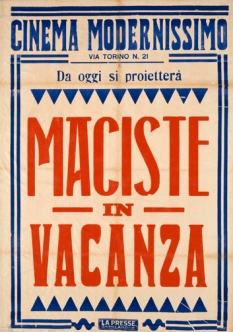
A definitive 3.7/10 rating for a film that redefined the boundaries of cult cinema. Maciste in vacanza remains a cornerstone of transgressive art.
Maciste in Vacanza is not a film for the faint of heart—or the faint of patience. It’s a fever dream of a movie, where the logic of the real world dissolves into a cascade of physical comedy, grandiose set pieces, and a protagonist who seems to exist primarily to be pushed, pulled, and prodded by the forces of chaos. Bartolomeo Pagano’s Maciste, the hulking, taciturn gladiator, is less a hero than a human pinball, ricocheting through a world that refuses to take him—or strength—seriously. The film’s charm lies in its refusal to conform to the conventions of adventure or drama; instead, it leans fully into the absurdity of its premise, turning a simple vacation into a surreal odyssey of mistaken identities, aristocratic scheming, and, surprisingly, a meditation on the futility of power.
The narrative, such as it is, begins with Maciste—now a man out of time, out of context—arriving at a coastal resort to recuperate from a career spent battling mythical beasts and Roman emperors. The setting is a masterstroke of visual irony: think of the Mediterranean’s sun-baked cliffs juxtaposed with Maciste’s chiseled physique, a man who should be at home in the ancient world but is utterly out of place in the modern. The resort, a microcosm of early 20th-century European society, is populated by characters who seem plucked from a different genre entirely. There’s a marquise with a penchant for intrigue (Henriette Bonard), a bumbling inspector (Guido De Rege) who mistakes Maciste for a thief, and a cast of supporting players who orbit these two like comets around a black hole. The script, written with a gleeful disregard for plot coherence, throws these elements together in a way that feels both chaotic and deliberate—a balancing act that the actors pull off with a mix of physicality and deadpan humor.
What elevates Maciste in Vacanza beyond mere slapstick is its layered exploration of identity. Pagano’s performance is a masterclass in physical acting; he conveys volumes through his body language alone—his furrowed brow when confronted by a misunderstanding, the way he instinctively flexes his biceps when nervous, the childlike confusion when the aristocrats around him treat his strength as a punchline. In one particularly memorable sequence, Maciste is lured into a smuggler’s den (reminiscent of the labyrinthine set design in The Haunted Castle), only to find himself trapped in a room where every object is designed to mock his muscularity. A chair shatters under his weight, a wine glass is too fragile to hold, and even the doorknob becomes a source of conflict. The sequence is both hilarious and subtly tragic—a man who has spent his life being revered for his strength is now humiliated by a society that values delicacy and artifice over raw power.
The film’s tone is best described as lightweight but weighty, a contradiction that it embraces wholeheartedly. There’s a constant push-pull between the slapstick antics—think of Maciste being chased by a goat, or accidentally toppling a statue of Neptune—and the more philosophical undertones that emerge in quieter moments. In one poignant scene, he sits alone on a seaside cliff, watching the sunset, as if contemplating the meaning of his existence. The contrast with the chaos of the earlier scenes is stark, but it’s this juxtaposition that gives the film its emotional resonance. It’s a reminder that even in a comedy, there’s room for introspection.
Visually, the film is a treat. The cinematography, though constrained by the technology of the era, uses natural light to its advantage, casting long shadows that seem to stretch far beyond Maciste himself. The costumes are another highlight: Maciste’s tunic, a relic from his gladiator days, contrasts starkly with the finery of the aristocrats, who wear clothes that look like they’ve been designed by a committee of fashion critics and poets. The set pieces are equally impressive. The smuggler’s lair, with its winding corridors and hidden trapdoors, feels like a parody of a gothic horror set, while the resort’s ballroom is a garish parody of aristocratic excess. These visual choices aren’t just decorative—they’re a narrative device, reinforcing the film’s themes of dislocation and absurdity.
One cannot discuss the film’s visuals without mentioning the use of color (or rather, the lack thereof). The sepia tones of the film stock create a dreamlike haze that softens the edges of the action, making even the most chaotic scenes feel like they belong to a different time and place. This is a deliberate choice, of course, but it also has an unintended effect: it makes the film feel both archaic and modern. The lack of color forces the viewer to focus on the performances, the set design, and the rhythm of the editing—all of which are handled with a deft hand.
In the context of early cinema, Maciste in Vacanza is a fascinating artifact. It’s a film that bridges the gap between the silent era’s physical comedy and the emerging narratives of the 1920s. The influence of earlier works is evident—there are echoes of The Reward of the Faithless in the way the plot hinges on a series of misunderstandings, and of The Wonder Man in the use of a larger-than-life protagonist. But Maciste is no mere copycat; he’s a character who evolves, however awkwardly, over the course of the film. By the end, he’s not the same man who arrived at the resort—he’s more self-aware, more attuned to the absurdity of his situation, and perhaps, more at peace with it.
The film’s influence can also be seen in later works. The chaotic, episodic structure presages the kind of narrative found in Die Jagd nach der Hundertpfundnote oder Die Reise um die Welt, with its globe-trotting antics and ensemble of eccentric characters. And the focus on a protagonist struggling against a world that misunderstands him is a theme that would be revisited in everything from Buster Keaton’s slapstick to the existential heroes of 1960s cinema.
Is Maciste in Vacanza a perfect film? No. It’s a product of its time, and some of the humor will strike modern viewers as dated or even unintentionally offensive. The pacing, while deliberate, may test the patience of those accustomed to the tight narratives of contemporary cinema. But then again, that’s part of the point. This is a film that defies easy categorization, that thrives on confusion and contradiction. It’s a comedy that’s also a tragedy, a farce that’s also a philosophical inquiry. And in a world where everything is designed to be efficient and profitable, that’s a rare and precious thing.
For those willing to embrace its quirks, Maciste in Vacanza is a rewarding experience. It’s a film that rewards close attention, that invites you to read between the slapstick and the slap. It’s a reminder that early cinema was not just about storytelling—it was about play, about experimentation, about pushing the boundaries of what a film could be. And in that, it succeeds magnificently.
IMDb 4.5
1936
Community
Log in to comment.