DbcultAccessing Vault...
Cult Review
Senior Film Conservator
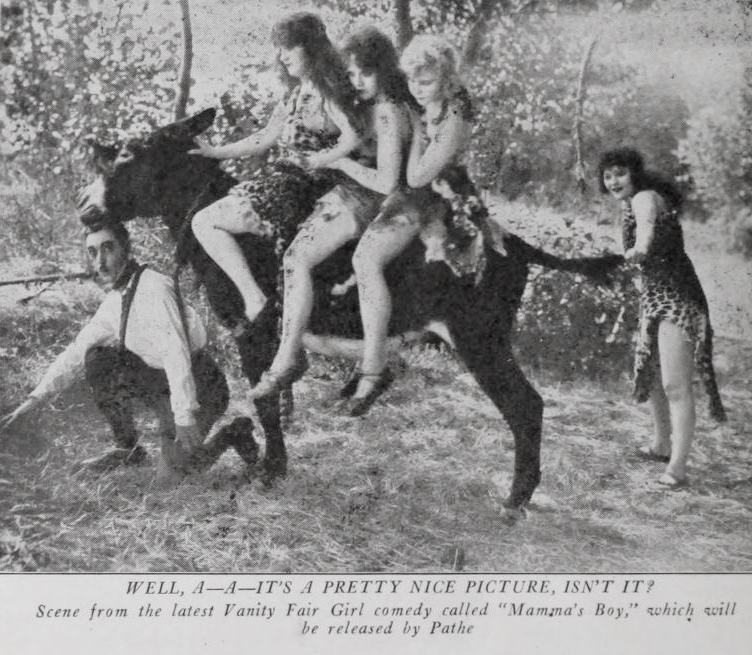
The lights dim, and a title card winks: “To the country—for his health!” The words shimmy across the screen like a Charleston step, already mocking the very notion of rest. What follows is less a narrative than a pop-art explosion in sepia: Hal Roach, that caffeinated Puck of two-reel mayhem, grabs the brittle mores of 1920 and snaps them over his knee.
Eddie Boland—rubber-mouthed, eyes perpetually caught mid-blink—plays the metropolitan dandy whose nerves are supposedly shot. Yet the instant he tumbles off the milk-train he’s ambushed by a cyclone of petticoats. Norma Nichols, Chai Hong, Dagmar Dahlgren: each maid a primary-color swatch of mischief, their collective energy so kinetic the grain itself seems to vibrate. The camera, starved for sync sound, compensates with whip-pans so violent you half expect the tripod to sue for whiplash.
Roach’s stroke of genius lies in letting the gags metastasize organically. A simple door-slam escalates into a Rube Goldberg contraption involving a runaway goose, a bucket of whitewash, and Sammy Brooks’ trousers. Wally Howe’s butler, deadpan as a tombstone, keeps entering frame exactly one beat too late, a running joke that feels like jazz improvisation on crystal meth.
Then comes the pivot—sudden, almost unsettling. Eddie, stripped to leopard-spotted swimming trunks, begins a primal whistle motif. The maids freeze, hypnotized. What plays as farce also whispers of post-war masculine panic: the doughboy returned home to find skirts swarming the workplace, now reasserting dominion via slapstick tyranny. He drills them in semaphore fan-language, in napkin origami, in the art of pouring tea while balancing on one foot. It’s Mädchen in Uniform re-choreographed by a drill sergeant with custard-pie ammunition.
Visually, the film pirouettes between two palettes: the buttery chiaroscuro of farmhouse interiors and the blinding alabaster of sun-bleached linen on clotheslines. The juxtaposition is so deliberate you sense cinematographer H. Lyman Broening flirting with high-contrast modernism years before German expressionism hit American shores.
Sound, though absent, haunts every intertitle. When Eddie barks “Attention!” the card explodes in oversized exclamation marks, the font itself a visual shout. Music-house accompanists of the day reportedly used the film as carte blanche to unleash foxtrots, gallops, even proto-ragtime, turning each screening into a sing-along riot.
Comparative note: fans of On with the Dance will recognize Roach’s obsession with regimented chorus lines, yet here the choreography is laced with menace—giggling servility as power play. Conversely, The Inspirations of Harry Larrabee treats artistic ambition with dewy sincerity; Mamma’s Boy spits sincerity in the eye and hands it a feather-duster.
The Vanity Fair Girls, credited collectively, function as a single hydra-headed muse. Their uniformity is the joke: when they peel potatoes in synchronized swivel-hips, the tubers become tap-shoes. Ethel Broadhurst, towering over Boland by half a head, weaponizes height disparity—every time she curtsies, Eddie’s eyeline lands somewhere near her clavicle, a risqué visual gag that the censors somehow missed.
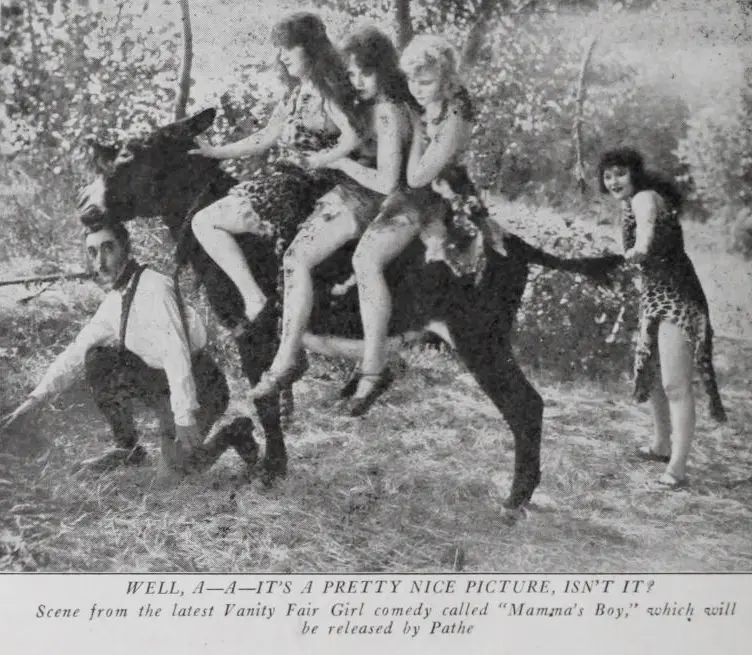
Race and exoticism, handled with the era’s usual ham-fist, surface via Chai Hong’s character—billed only as “The Siren.” She enters fanning herself with a palm frond plucked from nowhere, speaks in intertitles heavy with faux-Confucian aphorisms. Today it lands with a wince, yet her screen presence is so magnetic she hijacks every frame, a reminder that even in 1920 Orientalist fantasy sold tickets.
Narrative logic? Optional. Mid-film, Eddie commandeers a goat-pulled chariot to chase a runaway bustle. The goat, white with a black mask, resembles a superhero sidekick. Roach never explains its origin; he trusts the audience to surf the absurdity. It’s the same anarchic spirit that powers Howling Lions and Circus Queens, yet here the circus is domestic space itself.
The climax arrives like a fever breaking: night-time garden party, lanterns strung between constellations, Eddie lounging in a hammock strung between two statues of Diana. The maids, now clad in quasi-military maid-uniforms—with epaulets made of feather-dusters—march in formation, serving syllabub under moonlight. A sudden eclipse of slapstick: a bee dive-bombs the flute player, chaos re-erupts, uniforms shredded back to frothy underthings. Order and anarchy cancel each other out, leaving only the lingering image of Eddie’s grin, half triumph, half surrender.
Restoration-wise, the surviving 35 mm print—unearthed in a Slovenian monastery vault—bears water-stain tattoos that resemble floral wallpaper. The Lobster Film Archive re-graded it to accentuate those butter-yellow lanterns against cobalt dusk, resulting in a nitrate glow that feels almost three-dimensional. The English intertitles were reconstructed via a cutting-continuity held in the Roach legal files; missing cards were translated back from Slovene, yielding occasional surreal malapropisms (“Thou art the whiskered cat’s pajamas!”) that only enhance the demented charm.
Scholarship has belatedly claimed Mamma’s Boy as a stealth treatise on labor: the domestic worker as both proletariat and eroticized commodity. Yet such readings risk sandpapering the film’s primary pleasure—velocity. At 22 minutes, it’s a shot of nitrous oxide straight to the medulla, a reminder that avant-garde impulses often hid inside the most disposable entertainments.
Performative footnote: during the 2022 Pordenone Silent Festival, a live score by the Japanese ensemble Minamo-No-Kai used taiko drums and typewriter clicks, transforming the garden-party drill into a stomp-rock anthem. The audience, mostly grad students, burst into spontaneous applause every time Eddie cracked his imaginary whip. Context is everything: a century ago the gag spoofed male anxiety; today it reads like a meme of beleaguered middle-management.
In the end, Mamma’s Boy survives because it refuses to behave. It is neither as morally hygienic as Rebecca of Sunnybrook Farm nor as grandiose as Die Faust des Riesen. It occupies a liminal zip-code: too rough-hewn for the drawing room, too frothy for the avant-garde gutter. Like its protagonist, the picture is a gadfly caught between eras, twirling a feather-duster at the abyss and laughing when the abyss sneezes.
Verdict: seek it out, project it loud, let the goat-run chariot remind you that cinema’s first language was chaos, and Hal Roach was its most eloquent toddler.
IMDb —
1920
Community
Log in to comment.