DbcultAccessing Vault...
Cult Review
Senior Film Conservator
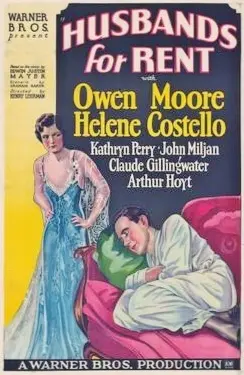
Is Husbands for Rent worth watching today? Short answer: yes, but only if you have a high tolerance for the manipulative 'father-knows-best' tropes of the late silent era. This film is for enthusiasts of domestic farce and those who study the evolution of the marriage-and-remarriage genre; it is certainly not for viewers who demand modern emotional logic or female agency in their storytelling.
This film works because the central performances by Owen Moore and Helene Costello possess a frantic, nervous energy that perfectly captures the claustrophobia of a failing honeymoon phase. This film fails because the resolution relies entirely on a paternalistic deception that feels more like gaslighting than a romantic reconciliation. You should watch it if you want to see how the 1920s cinema handled the burgeoning 'divorce culture' with a mix of anxiety and slapstick humor.
At the heart of Husbands for Rent lies a performance by Claude Gillingwater that is both charming and deeply unsettling. As the father who refuses to let his daughter’s marriage dissolve, Gillingwater operates as a literal director within the film. He isn't just a character; he is a plot device incarnate. His performance is a masterclass in the 'cranky but golden-hearted' archetype that was so prevalent in the late 1920s.
In one specific sequence, where the father orchestrates a series of 'accidental' encounters between the estranged couple, Gillingwater’s facial expressions convey a smug superiority. It’s a bold choice. He doesn't play for sympathy; he plays for results. This creates an interesting tension. We are supposed to root for the couple, but we find ourselves fascinated by the machinery of the father's deceit. It is a stark contrast to the more straightforward romantic conflicts found in films like Nearly Married.
The film’s reliance on this meddling patriarch highlights a specific cultural anxiety of 1927. The 'six-month marriage' was seen as a symptom of a fast-moving, modern society. By having a representative of the older generation 'fix' the problem through trickery, the film suggests that youth is too impulsive to manage its own happiness. It’s a cynical take wrapped in a comedic bow. It works. But it’s flawed.
The pacing of Husbands for Rent is relentless, a hallmark of the writing team which included the likes of Edwin Justus Mayer and C. Graham Baker. The script doesn't waste time on the 'why' of the divorce. It accepts the couple's misery as a starting point and moves immediately into the mechanics of the father's counter-plot. This efficiency is refreshing, even if it leaves the characters feeling a bit thin.
Consider the scene where the couple first announces their intent to separate. The framing is tight, almost suffocating, emphasizing the domestic trap they feel they've walked into. Owen Moore, playing the husband, uses his physical space with a restless agitation. He’s a man who wants out, and his body language screams it. This isn't the polite disagreement seen in Her Awful Fix; this is a visceral, albeit comedic, rejection of the status quo.
The use of intertitles in this film is particularly sharp. Instead of merely explaining the plot, they often provide a sarcastic commentary on the characters' plight. This meta-textual layer adds a level of sophistication that was becoming standard as the silent era reached its technical and creative peak. The writers knew the audience was familiar with these tropes, and they leaned into the absurdity of the situation.
Visually, the film is a product of its time, but with a few surprising flourishes. The lighting in the domestic interiors transition from bright, high-key setups during the 'happy' flashbacks to more shadowed, moody compositions as the divorce talk begins. This visual shorthand is effective, if not subtle. It guides the audience through the emotional beats without needing a single word of dialogue.
There is a standout moment involving a mirror—a classic silent film trope—where the wife (Helene Costello) looks at her reflection and sees not herself, but the ghost of her wedding day. It’s a rare moment of genuine pathos in a film that otherwise trades in cynical comedy. It reminds us that behind the father’s schemes, there are two people who are genuinely hurting, even if their pain is being played for laughs.
The camera work remains mostly static, which is typical for the era’s comedies, but the blocking is intricate. Characters move in and out of the frame like clockwork, especially during the climactic sequence where the father’s plot reaches its fever pitch. This choreography is what keeps the film from feeling like a filmed play. It feels cinematic, even when confined to a few rooms.
If you are looking for a deep exploration of the human condition, look elsewhere. However, if you want to understand the DNA of the modern 'rom-com' and see how the 'meddling parent' trope was perfected, Husbands for Rent is an essential watch. It occupies a unique space between the slapstick of the early 20s and the sophisticated 'talkie' comedies that would follow just a few years later.
The film is a fascinating time capsule. It shows us a world where marriage was a social obligation that required external maintenance. While the father's actions would be considered toxic by today's standards, within the context of 1927, they are presented as heroic. Watching it through a modern lens provides a jarring, yet educational, experience. It is a film that demands to be debated.
Pros:
Cons:
Husbands for Rent is a loud, busy, and occasionally brilliant piece of silent cinema. It doesn't have the emotional depth of something like The Mysterious Mr. Tiller, but it makes up for it with sheer comedic willpower. The film is a reminder that the 'war between the sexes' has always been a profitable subject for the silver screen, even if the weapons used in 1927 were a bit more primitive.
Ultimately, the film succeeds as a comedy but fails as a romance. We laugh at the father’s audacity, but we don't necessarily leave the film believing the couple will stay together for another six months once the credits roll. It’s a cynical, funny, and technically proficient movie that deserves a spot in the conversation about late silent-era transitions. It’s a bit of a relic, but a shiny one at that.
IMDb —
1923
Community
Log in to comment.