DbcultAccessing Vault...
Cult Review
Senior Film Conservator
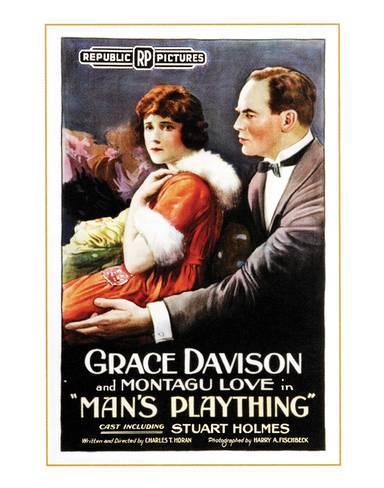
If the Jazz Age had a fever dream, it would look exactly like Man's Plaything—a 53-minute nitrate séance that survives only in frayed reels and rumor, yet burns brighter than most pristine restorations. The film is a guttering candle held against the void of 1919 morality, dripping wax on the manicured hands of the rich and letting the rest of us see just how easily love can be counterfeited when money changes palms.
If you squint through the scratches, you can still make out Grace Davison’s Nellie: part flapper, part fallen cherub, eyes wide as silver dollars yet already circled by fatigue. She’s selling flowers the way other people sell apologies—cheap, fast, and with no guarantee of acceptance. Davison’s performance is silent-film semaphore at its most urgent: every shrug of her shoulder strap is a sentence, every tremor of her lower lip a paragraph about precarity. Compare her to Blanche Sweet’s Judith, who wielded a sword like a press release; Nellie’s weapon is visibility itself, and it fails her twice—once when she is slandered, again when she is believed.
Jack W. Johnston’s Pelton Van Teel arrives with the careless gravity of someone who has never feared the sidewalk. His tuxedo fits like inherited sin, and when he slumps at Maddox’s rigged baccarat table you can practically hear the silver spoons clinking in his pockets. Johnston lets his cheeks flush coral under the nitrate tinting, a live-in reminder that even the golden can hemorrhage. The gambling scenes unfold in a hallucinatory strobe: cigarette haze, champagne spume, and Montagu Love’s Maddox dealing cards with the languid precision of a surgeon flirting with malpractice. Love, rakish and reptilian, swaggers in evening cape folds so deep you could hide a marriage certificate inside—or a death warrant.
The rumor that detonates the plot—Nellie as Maddox’s kept woman—spreads with the efficiency of a stock-tip. In 1919 tongues wagged faster than newsreels; here the film weaponizes that velocity. Note how director Charles Horan never shows the lie actually birthed; he simply cuts from Maddox’s smirk to a room where every male eye has already undressed her. We infer the rest, and complicity feels like humidity. The device is as brutal as it is economical, predating the #Meantoo mechanics of Wall Street Tragedy by a full century yet landing the same punch.
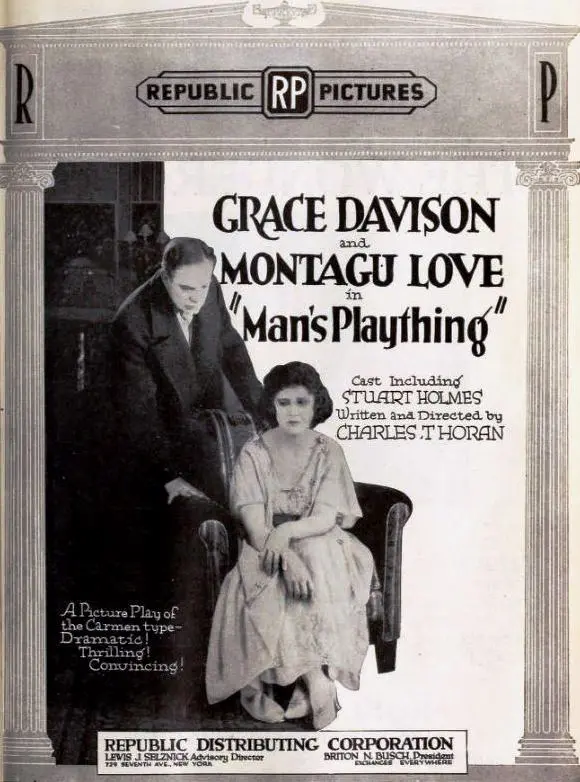
Nellie’s ultimatum—marry me tonight or I drown—feels less like romantic hope than a futures contract on respectability. The wedding scene, glimpsed through a doorway, is staged like a heist: witnesses hustled, vows gabbled, rice hurled like shrapnel. Horan withholds close-ups; we watch from the corridor, voyeurs denied catharsis. The camera’s reticence makes the sacrament feel forged, a sentiment that curdles when Pelton’s rubber check resurfaces like a bloated secret.
Enter the film’s pièce de résistance: the showdown in Maddox’s penthouse, a cavern of Deco mirrors and predatory silks. Cinematographer Jules Cronjager lenses it like a cathedral dedicated to venality—low Dutch angles, chandeliers swaying like hanged men. Nellie’s pistol is a dainty thing, pearl-handled, almost flirtatious; when it bucks, the recoil seems to surprise her more than Maddox. The lamp he flares at her explodes in a shower of tungsten and guilt, a visual rhyme with the earlier flower petals now ground under nightclub heels. Blood blooms on his white waistcoat in the exact shade of the roses Nellie once sold—a symmetry worthy of Poe.
Yet the true coup arrives in the guise of Stuart Holmes’s butler, a man whose face has spent years practicing neutrality. When he snaps open the handcuffs meant for Nellie and claps them instead on Maddox, the reversal is so elegant it feels like origami performed on your ventricles. His disclosure—elder Van Teel’s embedded detective—retroactively rewrites every servile bow, every tray of martinis, into an act of surveillance capitalism avant la lettre. The moment is less deus ex machina than deus ex boardroom, suggesting that even patriarchs fear for their prodigals.
Compare this resolution to The Master Mind, where the puppeteer is unmasked by poetic justice rather than private capital. Here money itself talks, and it speaks in the crisp accent of law enforcement. The dénouement feels chillingly modern: justice outsourced, reputation managed, love disinfected and returned laundered. The final shot—Nellie and Pelton silhouetted against a sunrise that could be either apocalypse or America—offers no assurance, only a stay of execution.
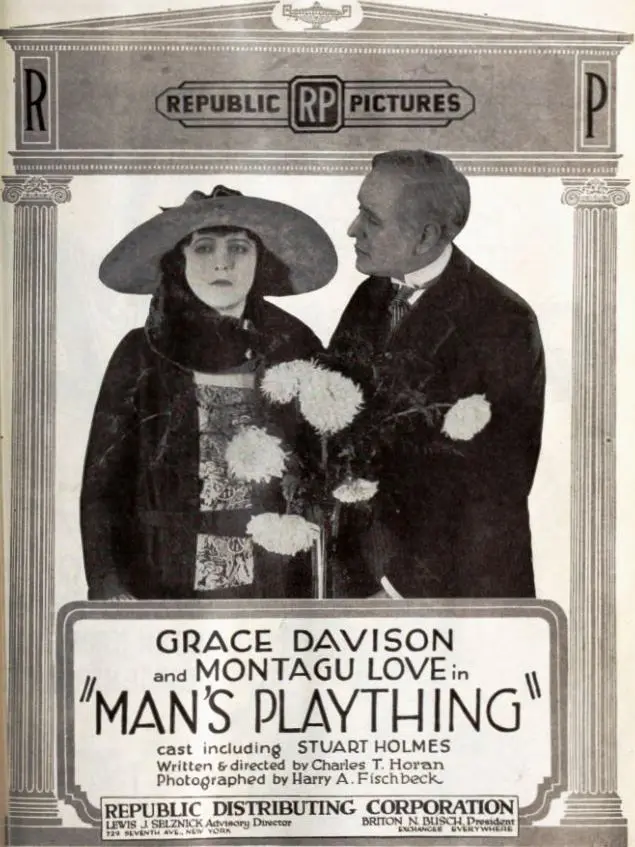
The film’s racial politics, or their absence, deserve scrutiny. The nightclub’s clientele is lily-white; the band presumably Black, unseen in the extant print. Their erasure is the negative space around which the plot pirouettes, much like the off-screen labor that powers every Gatsby soirée. When Nellie ascends from selling posies to wielding a revolver, she crosses a class threshold built on who remains unheard.
Musically, exhibitors in 1919 were advised to accompany the picture with a medley of "The Vamp" and "The Flower of Dixie," syncopated numbers that would have underlined the scandalous shimmy of Nellie’s hips. Modern restorations improvise, often pairing the visuals with minimalist piano, a choice that paradoxically amplifies the terror. Each unresolved chord becomes the echo of Maddox’s footsteps behind you.
Archivally, Man's Plaything exists in a 35mm nitrate print at the Library of Congress, unpreserved, too brittle to project. A 2018 2K scan circulated among private collectors reveals missing intertitles reconstructed via contemporary synopses, giving the film a ghostly stutter. Those lacunae feel apt: a story about rumor and loss should itself be pockmarked with amnesia.
Feminist readings might bristle at Nellie’s need for matrimony as shield, yet Davison plays her less as damsel than as strategist trapped in a rigged market. Her gun is not phallic bravado but ledger balance: an attempt to settle accounts when every institutional ledger has already discounted her. She shoots, misses lethal intent, yet the act itself rewrites the contract of her body. Contrast this with The Apple-Tree Girl, whose heroine finds agency through agrarian self-reliance; Nellie’s soil is asphalt, her only crop the gunpowder seed.
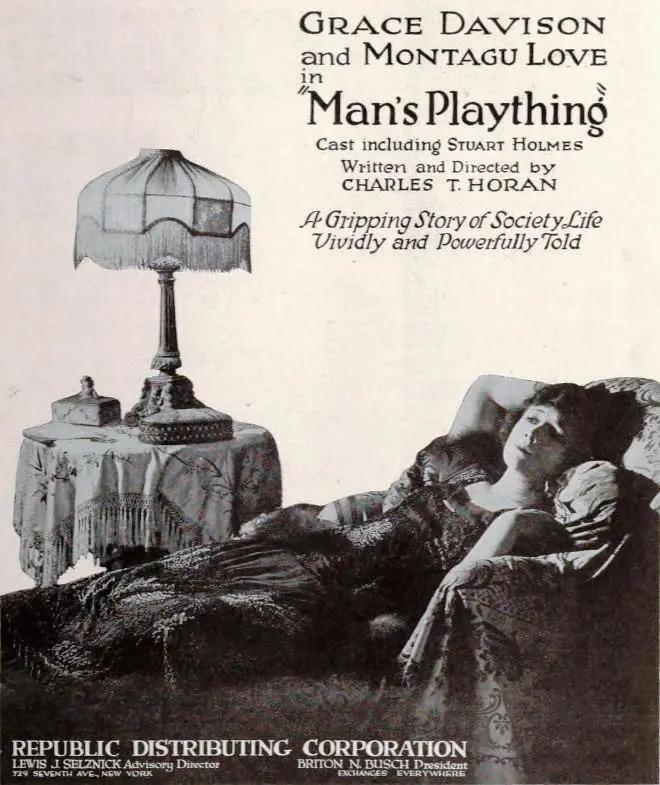
Cinephiles hunting for DNA strands will spot anticipatory fingerprints of noir: the chiaroscuro hallway, the femme fatale who isn’t yet aware of her designation, the criminal entrepreneur as corporate CEO. The DNA is still mutating, not yet coalesced into the postwar cynicism of London Sharks, but the helix is unmistakable.
Box-office receipts, reported in Motion Picture News, peg the film’s earnings at $117,000 against a $19,000 budget—robust for an indie release eclipsed by Chaplin’s Sunnyside. Critics praised its "unflinching social gaze," a phrase that today reads like ironic foreshadowing, given how thoroughly the film was buried beneath later glossier scandals.
For modern viewers, the thrills arrive not via suspense—outcomes are pre-chewed by history—but through texture: the way a cigarette ember punctuates darkness like a Morse code confession, the hush that falls when a woman realizes her name is now a euphemism. You watch seeking not what happens but how it felt to inhabit a body whose value could deflate faster than Weimar currency.
Stream it via illicit rip on archive forums, or catch the MoMA’s one-off 2025 screening rumored to feature live accompaniment by the Kronos Quartet. Either way, bring nose plugs; nitrate ghosts carry the whiff of vinegar and vertigo.
Bottom line: Man's Plaything is a brittle valentine from an era learning to weaponize gossip, a nickelodeon Barry Lyndon without the luxury of runtime. It will not comfort you about human nature; it will, however, validate every side-eye you’ve ever cast at velvet-rope sanctuaries. Watch, shudder, and maybe send flowers—just keep the receipt.
IMDb —
1935
Community
Log in to comment.