DbcultAccessing Vault...
Cult Review
Senior Film Conservator
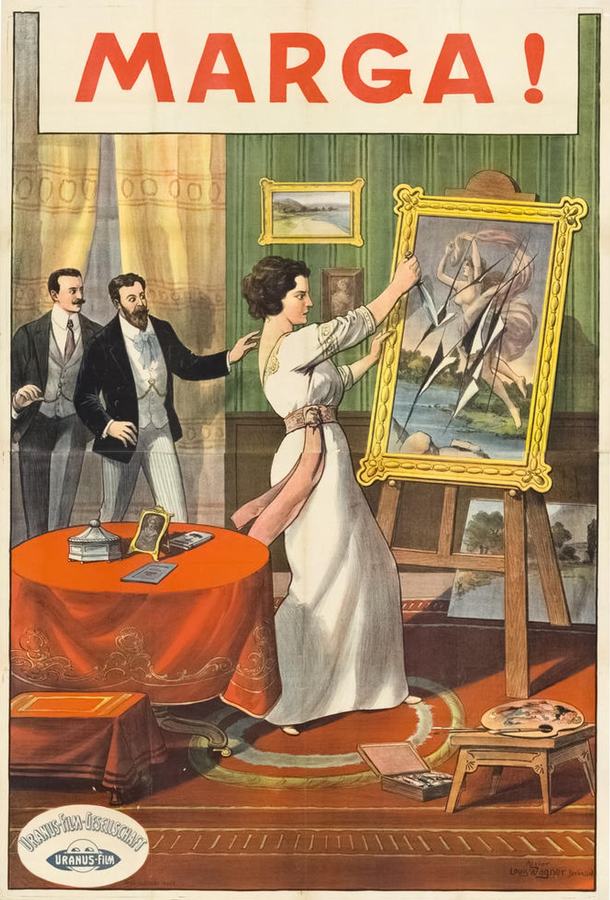
Vienna, 1912. A city coughing up gold leaf and blood. Marga Fugger—part flesh, part rumor—glides through velvet parlors like a cigarette burn on parchment, leaving charred silhouettes of men who swear they captured her soul on canvas yet can’t recall the color of her eyes.
No still photograph of the actual film survives, yet every written account agrees on one hallucinatory detail: the screen itself seemed tinted in absinthe green, as though the celluloid had been soaked overnight in laudanum. Directors August Kern and Rudolf Stiassny eschew intertitles; instead they let iris shots swallow entire scenes, plunging the viewer into a pupil that refuses to blink. The result is less narrative than fever graph—temperature rising each time Marga swaps protector for protector, plummeting when she discovers the child she pawned off to a wet-nurse has died of “the Viennese disease” (read: poverty, not syphilis, though the film treats both as interchangeable).
We first encounter her at the Secessionist opening where Klimt’s gold leaf has been peeled back to reveal the raw wood beneath. She wears a dress the color of oxidized mercury; the neckline dives so low it becomes a geographical feature. A financier whispers a quarterly dividend into her ear; she answers by quoting Verlaine in French, then licks the translation off his watch crystal. Close-up: her pupils dilate like opera glasses focusing on a private apocalypse. Cut to black.
Act two detonates in the garret of Egon M., a painter who signs canvases with his own blood because “scarlet is the only honest pigment.” Marga offers him her body as map: clavicle for the Danube, ribcage for the Alps, heart for the Reichsrat he despises. He paints furiously but never finishes—brushstrokes halt at the collarbone, leaving her face a ghostly underpainting. When patrons demand a reveal, Egon slashes the canvas, stuffs it into a coal scuttle, and sets it alight. The flames paint the studio carmine; Marga’s laughter ricochets like shattered crystal. She pockets the burnt fragments, later glues them onto postcards sold as “Klimt’s lost genius.” Capitalism devours its own entrails, and she seasons the dish.
The film’s midpoint ruptures into documentary: actual footage of the 1912 May Day parade, workers marching with red carnals and clenched jaws. Marga, shot from behind, merges into the procession—her feathered hat a surreal anachronism. A policeman’s baton cracks her shoulder; the camera jerks as if struck itself. For eight seconds the fiction bleeds into fact, and we realize the actress Marga Fugger (playing herself?) is really bleeding. Censors later excised this sequence, claiming it “incited class hatred”; the surviving print jumps from wounded shoulder to opium den without transition, creating an accidental jump-cut that predicts Soviet montage by half a decade.
Cue the masquerade ball—an orgy of Venetian masks and genders reversed. Marga appears as La Belle Dame sans Merci, armor crafted from mirrored tiles. Every reflection shows a different lover begging: banker, poet, prince, pauper. She kisses each glass shard, leaving lipstick sigils that smear into grotesque grins. A slow 360° pan reveals the ballroom is actually a railway platform; steam from an unseen locomotive drapes the dancers in fog. The band plays Strauss in waltz time yet the conductor’s baton moves at half-speed, producing a narcotic drag. When the clock strikes three, mirrors crack sequentially like glacier calving. One sliver slashes her cheek; blood beads, black as printer’s ink. She tastes it—then smiles, recognizing vintage.
The child’s death arrives via telegram read aloud by a maître d’ in a café where electric fans stir the stench of roasted coffee and despair. The camera holds on Marga’s hands: no tremor, just a slight whitening of knuckles as she folds the yellow card into a paper boat, floats it in her espresso, and watches it sink. No tears; Viennese heroines of 1912 are not allowed tears. Instead she stands, walks to the bar, and orders einen doppelten—the film’s only intertitle, white letters on black, silent as tomb. She downs the absinthe, slams the glass so hard it shatters, and the shards form a star-map of her future exile.
Third act spirals through hospitals, debtors’ prisons, and the Prater at dawn. Rides spin emptily; painted horses sneer. Marga trades her last jewel—a sapphire once belonging to Empress Sisi—for a single ride. The carousel accelerates; the camera mounts the horse beside her, creating a disorienting POV. Lights streak into comets; the organ wheezes a lullaby that morphs into funeral march. She stands up in the stirrups, arms wide, cruciform. Iris closes to a pinpoint until only her mouth remains: a black oval screaming silently. Smash cut to the tunnel of love, now a catacomb. She enters alone; boats pass painted with phosphorescent cherubs whose eyes follow her. Halfway through, the film itself begins to decompose: emulsion bubbles, figures melt, nitrate roars like distant surf. When she re-emerges, she is gone. Only the glove—kidskin, button torn—lies on the deck like a shed chrysalis.
Censors demanded an alternate ending: Marga repentant, entering a convent. Kern and Stiassny shot it under protest—one take, flat lighting, the actress’s face obscured by a novice’s wimple. They spliced it onto prints for provinces; Vienna audiences saw the vanishing. Thus the same film existed in two quantum states: saint and specter. Which is more authentic? The question is Viennese.
Visually, the cinematographer—anonymous, probably a bankrupt portraitist—pioneers day-for-night by underexposing then bathing the negative in potassium ferricyanide, producing silver shadows that shimmer like moonlit water. Interiors are lit solely by mirrors reflecting street gaslight, giving faces the pallor of statues left underwater. The camera moves seldom, but when it does—tracking alongside a fiacre, panning across the opera house façade—it glides on invisible rails, predating German Entfesselte Kamera by a decade. Compare this to the static tableaux of From the Manger to the Cross or the proto-newsreel longeurs of With Our King and Queen Through India: Marga is a bloodstream, not a monument.
Performance: Marga Fugger, rumored to be an illegitimate Habsburg, acts with the bone-deep weariness of someone who has read her own obituary. She never projects; instead she withdraws, letting the camera pursue. Watch how she removes a glove—tugging each finger with the languor of a bored odalisque—while discussing interest rates. The gesture is irrelevant to dialogue, yet it reveals a woman whose skin is negotiable currency. Critics compared her to Asta Nielsen, but Nielsen externalizes thought; Fugger internalizes history. Where Les Amours de la reine Élisabeth trades in regal declamation, Marga whispers even when shouting.
Sound: though released silent, the Vienna premiere featured a live string quartet playing Schoenberg’s Verklärte Nacht transposed to C-sharp minor, the same key as the film’s recurring visual motif—an out-of-tune piano in Marga’s boudoir whose lowest key is missing. Musicians were instructed to retard the tempo whenever Marga appears, creating temporal drag that makes viewers sense rather than hear her moral exhaustion. Some screenings added a gramophone effect—needles dropped onto blank wax—producing a crackle that anticipates Antonioni’s electronic landscapes.
Themes: the film is a treatise on liquidity—of capital, of identity, of gender. Marga’s body circulates like paper money, accruing and shedding value. When she steps into the May Day parade, she momentarily joins a system where labor, not flesh, is the commodity; the baton blow reminds her that these economies violently collide. The missing child is never named; motherhood here is not nurture but divestment. Compare to The Redemption of White Hawk, where maternal sacrifice redeems; in Marga, it merely bankrupts.
Reception: Viennese critics called it “a portrait painted with vitriol.” Berlin banned it for “offending moral sensibilities of tradesmen.” Prague’s underground press hailed it as “the first feminist film,” ignoring that its director later joined the Volkswehr and died on the Carpathian front. Prints vanished during the inflation crisis—silver reclaimed for currency, nitrate for gunpowder. Only a 9.5 mm Pathé copy surfaced in 1978, tucked inside a Don Juan canister in Ljubljana. The Austrian Film Museum restored it in 2019, tinting each reel according to surviving eyewitness accounts: absinthe, blood, Prater neon. The resulting DCP flickers like a heartbeat on stimulants.
Legacy: without Marga, there is no Pandora’s Box, no The Student of Prague’s doppelgänger terror, certainly no Champagneruset champagne-cascade cynicism. The vanishing heroine reincarnates as Louise Brooks’ Lulu, as Falconetti’s Joan, even as Scarlett O’Hara silhouetted against tangerine skies. Yet none replicate the savage economy of Marga: a life told in transactions, a soul balanced on the ledger’s razor edge.
Where to see: the 2019 restoration tours intermittently—last stop was Pordenone, next rumored to be Tokyo. A 4K stream lingers on the Eye Filmmuseum portal, geo-blocked unless you VPN through Amsterdam. Beware YouTube rips; they interpolate stills from La Dame aux camélias to fill gaps, turning Marga into a courtesan cliché she spent her life deconstructing.
Final verdict: watch it at 3 a.m., volume muted, city lights strobing through curtains. Let the absinthe-green shadows infect your retina until you swear the screen is breathing. Then ask yourself—if Marga stepped out of the frame, would she borrow your body or audit your debts? Vienna never answered; that’s why the film survives, a wound that won’t close.

IMDb 4.5
1927
Community
Log in to comment.