DbcultAccessing Vault...
Cult Review
Senior Film Conservator
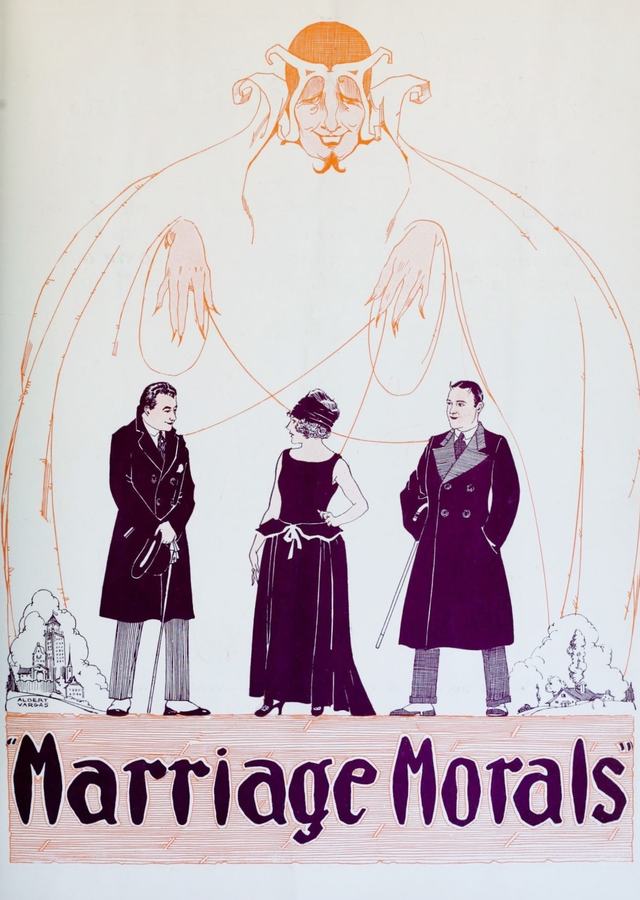
Marriage Morals arrives as a silent‑era parable, a study in the corrosive allure of wealth juxtaposed against the earnest yearning for genuine affection. Director William Nigh orchestrates a tableau where the opulent mansions of Harry Ryan (Harry T. Morey) become both sanctuary and prison, while the modest beauty‑shop of Mary Gardner (Florence Billings) radiates an unpretentious vitality that the affluent protagonist cannot resist.
The film’s narrative unfolds in three distinct acts, each delineated by a shift in visual tone and symbolic color palette. The opening act, suffused with lavish set pieces, establishes Ryan’s reckless spending—a motif underscored by recurring shots of glittering champagne glasses and the incessant clinking of gold coins. Mary’s entrance, framed against a muted backdrop of pastel walls, immediately signals a thematic contrast: simplicity versus extravagance.
As the romance matures, Nigh employs a series of close‑ups that capture Mary’s tentative smile and Ryan’s fleeting glances, suggesting an intimacy that is more performative than substantive. The marriage ceremony itself, captured in a single, sweeping crane shot, is both a celebration and a foreshadowing of the impending disintegration. The camera lingers on the exchange of rings—a visual metaphor for the cyclical nature of promises that are destined to be broken.
Harry T. Morey delivers a nuanced performance, balancing the bravado of a spendthrift magnate with the vulnerability of a man haunted by his own excess. His physicality—grand gestures, a swaggering gait—conveys an external confidence that belies an internal void. When the narrative pivots to his bedridden state, Morey’s restrained pantomime—eyes glazed, hand trembling—evokes a palpable sense of loss, rendering his downfall not merely financial but existential.
Florence Billings’ portrayal of Mary is a masterclass in understated expressiveness. She conveys resilience through subtle shifts— a tightened chin, a lingering gaze—without resorting to melodramatic excess. Her departure from Ryan’s mansion is filmed through a series of long shots that emphasize the emptiness of the corridors she walks, reinforcing her isolation amidst opulence.
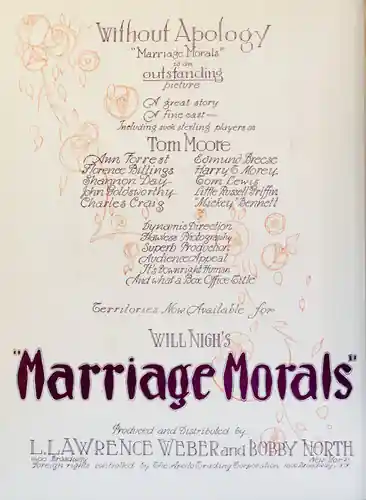
The climactic revelation—that Mary’s return and the subsequent reconciliation are but a dream induced by the reading of J. C. Black’s Marriage Morals—functions as a meta‑commentary on the didactic literature of the 1920s. Nigh’s decision to blur the line between subconscious yearning and tangible action invites the audience to question the authenticity of moral redemption. The dream sequence is rendered in a wash of sea‑blue tint (#0E7490), a visual cue that distinguishes it from the film’s more saturated reality.
Cinematographer Ben Hendricks Jr. employs chiaroscuro lighting to accentuate the moral dichotomies at play. The opulent interiors are bathed in warm, amber hues, while Mary’s modest world is illuminated with soft, diffused daylight. The strategic use of shadows during Ryan’s moments of excess serves as a visual metaphor for the darkness that greed engenders.
The film’s editing rhythm mirrors the protagonist’s emotional turbulence. Rapid cuts accompany scenes of gambling and revelry, whereas lingering takes dominate the introspective moments between Mary and Ryan. This juxtaposition creates a kinetic tension that keeps the viewer emotionally invested.
When placed alongside contemporaneous works such as The Barnstormers and Determination, Marriage Morals distinguishes itself through its introspective focus on marital dynamics rather than external adventure. While The Barnstormers revels in kinetic spectacle, Nigh’s film opts for a slower, contemplative pace that rewards patient observation.
The moralistic underpinnings echo those found in Diamonds and Pearls, yet Nigh refrains from the overt didacticism that plagues many of its peers. Instead, he embeds the cautionary message within the characters’ lived experiences, allowing the audience to infer the consequences of unchecked indulgence.
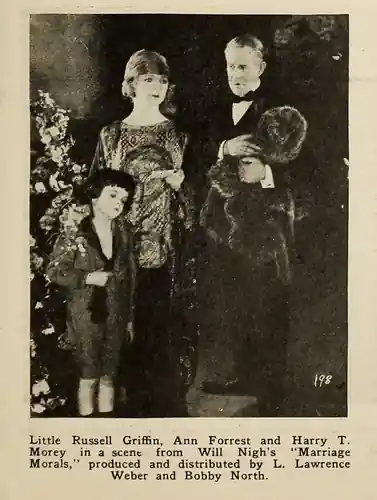
The supporting cast—Tom Moore as the steadfast confidant, Russell Griffin as the cynical bartender, and John Goldsworthy as the patriarchal figure—provide textured layers that enrich the central narrative. Their interactions, often delivered through expressive pantomime, underscore the silent era’s reliance on physical storytelling.
Though silent, the film’s original score, reconstructed from period sheet music, utilizes a recurring motif in minor key that swells during Ryan’s downfall, juxtaposed with a hopeful major theme that surfaces during Mary’s moments of resolve. This auditory duality reinforces the film’s central tension between despair and redemption.
At its core, Marriage Morals interrogates the sustainability of relationships founded on material allure. In an era where consumerism continues to shape personal connections, the film’s cautionary narrative resonates with contemporary audiences. The dream revelation serves as a reminder that moral introspection often occurs in the private chambers of the mind, away from public spectacle.
Moreover, the film anticipates later cinematic explorations of marital disillusionment, prefiguring the thematic concerns of works like Diane of the Green Van and Polly of the Storm Country. Its influence can be traced through the evolution of domestic drama in early American cinema.
The production design, overseen by Russell Griffin, juxtaposes the extravagance of Ryan’s mansion—crystal chandeliers, gilded furniture—with the modest, functional aesthetics of Mary’s workplace. Costumes reflect this dichotomy: Ryan’s silk tuxedos contrast sharply with Mary’s simple, earth‑toned dresses, visually reinforcing their disparate social strata.
While Marriage Morals has not achieved the mainstream notoriety of some of its silent‑era counterparts, its preservation by the Library of Congress ensures that scholars and enthusiasts can continue to dissect its layered narrative. Restorations have highlighted the film’s original tinting, allowing modern viewers to experience the deliberate sea‑blue dream sequences as intended.
In conclusion, Marriage Morals stands as a compelling artifact of early 20th‑century American cinema—a film that marries moral instruction with artistic ambition. Its intricate character work, visual symbolism, and daring narrative twist render it a worthy subject of study for cinephiles and historians alike.
IMDb 6.2
1915
Community
Log in to comment.