DbcultAccessing Vault...
Cult Review
Senior Film Conservator
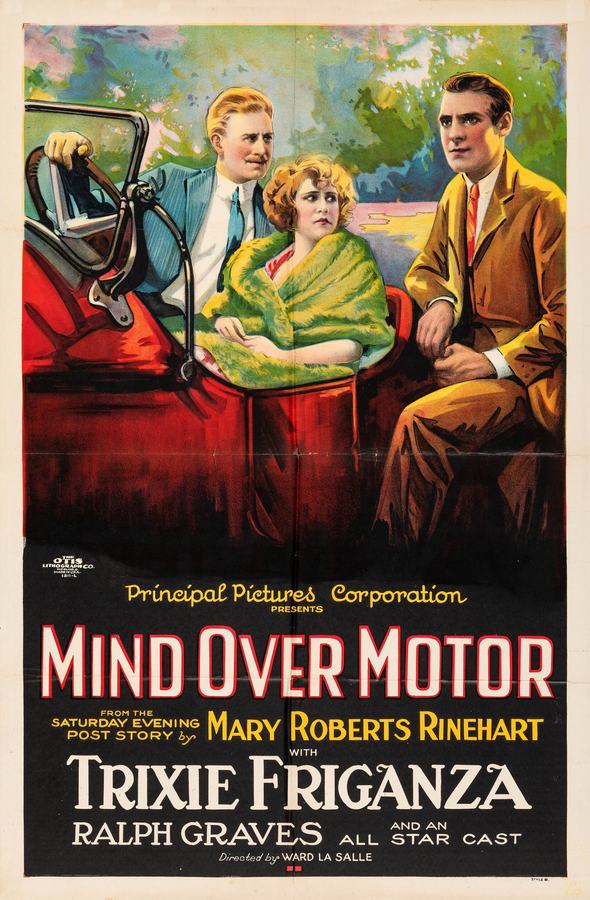
When the roaring twenties roared louder, the silver screen began to echo the thunder of engines, and Mind Over Motor emerged as a kinetic ode to ambition, deception, and unexpected heroism. Directed by the collaborative pen of Bennett Cohen, H. Landers Jackson, and Mary Roberts Rinehart, the film fuses melodramatic intrigue with the visceral excitement of early motor racing, a combination rarely achieved in the silent era.
Ellis (Larry Steers) operates as the archetypal promoter, a man whose polished veneer conceals a web of corruption. He lures Tish (the effervescent Trixie Friganza) into financing a race, painting the venture as a philanthropic gesture. Tish’s characterization is a study in paradox: outwardly frivolous, yet internally driven by a fervent love for automobiles that borders on obsession. This "automaniac" label, while seemingly pejorative, becomes a badge of empowerment as the plot unfurls.
Jasper McCutcheon (Ralph Graves), Tish’s steadfast friend, embodies the earnest competitor. His imminent victory is abruptly snatched away by Ellis’s hired muscle, a narrative twist that underscores the film’s critique of capitalist exploitation. The sheriff’s ultimatum—"win the race or face conspiracy charges"—propels Tish into the driver’s seat, both literally and metaphorically.
In an era when women were often relegated to passive roles, Tish’s decisive plunge into the race car shatters expectations. Her triumph is not merely a personal victory; it is a cinematic assertion that agency can be seized even within a patriarchal framework. This motif reverberates through contemporary works such as A Modern Mother Goose, where female protagonists also subvert societal norms.
Ellis’s downfall, precipitated by his own machinations, serves as a cautionary tale about the perils of unchecked ambition. The sheriff, initially an antagonist, transforms into a reluctant ally, illustrating the fluid morality that pervades early 20th‑century cinema.
Trixie Friganza delivers a performance that oscillates between comedic timing and raw determination. Her expressive eyes convey a spectrum of emotions without the crutch of dialogue, a testament to her seasoned stage background. Ralph Graves, as Jasper, offers a stoic counterbalance, his restrained demeanor amplifying the shock of his forced ejection.
Supporting actors—Lucy Handforth, Pietro Sosso, Edward Hearn, and Clara Horton—populate the racetrack with vivid caricatures, each contributing to the film’s textured tableau. Notably, George Guyton’s turn as the sheriff injects a begrudging gravitas, while Grace Gordon’s brief appearance adds a touch of domestic normalcy that underscores Tish’s radical departure from tradition.
The cinematographic choices merit particular praise. The camera follows the racing sequences with kinetic energy, employing rapid cuts and low‑angle shots that simulate the wind‑blown rush of a 1920s speedway. The use of chiaroscuro—deep shadows against the stark, black‑tinted backdrop—heightens the drama, while occasional flashes of yellow (#EAB308) in the title cards echo the flare of gasoline‑lit headlights.
The film’s palette, though constrained by monochrome technology, is subtly hinted at through set design. The rust‑red of the racing cars, the dark orange (#C2410C) of Ellis’s suit, and the sea‑blue (#0E7490) of the sheriff’s badge are suggested through costuming and lighting, inviting the audience to fill in the chromatic gaps with imagination.
When placed beside other silent thrillers like The Gates of Doom or the comedic romp What's Wrong with the Women?, Mind Over Motor distinguishes itself through its fusion of sport and social commentary. While The Gates of Doom leans heavily on supernatural dread, and What's Wrong with the Women? revels in farcical misunderstandings, this film anchors its tension in the tangible world of competition and the intangible realm of personal agency.
The film also shares thematic DNA with The Strong Way, where perseverance against systemic oppression forms the narrative spine. Both movies employ the motif of a protagonist confronting a corrupt establishment, yet Mind Over Motor does so on a racetrack, a literal arena of speed and risk.
The trio of writers—Cohen, Jackson, and Rinehart—craft a screenplay that balances brisk pacing with nuanced character beats. The exposition is economical; Ellis’s scheming is revealed through visual cues rather than expository intertitles, preserving the film’s momentum. The climactic race sequence is meticulously staged, each lap representing a crescendo of tension that mirrors Tish’s internal transformation.
The resolution, while satisfying, avoids melodramatic excess. Tish’s victory is depicted not as a triumphant fanfare but as a quiet, resolute crossing of the finish line, underscored by a soft fade to black that leaves the audience contemplating the cost of ambition.
Although Mind Over Motor has languished in relative obscurity compared to contemporaneous blockbusters, its influence resonates in modern depictions of women in motorsport, such as the biopic Rush and the documentary series Fastest Women. The film’s early advocacy for gender parity on the track predates the feminist movements that would later champion such causes.
For cinephiles seeking a glimpse into the silent era’s capacity for progressive storytelling, this film offers a rare blend of thrills and social insight. Its preservation status remains uncertain, prompting a call for archival efforts to safeguard this cultural artifact.
In sum, Mind Over Motor is a kinetic masterpiece that transcends its modest budget and era-specific constraints. It delivers a compelling narrative, robust performances, and a visual language that captures the exhilaration of early auto racing. Its thematic daring—particularly in foregrounding a woman’s agency within a male‑dominated arena—renders it a noteworthy study for scholars and enthusiasts alike.
IMDb 6.6
1923
Community
Log in to comment.