DbcultAccessing Vault...
6.7/10
Senior Film Conservator
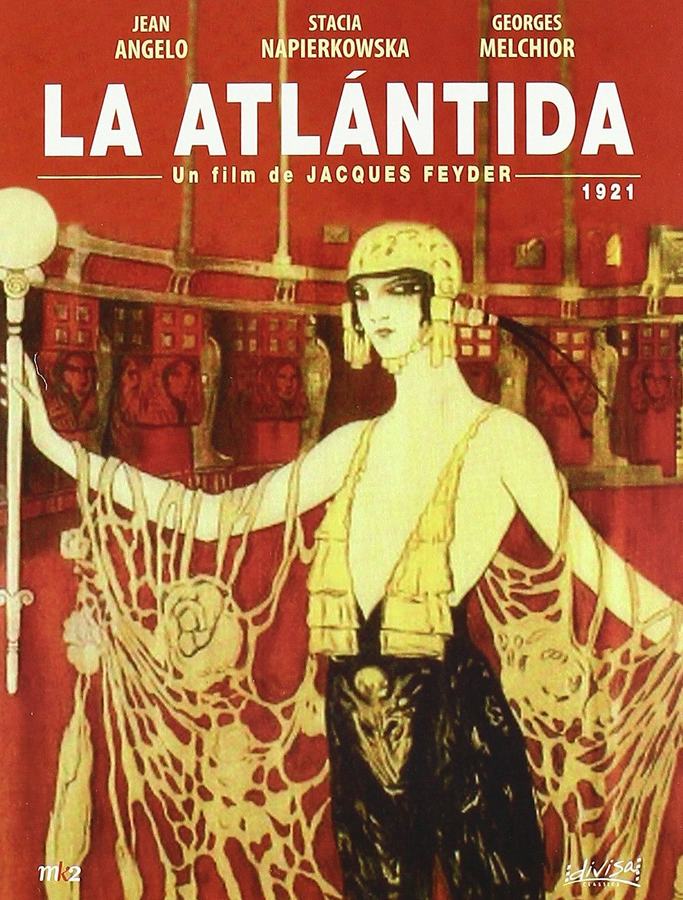
A definitive 6.7/10 rating for a film that redefined the boundaries of cult cinema. Missing Husbands remains a cornerstone of transgressive art.
The first time I encountered Missing Husbands I was nursing a cracked 16-mm print in a Montmartre cellar that smelled of vinegar and Gauloises; the projector’s claw kept shredding the sprockets, yet every mutilated frame glowed like a garnet—an appropriate baptism for a film that treats memory as lacerable celluloid.
Jacques Feyder, still two years shy of directing Carnival in Flanders, here orchestrates a mirage so potent it feels less like a narrative than like heatstroke inscribed on nitrate. Pierre Benoît’s bestselling novel L’Atlantide had already been filmed once in 1919, but Feyder refuses archaeological fidelity; instead he excavates the subconscious strata of the book, dissolving colonial bravado into hallucination.
Plot, in any conventional sense, evaporates by reel two. What remains is a diaphanous choreography of gazes: the husbands look at the desert, the sand looks back; they look at Antinea, Antinea looks through them. Cinema becomes ophthalmology.
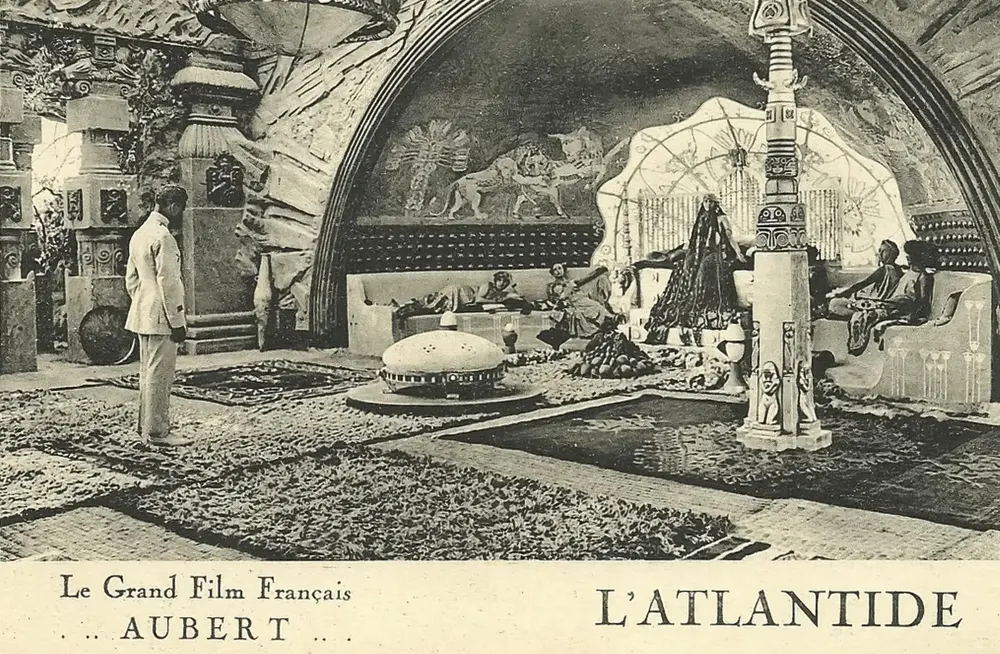
The casting itself feels like sleight of hand. Cristiane Mancini—Italian prima ballerina turned actress—incarnates Antinea with the languid carnality of a panther napping on marble. She never rushes a gesture; her eyelids operate like guillotines on the men’s past. Opposite her, Émile Daltour and René Lorsay embody distinct archetypes of masculine fragility: Daltour angular, fevered, a compass needle spinning without magnetic north; Lorsay stocky, grounded, his beard a futile hedge against emasculation.
Georges Specht—credited as Georges Melchior—photographs the Sahara as if it were a studio of liquid chrome. Night scenes were clearly shot day-for-night, then bathed in cyan toner, producing lunar silhouettes that ripple like reflections on mercury. The result is a chimeric texture somewhere between Eugène Atget’s Paris and a Gustav Doré engraving dissolved in absinthe.
Feyder’s visual lexicon anticipates expressionism yet never succumbs to its angular cynicism. Instead of Caligari’s cardboard hysteria, we get cyclopean horizons, negative space rendered as moral vertigo. In one staggering iris shot, the frame closes around Antinea’s pupil until the screen becomes a black planet ringed by gold—an eclipse that swallows the spectator along with the husbands.
Intertitles—often maligned in silent cinema—here operate like incantations. ‘Le désir est un sable qui boit les os’ (‘Desire is a sand that drinks the bones’) appears superimposed over a dolly-in on a skull half-submerged in dust, the words themselves vibrating as though carved on a tuning fork. Translator Paul Franceschi allegedly spent three weeks perfecting the French, only for distributors to hack the text in export prints; surviving shards suggest linguistic haiku lost to philistine scissors.
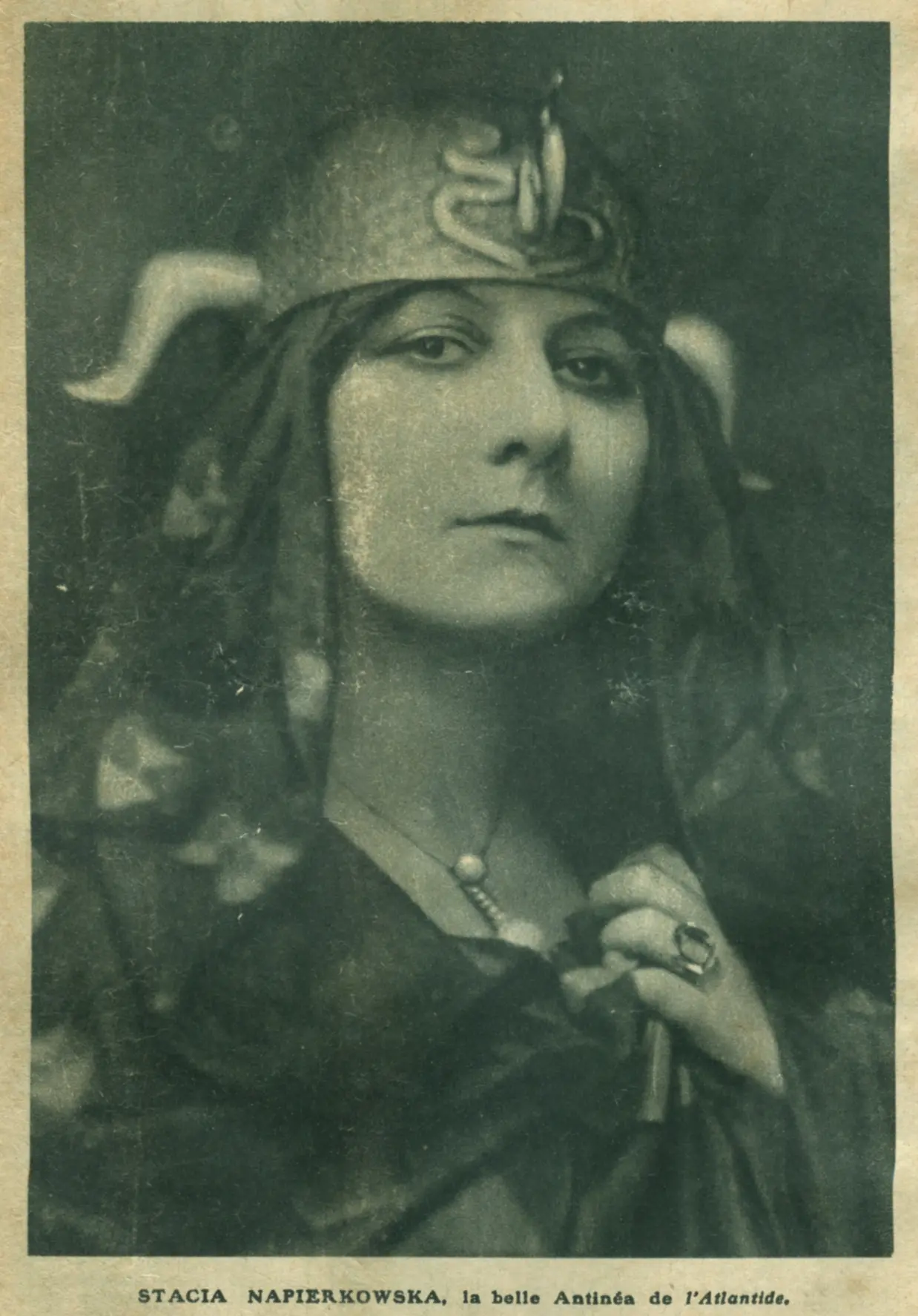
Sound, of course, was never part of the original contract, yet the film’s current restoration on Arte invites composers to court. I recommend cranking Erik Satie’s Gnossiennes at half-speed while watching; the dissonance syncs uncannily with Stacia Napierkowska’s serpentine dance, performed in a sarcophagus-niche lit by magnesium flares.
Modern viewers will flinch at the orientalist residue: turbaned warriors genuflecting before a half-naked white queen, the Sahara rendered as blank canvas for European neurosis. Yet Feyder complicates the power dynamic; Antinea’s empire is not conquered land but psychic quicksand. The husbands arrive armed with cartographic certitude and leave sans memory, identity, even footwear. Imperial masculinity is un-manned not by force but by erasure.

Compare this sexual-political ricochet with Alice Joyce’s proto-feminist revolt in The Sporting Duchess, where the heroine wields a riding crop instead of mythology; Feyder’s queen needs no whip—she owns the archive of forgetting.
Mancini’s Antinea never raises her voice above a murmur, yet the men lean in as though she bellows through conch shells. Watch her fingers when she offers the silver chalice: they tremble imperceptibly, betraying that immortality bores her. That microscopic twitch—caught in extreme close-up—humanizes the myth, prefiguring Marlene Dietrich’s weary sensuality in Shanghai Express.
Among the husbands, André Roanne provides the film’s moral anchor. His character, Lieutenant Morhange, clutches a pocket diary the way penitents grip rosaries. In the climactic sand-moth deluge, the diary flies open; pages shred into hieroglyphs that reassemble as desert constellations—a visual coup that anticipates the cosmic montage of 2001 by nearly five decades.
Fernand Ledoux—later celebrated for Le Corbeau—appears briefly as a blind minstrel strumming a single-stringed rebab. His milky eyes reflect Antinea’s silhouette, suggesting that even sightlessness cannot evade her surveillance.
Today’s algorithmic rabbit holes—TikTok spirals, doom-scrolling—echo the film’s labyrinthine corridors, each swipe an act of voluntary amnesia. Antinea’s palace is the original infinite scroll: every doorway refreshes new erotic content while erasing prior tab history. No wonder the husbands emerge with identity amputated; they are early victims of data colonialism, their memories mined like rare earth.
Feyder intuited that modernity’s peril is not censorship but saturation. In an age where cinephilia itself turns fandom into compulsive archiving, Missing Husbands warns that to collect is to be collected, to map is to be swallowed by the map.
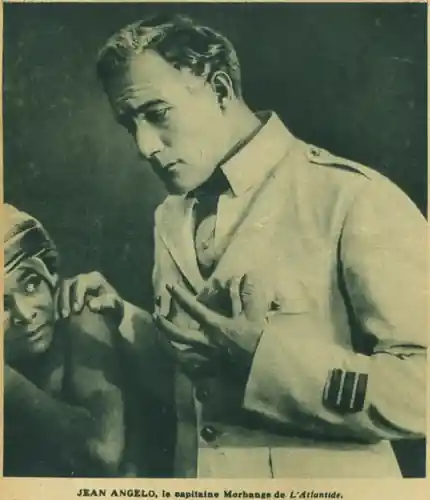
For decades the film was presumed lost, a casualty of WW2 nitrate salvage drives. Then in 1987 a sole, vinegar-syndrome riddled copy surfaced in a Sao Paolo asylum—apparently screened for psychiatric patients as occupational therapy. The Brazilian Cinemateca performed triage: re-hydrated the stock, duplicated onto polyester, but the final reel dissolved mid-transfer. What circulates today is a 73-minute fragment, bridged by stills and translated intertitles reconstructed from censorship records in Madrid.
Even mutilated, the film detonates. The missing reel—detailing the husbands’ attempted flight—survives only in a scrawled continuity by critic Irma Perrot, discovered inside a 1923 program at a Clermont-Ferrand flea market. Her synopsis ends on an imperative: ‘Il faut imaginer Sisyphe heureux de ne plus se souvenir’—a riff on Camus avant la lettre.
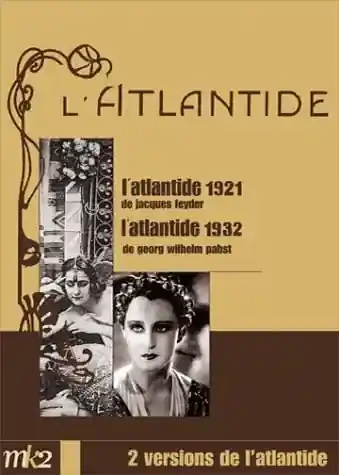
Place Missing Husbands beside contemporaneous desert hallucinations—The Test with its racialized endurance trials—and Feyder emerges proto-post-colonial. Pair it with The Victim, another study in feminine retribution, and you chart a genealogy of early cinema’s anxious negotiation with matriarchal terror.
Within Feyder’s own corpus, the film is the missing link between the earthy Flemish humanism of Carnival in Flanders and the nocturnal fatalism of Pension Mimosas. Without Atlantis, there is no Mimosas.
I have watched this film on a Moviola in July heat, the bulb roasting the frame until it smelled like burnt thyme. I have watched it on a 4K scan in an air-conditioned archive, pixels so sterile they squeaked. Neither experience trumped the other, because Missing Husbands is not a relic to be mastered; it is a sandstorm that masters you.
If you exit the screening remembering your own name too clearly, you have mis-watched. The film’s greatest gift is its capacity to steal coordinates, leaving you stranded between who you were and who you might become—an unmapped expanse where perhaps, like Antinea’s discarded lovers, you will finally hear the echo of your own footsteps vanishing into dune after dune after dune.
For further fever-dreams, chase Twin Bed Rooms or Indiscreet Corinne—but none will abduct you quite like the queen beneath the sand.
IMDb —
1921
Community
Log in to comment.