DbcultAccessing Vault...
Cult Review
Senior Film Conservator
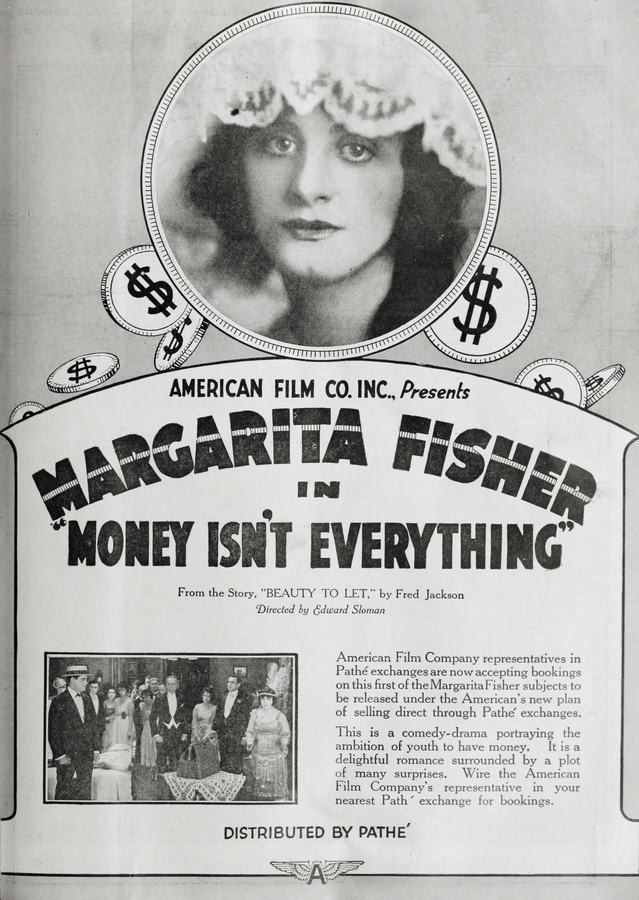
Ah, the silent era! A time when storytelling relied on the sheer power of visual narrative, the emotive range of its stars, and the subtle dance of intertitles. It was a period of grand gestures, dramatic flourishes, and often, surprisingly nuanced social commentary. Among the myriad films that flickered across screens a century ago, Money Isn't Everything (1918) emerges as a fascinating artifact, a romantic comedy-drama that, despite its somewhat quaint premise by modern standards, resonates with themes that remain remarkably pertinent today: the commodification of beauty, the deceptive allure of wealth, and the eventual triumph of genuine affection and intellect over superficiality. Directed by William Parker and penned by Parker himself alongside Frederick J. Jackson, this film, starring the luminous Margarita Fischer and the earnest Wedgwood Nowell, offers more than just period charm; it provides a window into societal values and anxieties of its time, while still managing to entertain and provoke thought.
The narrative unfurls with Margery Smith (Margarita Fischer), a woman whose fortunes have taken a decidedly southward turn, seeking financial counsel from lawyer Franklyn Smith (Wedgwood Nowell). Ironically, Franklyn, despite his outwardly prosperous demeanor, finds himself in an equally precarious financial bind. It's a classic setup, immediately establishing a shared vulnerability between our protagonists, albeit one initially unrecognized by Margery. Franklyn, struck by Margery's undeniable beauty, devises a scheme that is both audacious and, frankly, ethically murky: the creation of 'Beauty to Let.' This enterprise offers Margery's chaperoned company at social functions—dances, teas—to lonely gentlemen willing to pay for her captivating presence. The catch? Franklyn, in a moment of patronizing shortsightedness, forbids her to speak, convinced that her intellect is as barren as his bank account. This conceit, that beauty and brains are mutually exclusive, forms the central, delightful irony of the film.
The 'Beauty to Let' corporation, against all cynical expectations, proves to be a resounding success. Margery's ethereal charm captures the attention of the city's elite, most notably two wealthy scions: Henry P. Rockwell and the aptly named 'Diamond Tim' Moody (Jack Mower and J. Morris Foster, respectively). Both men, captivated by Margery's silent allure, propose marriage. Here, the film begins to explore the dangerous waters of objectification, portraying Margery as a prize to be won, her true self obscured by Franklyn's restrictive mandate. It's a theme that echoes in other silent era films grappling with women's roles, perhaps with a less cynical edge than The House of Mirth, but certainly touching upon similar societal pressures that commodify feminine presence.
As the plot thickens, Margery finds herself in an emotional predicament far more complex than her initial financial woes. She has, against the transactional nature of their arrangement, fallen deeply in love with Franklyn. This blossoming affection is immediately tested by the revelation that Franklyn has purchased bachelor's quarters from 'Diamond Tim' Moody. This seemingly innocuous detail quickly morphs into a pivotal plot point when it's discovered that Tim, a character whose moral compass points decidedly south, has forged the deed to the property. This introduces a tangible threat to Franklyn's burgeoning financial stability and, by extension, to Margery's hopes for a genuine future with him.
The film then pivots into a thrilling, almost caper-like sequence. Margery, driven by her love for Franklyn and her keen, if previously unacknowledged, intelligence, sneaks into Tim's room, intent on retrieving Franklyn's money and exposing the forgery. However, in a classic cinematic misunderstanding, Franklyn discovers her, misconstruing her intentions entirely. He sees not a savior, but a thief, or worse, someone complicit in Tim's deceit. This moment of dramatic irony is beautifully executed, relying on the actors' ability to convey complex emotions without dialogue, a hallmark of silent film excellence. The anguish on Fischer's face and the confusion mixed with betrayal on Nowell's are palpable, drawing the audience into their emotional turmoil. This kind of miscommunication, fueled by a character's hidden motives or actions, can be seen in other contemporary works like The Secret Game, where hidden truths drive much of the narrative tension.
Margarita Fischer delivers a performance that transcends the 'damsel in distress' archetype, injecting Margery with a quiet resilience and an innate intelligence that eventually shines through. Her initial portrayal as a demure, silent beauty is expertly contrasted with her later actions, revealing a woman of quick wit and moral fortitude. This transformation is crucial to the film's message, challenging the very premise of Franklyn's 'Beauty to Let' scheme. Fischer's nuanced expressions and graceful movements convey a world of unspoken thoughts, making her character's journey from object to agent truly compelling. One might draw parallels to characters like those in The Girl Who Didn't Think, where female protagonists often navigate societal expectations that limit their perceived intellectual capabilities, only to prove them wrong.
Wedgwood Nowell's Franklyn is equally complex. Initially portrayed as a pragmatic, somewhat cynical lawyer, his character undergoes a significant evolution. His initial attraction to Margery is purely superficial, his plan born of desperation and a misjudgment of her depth. His slow realization of her true worth, culminating in the understanding that she is 'bright as well as beautiful,' forms the emotional core of the film. Nowell skillfully portrays Franklyn's internal struggle, his initial arrogance giving way to genuine admiration and love. His arc is one of enlightenment, a testament to the film's titular message. The chemistry between Fischer and Nowell, though unspoken for much of the film, builds subtly, relying on longing glances and shared moments of tension and relief.
'Diamond Tim' Moody, played by J. Morris Foster, serves as the archetypal villain, a symbol of the corrupting influence of unchecked avarice. His forgery of the deed underscores the film's exploration of financial ethics and the lengths to which some will go for monetary gain. His character provides the necessary external conflict, driving Margery's heroic actions and Franklyn's eventual redemption. Jack Mower's Henry P. Rockwell, while less central, adds to the tapestry of suitors, highlighting the superficial allure of Margery's 'marketable' beauty.
The central theme of Money Isn't Everything is, unsurprisingly, encapsulated in its title. The film deftly argues that true value lies not in material wealth or superficial beauty, but in integrity, intelligence, and genuine affection. Franklyn's initial belief that Margery's silence is an asset, a way to prevent her supposed intellectual deficiencies from deterring potential clients, is systematically dismantled throughout the narrative. Her actions, born of loyalty and courage, ultimately prove her to be far more valuable than any 'beauty to let' scheme could ever quantify.
This exploration of appearance versus reality is particularly potent. The film critiques a society that often prioritizes outward presentation over inner substance, a commentary that remains strikingly relevant. We see characters blinded by the dazzling prospect of wealth, willing to compromise their ethics, or to objectify others, in its pursuit. The journey of Margery and Franklyn is one of peeling back these layers of societal expectation and personal misconception to reveal a more profound truth. This thematic exploration of wealth and its corrupting influence, or its inability to buy true happiness, is a recurring motif in cinema, seen in films like The Almighty Dollar, which similarly scrutinizes the grip of money on human lives.
Moreover, the film touches upon the agency of women in a patriarchal society. While Margery initially operates under Franklyn's restrictive rules, her eventual defiance and proactive role in resolving the crisis assert her independence and intellectual prowess. It's a subtle but powerful message about female empowerment, demonstrating that a woman's worth extends far beyond her physical attributes, a sentiment that resonates with the burgeoning feminist movements of the early 20th century. This aspect makes the film a compelling companion piece to works that challenged traditional gender roles, perhaps less overtly than some, but effectively through character development.
William Parker's direction is straightforward yet effective, allowing the performances and the narrative twists to shine. The pacing is well-maintained, building suspense and comedic relief in equal measure. The use of intertitles is judicious, providing necessary exposition without overwhelming the visual storytelling. The screenplay by Parker and Frederick J. Jackson is commendably structured, setting up clear stakes and delivering satisfying resolutions. The plot, while relying on some classic silent film tropes—the misunderstanding, the last-minute rescue—weaves them together with a fresh perspective, especially concerning Margery's character arc.
The film's visual style, while typical of its era, effectively conveys the social milieu. The opulent settings of the dances and teas contrast sharply with Margery's initial straitened circumstances, visually reinforcing the film's thematic concerns about class and wealth. The cinematography, though perhaps not groundbreaking, serves the story admirably, capturing the emotional nuances of the actors' performances.
When considering Money Isn't Everything in the broader context of silent cinema, it stands as a solid example of how popular entertainment could also carry significant social commentary. It might not possess the epic scale of The Life of Richard Wagner or the fantastical elements of The Extraordinary Adventures of Saturnino Farandola, but its intimate focus on character and moral dilemmas gives it an enduring appeal. It shares a certain spirit with films like Gambler's Gold, where characters navigate risky propositions, though here the 'gamble' is more on human nature and perception than literal cards or dice.
The film's resolution, where Margery and Franklyn outwit Tim and Franklyn proposes, is deeply satisfying. It's not merely a happy ending, but a validation of Margery's intelligence and a testament to Franklyn's growth. His realization that his partner is 'bright as well as beautiful' is the true climax, signifying a shift from objectification to genuine respect and admiration. This kind of redemptive arc, where initial misjudgments are corrected by the protagonist's actions, is a powerful and timeless narrative device.
In conclusion, Money Isn't Everything is more than just a relic of a bygone cinematic era; it is a charming, insightful, and surprisingly relevant film that continues to speak to contemporary audiences. Its exploration of wealth, beauty, and intellect, wrapped in a engaging romantic drama, makes it a compelling watch for anyone interested in silent film or timeless human stories. Margarita Fischer and Wedgwood Nowell deliver memorable performances, imbuing their characters with depth and relatability. The film serves as a gentle reminder that while money can open doors, it cannot purchase true happiness, respect, or love, and that often, the greatest treasures are found beneath the surface, waiting to be recognized and cherished. Its message, delivered with elegance and a touch of wit, ensures its place as a minor but significant gem in the annals of early cinema, reminding us that some truths are, indeed, eternal. Much like the nuanced romantic entanglements found in Castles for Two or the moral quandaries of For $5,000 a Year, this film transcends its simple premise to deliver a profound and heartfelt narrative. It's a film that quietly asserts the enduring power of character over capital, proving that true worth is, indeed, priceless.

IMDb 6
1926
Community
Log in to comment.