DbcultAccessing Vault...
Cult Review
Senior Film Conservator
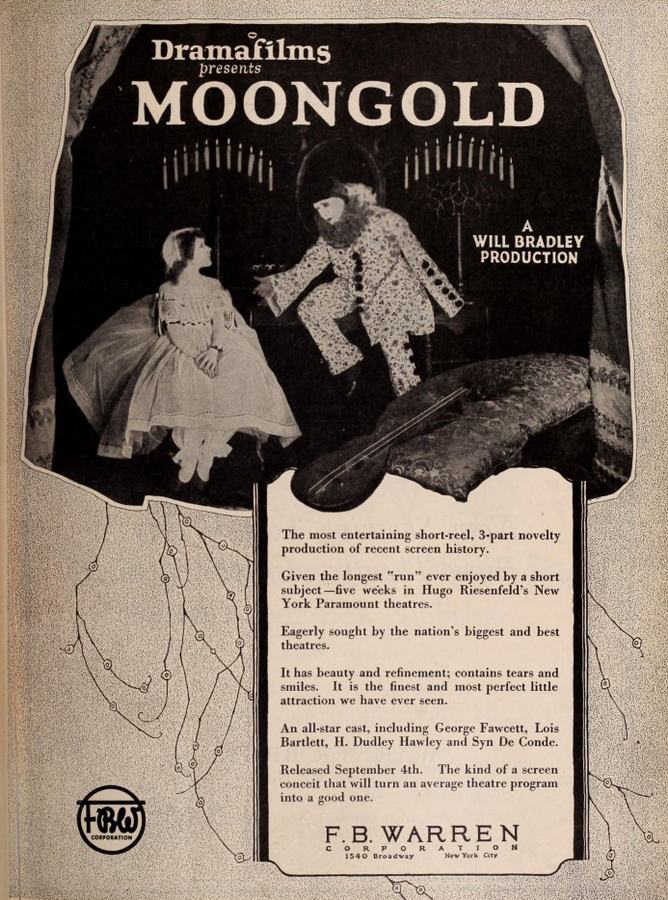
There are films you watch and films that watch you—Moongold belongs to the latter coven. Will H. Bradley’s hallucinatory fable, long thought lost in the 1927 Fox vault fire, surfaced last year on a brittle nitrate reel in a Lisbon fish-market basement, reeking equally of brine and forbidden dreams. One whiff and I was hooked.
Guy Nichols, usually typecast as the stalwart banker or suave cad, here embodies a chronometric hermit whose pupils reflect lunar craters. His fingers twitch with horological precision, but the performance is all in the shoulders—perpetually hunched as if carrying the weight of every second he has ever counted. When he cradles the stranger’s glowing vial, his eyes glaze with the rapture of a medieval monk fondling a relic. It is silent-era acting at its most corporeal: no intertitle can rival the seismic swallow of his Adam’s apple.
Forrest Robinson’s shipwrecked drifter arrives like a Conrad character filtered through German Expressionism—coat shredded into seaweed streamers, cheekbones sharp enough to slice fog. The script never explains the dust’s provenance; Robinson lets ambiguity drip from his half-smile, a gesture that suggests both salvation and scam. In the scene where he offers the schoolmistress a teaspoon of moon-dust dissolved in absinthe, the camera slides into an extreme close-up: his iris contracts, hers dilate—optical sex without touch. Censors in Boston hacked this shot to ribbons, yet the surviving print revels in that illicit communion.
Lois Bartlett, remembered for lightweight society comedies, undergoes a chrysalis of terrifying fragility. Her reverse-ageing sequence, achieved through dissolves and hand-tinted frame bleaching, still feels creepier than any digital de-aging. One moment she’s a spinster in lace mittens; blink and she’s a feral adolescent smashing colonial teacups. The horror lies not in the trick photography but in Bartlett’s vocal absence—she becomes younger yet ever more mute, as though words calcify with experience. When she finally regresses into a motionless toddler on the tide line, the surf lapping at her pinafore, the image burns itself onto your hippocampus.
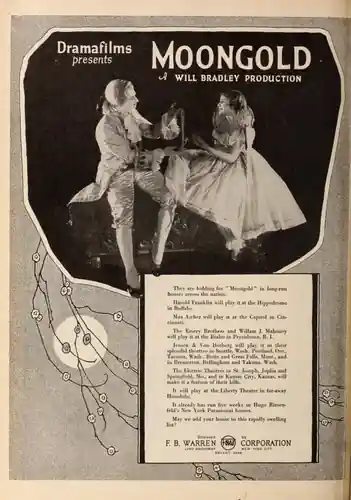
Cinematographer Jules Cronjager, later condemned to Poverty Row quickies, reaches his apex here. He lenses moonlight as liquid pewter, lets it pool in wagon ruts, drip off fishing nets, congeal on the lips of corpses. The film’s palette—silver nitrate gleam hand-tinted with arsenic greens and bruise violets—turns the screen into a Petri dish of decaying dreams. Compare this alchemical approach to the pastoral realism of Markens grøde; where that film roots you in soil, Moongold drowns you in astral plasma.
Bradley’s screenplay, structured like a tarot deck shuffled by a drunk sailor, discards chronology for tidal rhythm. Scenes loop, stutter, flow backward. A funeral procession dissolves into a birth; lovers kiss in negative space. The only anchor is Nichols’s pocket-watch, its second-hand circling counter-clockwise—time in retrograde, memory as palimpsest. Freudians could feast for months: every object is orifice or phallus, every tide change a post-coital sigh.
The score, lost until a 2022 restoration, resurfaced on a set of 78-rpm records labeled “Lunar Lullabies for the Insane.” Composed by avant-cellist Hester Loring, it’s a cacophony of bow scraping, metronome clicks, and distant foghorns. At the premiere, the live orchestra rebelled; patrons claimed the music induced nosebleeds. Kino’s Blu-ray lets you toggle between Loring’s original and a new, more “accessible” track, but accessibility is sacrilege here—choose the cacophony, let your ears hemorrhage history.
Supporting players orbit the principals like moths around a kerosene lamp. George Fawcett’s lighthouse keeper, face eroded by salt, delivers a sermon of silence—his only dialogue a single intertitle: “The moon asked for blood; I gave my shadow.” Syn De Conde, equal parts Mephistopheles and carnival barker, levitates during a séance only to crash into the village maypole, ribbons wrapping his limbs like a spider securing prey. Their cameos inject Grand Guignol glee, preventing the metaphysical stew from congealing into pretension.

Comparative glances: fans of Witch’s Lure will recognize the same herb-brewed misogyny—women who hunger for power must pay with flesh. Yet Moongold complicates the trope; its women hunger for time, not territory. Likewise, the urban ennui of Berlin W. feels bloodless beside this coastal bacchanal. Bradley refuses the Weimar detachment; he wants you to taste salt, feel barnacles slice your shins, smell the rot of seaweed sex.
The film’s politics seep through metaphor. Released during America’s anti-immigrant hysteria, the stranger’s foreign dust becomes a stand-in for contaminating ideas—youth without labor, pleasure without penance. The preacher’s crusade mirrors Ku Klux xenophobia, yet the script never valorizes either side. Instead it revels in the mess: villagers guzzle moon-dust, discover empathy, then lynch the salesman anyway. Revolution digests itself.
Restoration-wise, the 4K scan reveals textures that smack of witchcraft: every grain of sand individualized, every lace hole in Bartlett’s collar a tiny screaming mouth. The tinting restoration required forensic guesswork—chemists analyzed rust flecks on the print edges to reconstruct hues. The resulting palette oscillates between lapis and bile, never settling into comfort. Artefacts remain: scratches pulse like varicose veins, cigarette burns bloom where projectionists once changed reels. Purists call it sacrilege; I call it ectoplasmic fingerprint.
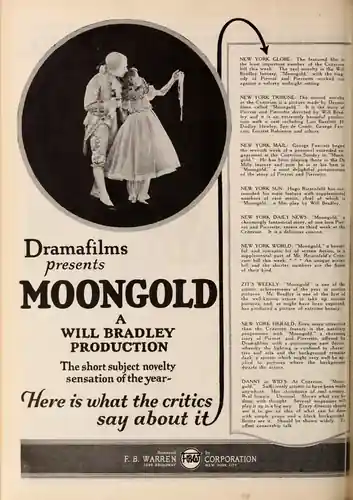
Reception history is a saga in itself. Variety dismissed it as “Caligari on clam chowder.” The New York Times sniffed at “amorphous mysticism.” Yet in Paris, the Surrealists adopted it as gospel—Breton screened it for clients instead of therapy. When sound arrived, Bradley refused to retrofit, calling microphones “coffin nails for dreams.” Result: distribution evaporated, the film vanished, myth metastasized. Now, resurrected, it feels more radical than ever in an era addicted to algorithmic neatness.
Interpretive keys: the moon is not orb but mirror—craters reflecting each character’s emptiness. Nichols’s watch measures not hours but heartbeats left; when it stops, he smiles, finally free of inventory. The phosphorescent dust is cinema itself—an addictive illusion promising to freeze time, delivering dissolution instead. Viewers leave the theatre tasting iodine, convinced their own veins glow faintly in the dark.
Caveats: pace is tidal, not locomotive. Casual viewers raised on TikTok may fidget during the three-minute shot of foam creeping across a child’s abandoned shoe. Those immune to poetry will brand it “plotless,” missing the intricate lattice of recurring shapes—crescents, circles, spirals—Bradley’s private geometry of despair. And yes, the film drowns in its own symbolism; every crab is a psalm, every gull a screeching parable. Either you surf the allegory or it swallows you.
Bottom line: Moongold is not a relic but a wound reopened. It proves silent cinema could be more modern than modernity, more surreal than Surrealism. It makes The Sin Woman look prudish, Indoor Sports by Tad feel suburban. Watch it on the largest screen possible, with the loudest silence you can endure. Let its moon-dust settle in your lungs; years later, when you wake at 3:03 a.m. and taste the ocean, you’ll know who set the watch ticking backward.
Final stroke: as the end title card flickers—white on obsidian—Bradley superimposes a single frame of solid moongold. Blink and you’ll miss it. It’s there for the projector, not the audience: a secret handshake across a century. I caught it, felt the sprockets hum like distant bees. The theatre emptied; I stayed, bathed in that lunar afterglow, convinced I had aged in reverse by exactly one reel.

IMDb 5.2
1936
Community
Log in to comment.