DbcultAccessing Vault...
6.6/10
Senior Film Conservator
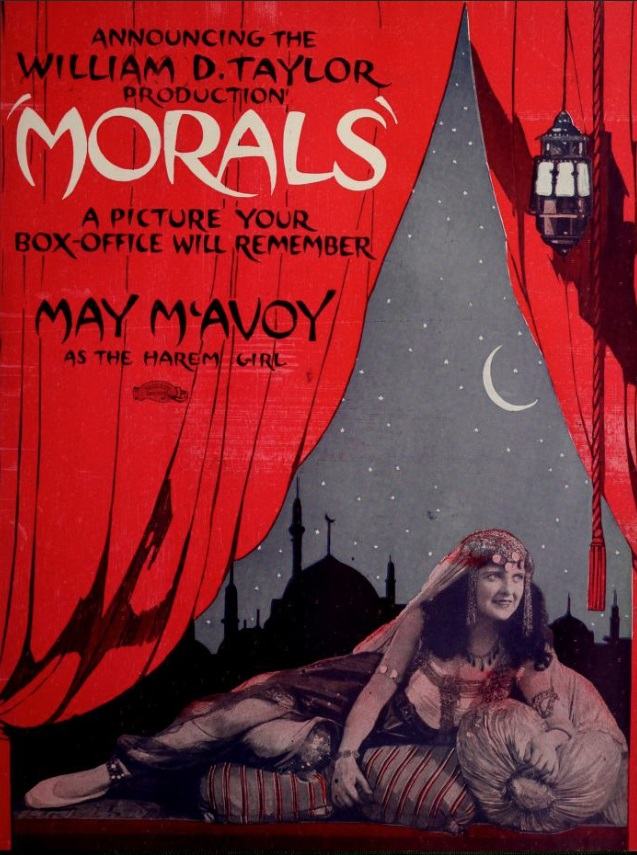
A definitive 6.6/10 rating for a film that redefined the boundaries of cult cinema. Morals remains a cornerstone of transgressive art.
Morals: A Tapestry of Turmoil and Transformation
William J. Locke and Julia Crawford Ivers’ Morals, a 1920s drama that marries the opulence of its era with the raw edges of human vulnerability, is a film that lingers like a half-remembered dream. At its heart lies Carlotta, a character so meticulously rendered by Kathlyn Williams that her silent despair seems to echo beyond the screen. Born into the gilded cage of a Turkish harem, Carlotta’s story is less about escape and more about the relentless pursuit of self-definition in a world determined to mold her into a mere ornament.
The film’s opening act is a masterclass in visual storytelling. The harem’s labyrinthine chambers are bathed in golden hour light, their beauty undercut by the suffocating weight of tradition. Carlotta’s flight to London, spurred by a forced marriage she cannot abide, is less a triumph and more a fracture. Her alliance with an English adventurer—a man whose name history forgets—offers fleeting solace before his untimely death plunges her into destitution. This sequence, though brief, is a testament to the era’s cinematic restraint; the tragedy is conveyed not through melodrama but through the subtle tilt of a hat, the frayed collar of a once-pristine dress.
Enter Sir Marcus Ordeyne (Sidney Bracey), a figure of duality: a man of means yet emotionally impoverished, whose patronage of Carlotta is initially framed as a chivalric gesture. Their dynamic is fraught with tension, a push-and-pull between pity and passion. The script, penned with a deft hand, avoids the trap of romanticizing their bond; instead, it dissects the power imbalances inherent in their relationship. Carlotta’s charm is weaponized against her, a tool to disarm the very man who becomes her savior and, later, her captor.
Judith Mainwaring (Marian Skinner) emerges as the film’s most insidious force. Her manipulation of Carlotta is not born of malice but of fear—a fear that Carlotta’s presence will unravel the carefully curated respectability Judith has clawed out for herself. The scene where Judith insinuates Sir Marcus’s marriage proposal is a calculated act to contain a scandal is a chilling study in emotional warfare. Skinner’s performance is a masterstroke of subtlety; her voice remains measured, her gestures poised, yet the venom beneath the surface is palpable.
The narrative’s second act spirals into moral ambiguity. Carlotta’s elopement with Pasquale (Starke Patteson) is not an act of rebellion but of desperation—a child grasping at any hand that offers stability. Patteson’s portrayal of Pasquale is nuanced; he is neither villain nor hero, but a man caught in the crossfire of others’ ambitions. The chemistry between Patteson and Williams is electric, their scenes together a dance of conflicting desires. Yet, the film never allows this subplot to overshadow the central tragedy: Carlotta’s struggle to reconcile her love for Ordeyne with the need to carve her own path.
The Parisian denouement is where Morals transcends its period trappings to speak to universal truths. The revelation that Ordeyne is still searching for Carlotta is not a twist but a reckoning. The final act, a reunion steeped in mutual vulnerability, is rendered with such aching sincerity that it defies the era’s reliance on stock romantic tropes. Carlotta’s return to Ordeyne is not a surrender but an assertion of her right to be loved unconditionally—a right that the film argues is as fundamental as any cultural tradition.
Technically, the film is a marvel. The cinematography by William P. Carleton (whose name remains a footnote in silent cinema history) bathes the film in a chiaroscuro that mirrors its protagonist’s inner turmoil. The use of negative space in key scenes—Carlotta alone in a grand London drawing room, Ordeyne silhouetted against a stormy sky—elevates the narrative to the realm of visual poetry. The score, though lost to time, must have been a symphony of restraint, allowing the performances to breathe without the crutch of overwrought musical cues.
Comparisons to other films of the era are inevitable. The Woman of Mystery (1920) shares Morals’s fascination with cultural dissonance, yet lacks its emotional depth. Similarly, The Narrow Path (1918) attempts a similar exploration of societal constraints but falters under the weight of its own didacticism. Morals, in contrast, allows its characters to grapple with their flaws organically, resisting the urge to sermonize. This restraint is its greatest strength, rendering the film’s themes of autonomy and fidelity as timeless as they are timely.
Kathlyn Williams’ performance is the linchpin of Morals. Her Carlotta is a study in contrasts: the fragility of a woman raised in isolation juxtaposed with the steel of one who has survived. In a pre-code era, Williams deftly navigates the tightrope between innocence and agency, her expressions a language in themselves. The way she holds a gaze, the tilt of her head when betrayal strikes—these are the moments that define the film’s legacy.
The supporting cast is equally compelling. Sidney Bracey’s Sir Marcus is a revelation, his stoicism cracking in the most unexpected moments—a flicker of hope in an otherwise grim setting. Marian Skinner’s Judith is a masterclass in restrained villainy, her every movement laced with the subtlety of a woman who understands the power of a well-placed word. Even minor characters, like Nick De Ruiz’s enigmatic Pasquale, are given dimension, their arcs serving the film’s larger meditation on love’s capacity to both destroy and heal.
In the pantheon of early 20th-century cinema, Morals stands apart for its refusal to sanitize its characters’ journeys. It is a film that dares to ask uncomfortable questions about the price of survival and the cost of love. The harem, London’s fog-laden streets, and Parisian boulevards are more than settings—they are metaphors for the internal landscapes its characters inhabit. This is a film that understands that morality is rarely black and white, but a spectrum as complex as the human heart.
For modern audiences, Morals is a window into a world where women’s choices were dictated by men’s whims, yet it is also a mirror reflecting our own struggles with identity and autonomy. The film’s enduring relevance lies in its unflinching portrayal of a woman’s resilience—a testament to the idea that true freedom is not found in escape, but in the courage to confront one’s past and choose one’s own destiny.
In conclusion, Morals is more than a period piece; it is a narrative of universal resonance. Its exploration of love’s duality, the clash of cultures, and the indomitable will to survive makes it a cornerstone of early cinema. For those seeking a film that balances aesthetic grandeur with emotional truth, this is an unmissable journey into the soul of a lost world.
IMDb 5.7
1921
Community
Log in to comment.