DbcultAccessing Vault...
7/10
Senior Film Conservator
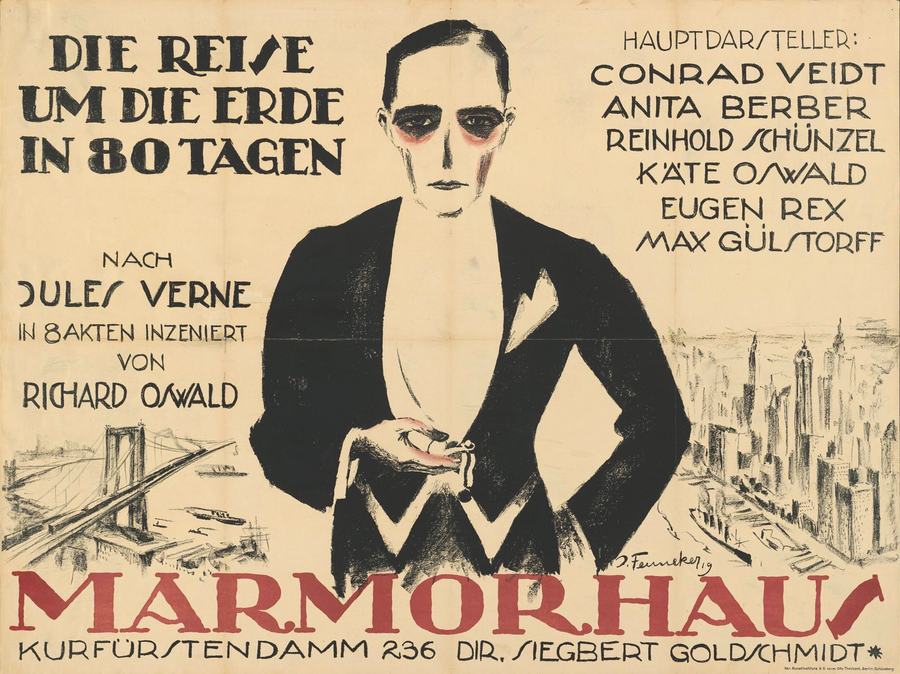
A definitive 7/10 rating for a film that redefined the boundaries of cult cinema. Around the World in 80 Days remains a cornerstone of transgressive art.
Richard Oswald's 1923 interpretation of Jules Verne's seminal novel materializes not merely as adaptation but as temporal cartography—charting the metamorphosis of early cinema itself. The celluloid becomes compass needle, spinning through exotic locales reconstructed in Berlin studios where papier-mâché temples coexisted with functional steam engines. Eugen Rex's portrayal of Phileas Fogg transcends theatrical rigidity; his blinkered precision manifests physically through metronomic gestures—a pocket watch's click made flesh. Observe how his fingers drum arrhythmia only when societal perception threatens his mathematical worldview, a nuance magnified against Conrad Veidt's Inspector Fix, whose pursed lips and predatory stillness evoke The Man Who Was Afraid's psychological tension.
The film's genius blooms in transportation sequences where static cameras transform into kinetic witnesses. Aboard the Mongolia steamer, Oswald employs diagonal framings to accentuate deck tilting during the typhoon—sailors slide diagonally like drunken chess pieces while Passepartout (Max Gülstorff) pirouettes with ropes coiled around his ankles. Such balletic catastrophe contrasts sharply with the claustrophobic cross-cutting during the Indian elephant trek: close-ups of Fogg's sweat-beaded brow alternate with extreme long shots diminishing the caravan against ochre canyons, visually echoing the temporal pressure crushing their mission. When juxtaposed with oceanic stillness in Protea II's maritime sequences, Oswald's restlessness feels revolutionary.
Modern eyes cannot ignore the problematic tableaux vivants of 'foreign' cultures—Hong Kong opium dens swirl with grotesque silhouettes, while Indian villagers prostrate before Fogg like deities. Yet within these cringe-worthy constructs emerges accidental subversion: Anita Berber's cameo as an Indian priestess radiates unsettling agency, her kohl-rimmed eyes dissecting Fogg with anthropological curiosity. The film inadvertently mirrors Europe's imperial anxieties when Sioux warriors (German extras in feathered headdresses) derail the Union Pacific train—a sequence whose chaotic energy predicts The Man from Funeral Range's frontier nihilism. Oswald frames these encounters as obstacle courses rather than cultural exchanges, revealing more about Weimar-era exoticism than Verne's original intent.
Conrad Veidt's Fix operates as the film's chilling counter-rhythm—a specter materializing in train corridors and Cairo bazaars with vampiric persistence. His physicality inverts Gülstorff's elasticity; where Passepartout tumbles, Fix glides. Watch the Yokohama tea house confrontation: Veidt's fingers spider across the table towards Fogg's watch, backlit to cast monstrous shadows recalling The Dagger Woman's expressionist dread. Yet Oswald grants him unexpected pathos—a close-up of Fix's trembling hand hovering over handcuffs as Fogg rescues a orphan in Liverpool suggests self-disgust. This moral wavering prefigures film noir's compromised detectives, transforming pursuit from plot mechanism into psychological autopsy.
The true marvels aren't geographical wonders but Oswald's anthropomorphization of technology. The SS Henrietta's furnace room becomes Hades' forge—stokers' sinews gleam like bronze statues as coal shovels scrape infernal rhythms. Editors construct locomotive symphonies: wheels churning mud, pistons ejaculating steam, telegraph wires humming across landscapes. This mechanized heartbeat crescendos during the American rail sabotage, where Passepartout's trapeze antics on the runaway train car blur into Duchampian motion studies. Unlike The Still Alarm's stationary tension, movement defines existence here—stillness equates to capture or failure.
Rex's performance arc constitutes silent cinema's finest metamorphosis. Early scenes render him geometrically—elbows pinned at 90-degree angles, neck stiff above starched collars. The Suez confrontation with Fix initiates thawing; his first ungloved hand gesture (palms open, fingers splayed) reads as shocking vulnerability. By the American plains sequence, wind ruffles his formerly immaculate hair as he cradles a dying engineer—a Pietà composition foreshadowing Under the Yoke's sacrificial motifs. His romance with Kathe Oswald's Aouda avoids sentimentality through tactile subtlety: a delayed hand withdrawal from hers, a hat adjustment replacing the absent pocket watch ritual. Humanity emerges not through grand gestures but through eroded precision.
Oswald's divergence from Verne proves revelatory. Where the novel mocked British imperialism, the film refracts post-WWI German fragmentation. The Reform Club's wager scene replays Versailles Treaty negotiations—aristocrats carving continents like birthday cake. Fogg's compulsive timing evokes hyperinflation-era trauma, his watch a bulwark against chaos. Even the Bank of England subplot mirrors Weimar conspiracy theories, later echoed in The Marcellini Millions. This contextual layering elevates the film beyond adventure into socio-political allegory—each border crossing mirroring national identity crises.
Gülstorff's interpretation shatters the bumbling servant trope. His introductory scene—calibrating clocks while juggling oranges—establishes him as Fogg's complementary opposite: ordered chaos. Notice how his 'clownish' interventions save their mission: impersonating a Rajah during the suttee rescue (darkly comedic turban wobbling), or sabotaging Fix's warrant in San Francisco through literal pants-down farce. His physical grammar borrows from commedia dell'arte yet anticipates Chaplin's pathos, particularly when comforting a weeping Aouda with shadow puppets—a moment echoing Playthings's tender absurdity. Here, laughter becomes survival tactic against bureaucratic absurdity.
Oswald dismantles Victorian technological utopianism through ironic juxtaposition. That triumphant locomotive pulling into Bombay promptly derails, scattering luggage like offal. The cutting-edge telegraph enabling Fix's manhunt proves useless during the Great Plains blizzard. Most tellingly, Fogg's critical time gain occurs aboard the Henrietta—a vessel he bribes the crew to wreck for fuel, progress literally cannibalizing itself. This ambivalence towards mechanization resonates with My Lady Nicotine's steam-powered anxieties, suggesting industrial acceleration erodes human agency.
The absence of synchronized sound births extraordinary visual acoustics. When Fix interrogates a sailor in Suez, pounding fists coincide with crashing waves outside the porthole—a brutalist percussion. Calcutta's marketplace sequence uses rapid cutting between haggling mouths, drumming fingers, and clinking coins to construct cacophony through montage. Even the celebrated split-screen showing global clocks dissolves into abstraction—pendulums swinging like metronomes conducting an orchestra of time zones. Such techniques surpass Fangen fra Erie Country Tugthus's narrative literalism, embracing cinema's unique sensory alchemy.
Beyond its 1956 remake's Technicolor spectacle, Oswald's vision permeates cinema's DNA. The cross-continent chase blueprint informs everything from The Gorgona's Mediterranean pursuit to Bourne trilogies. More profoundly, its exploration of time's subjectivity—Fogg's chronological rigidity versus Passepartout's experiential time—anticipates Tarkovskian philosophizing. Even the final twist, where gaining a day hinges on planetary rotation, seeds Christopher Nolan's temporal manipulations. Yet its most enduring gift remains the humanist core: beneath goggles and waistcoats, it's a testament to connection—Fix's hand finally clasping Fogg's not with steel but solidarity, travelers recognizing themselves in the other's exhaustion. No Kärleken segrar sentimentality, just hard-won grace.

IMDb 6.5
1926
Community
Log in to comment.