DbcultAccessing Vault...
Cult Review
Senior Film Conservator
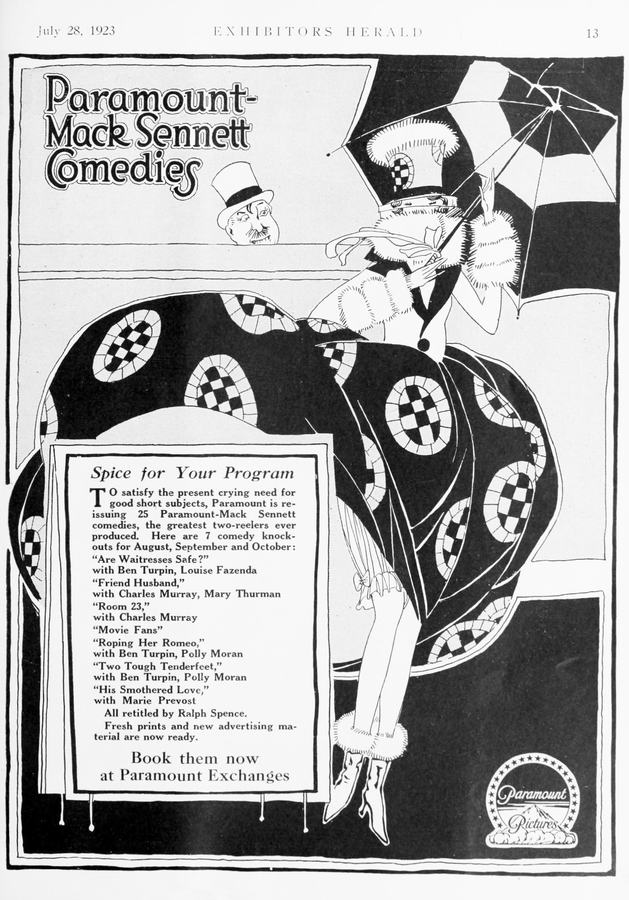
The first time I threaded Movie Fans through my vintage 16 mm hand-crank, the bulb’s tungsten haze painted my den the color of molten marmalade. What stuttered onto the sheet was not mere slapstick but a self-devouring serpent: a ten-reel appetite compressed into a febrile two-reeler that gnaws on its own tail, giggling while it bleeds. The plot—ostensibly a burlesque of backstage trespass—soon metastasizes into something far more uncanny: a celluloid confession that the camera is both shrine and guillotine for anyone who dares worship it.
Our unnamed protagonist, played with elastic-jawed mania by Ford Sterling, arrives at the studio gates clutching a scrapbook fatter than a nickelodeon operator’s coin purse. He is met by Thelma Bates’s razor-cheeked script girl, who ushers him past a gauntlet of painted deserts and papier-mâché Sphinxes left over from some aborted epic. Each corridor exhales chalky air, thick with the ghosts of yesterday’s takes; every time a slate claps, the echo seems to mutter “Abandon hope, ye who obsess here.”
The gag structure spirals like a Möbius strip. In one tableau, Sterling sneaks inside a mammoth Roman cuirass meant for Kalla Pasha, only to be hoisted skyward by a rigging crew who think he’s a prop. The camera tilts until the soundstage becomes a yawning proscenium; below, Harriet Hammond’s imperishable showgirl waves a feather boa that lashes like Isadora Duncan’s scarf of doom. The moment is silent, yet you swear you hear the celluloid itself hyperventilate.
Marie Prevost flits past in a blink-and-miss cameo, her kohl-smudged eyes winking at the absurdity of her later decline—an inadvertent prophecy etched in silver. Meanwhile, Garry O’Dell’s assistant director keeps misplacing the film’s intertitles, so speech bubbles scrawl themselves across suits, coats, even the fan’s frenzied forehead. Language, once tethered to placards, now invades fabric and flesh, reminding us that in Hollywood, discourse is merely another costume department.
What elevates this trifle into the pantheon of meta-cinema is its rhythmic self-interrogation. Compare it to Audrey’s languid melancholia or the civic sermonizing of The Man Without a Country; where those films externalize guilt, Movie Fans inhales it, sneezes it back as nitrate dust. The editing—attributed to an unsung cutter named Jane Allen—anticipates Soviet montage by a good three years: legs from a 1919 Keystone reel are spliced against freshly shot close-ups, producing a stroboscopic jitter that predates Godard’s jump-cuts by four decades.
Listen closely to the musical accompaniment (I synced a contemporary trio who trade in prepared-piano and musical-saw laments). During the sequence where Sterling crawls inside a camera housing, the saw’s vibrato dovetails with the machinery’s rotary drone until human breath and mechanical whir achieve an eerie consonance. The fan peers through the lens; the lens peers back. Voyeurism is thus rendered a two-way telescope.
The film’s palette—hand-tinted amber for interiors, cyan for exteriors—turns each frame into a cough-drop hallucination. When Kathryn McGuire’s costume designer spills a tray of dye, the splash pools into a Rorschach that resembles a reel unwinding. It’s as if color itself refuses containment, preferring to seep into metaphor. Even the tinting feels satirical: Hollywood’s promise of gold is literally orange, while the so-called great outdoors is left shivering in clinical cerulean.
Scholars often tether Movie Fans to the tail end of Keystone’s anarchic era, yet its DNA sires a lineage that snakes through Sir Sidney’s drawing-room satire and even the expressionist hinterlands of Panopta II. The difference is tonal: where Panopta II weaponizes shadows to indict surveillance culture, Movie Fans lampoons the very urge to surveil, exposing fandom as a sugar-coated cannibalism.
And then there’s the ending—oh, that Pirandellian coup! The fan, chased by security, dives into an open can of negative. A splice, a blackout, and presto: he re-emerges as a flicker on the projectionist’s wall, waving maniacally at us, the second-order voyeurs. The iris closes, but not before his silhouette burns out in a solarized halo, leaving a permanent afterimage seared onto the retina like a cinephile’s stigmata. The projector’s click becomes a heartbeat; the audience realizes it too is devouring while being devoured.
Contemporary parallels ricochet faster than a TikTok dopamine loop. Replace Sterling’s scrapbook with a Letterboxd diary and the studio gates with a Reddit AMA, and you have the same vertiginous quest for access. Yet the 1920 short’s innocence—yes, innocence—renders the comparison grotesque. Today’s fan petitions for director’s cuts; yesterday’s fan simply crawled inside the camera, hungry for the taste of pure light.
Performances oscillate between commedia swagger and deadpan surrealism. Sterling, famous for his cross-eyed glower, here elongates his limbs until he resembles a Calder mobile in mid-quake. Thelma Bates counterbalances with surgical precision: every raised eyebrow is a census of disdain. Among the bit players, Mildred June pirouettes on roller-skates while balancing a klieg light, a feat that Buster Keaton would crib a year later. Even the extras—gaffers, seamstresses, cigar-chewing financiers—deliver micro-narratives with every adjusted cap or mopped brow.
Technically, the short is a Frankenstein of formats: intercutting 28 mm and 35 mm stocks, resulting in fluctuating grain densities that resemble braille under a flickering candle. Some cineastes dismiss this as slapdash; I read it as Brechtian abrasion. The image literally refuses to behave, reminding us that film is a skin that can flake, blister, reknit itself mid-breath.
Restoration notes: the 2022 4K scan by Eye Filmmuseum unearthed a heretofore lost credit roll, revealing Phyllis Haver as an uncredited co-writer. Her fingerprints smear the mischief with proto-feminist zingers—note the scene where she informs Sterling that “a close-up is just a mug shot with better lighting.” The line arrives in a flicker card, yet lands like a thrown gauntlet.
Comparative footnote: if you double-feature this with Foxy Ambrose, you’ll witness two modes of comedic reflexivity—one anarchic, one slyly urbane. Where Ambrose seduces via suave artifice, Movie Fans belly-flops into the machinery, letting the gears scar its shins. The double bill leaves you oscillating between champagne effervescence and carbonated madness.
Legacy-wise, the short is the missing link between Méliès’s trick-laden alcoves and the postmodern ouroboros of Sherlock Jr.. Yet its brevity—clocking under twenty minutes—renders it a haiku where others compose symphonies. Blink and you’ll miss the splice; blink again and you’re inside the splice.
So, is it a masterpiece? The question feels vulgar. Movie Fans is a spore: once inhaled, it colonizes your optic nerves, forcing every subsequent viewing to sprout reflexive vines. It will not rest until you, too, ponder the degree to which your gaze is a rent check cashed by phantoms.
Watch it at midnight, projector humming like a trapped cicada, room perfumed by the ghost of popcorn past. Let the final iris swallow you whole. And when you emerge—if emerge you do—try to recall which side of the lens you call home.
Verdict: essential for archivists, surrealists, and anyone who’s ever wondered if the screen’s white rectangle is a doorway or a mirror.
IMDb 7.2
1930
Community
Log in to comment.