DbcultAccessing Vault...
Cult Review
Senior Film Conservator
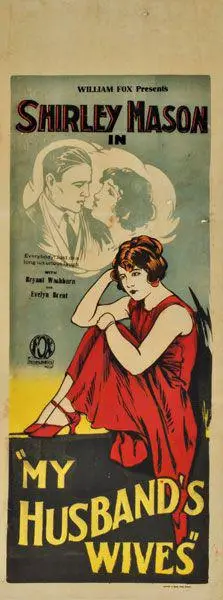
In the realm of early 20th-century cinema, where the nuances of relationships were often oversimplified, My Husband's Wives emerges as a film of intriguing dynamics, woven around the lives of Vale Harvey, her husband William, and the latter's former spouse, Marie Wynn.
The story commences with Vale, played by Shirley Mason, extending an invitation to Marie, an old school friend, oblivious to the complex history shared between Marie and her husband, William Harvey (Bryant Washburn). This oversight on Vale's part sets the stage for a series of events that would test the bonds of their marriage.
Upon Marie's arrival, her intentions become clear: she seeks to rekindle her romance with William, now her husband. This development precipitates a chain reaction, with Vale finding herself increasingly discomfited by Marie's presence. The situation escalates to a point where Vale's subconscious begins to weave fantasies of her own, envisioning William in a romantic liaison with the Italian actress, Madame Corregio.
However, the narrative takes a significant turn when William, finally cognizant of Marie's true intentions, summons the courage to confront her. The climax of the story unfolds as William firmly but courteously demands Marie's departure from their home, signaling a pivotal moment in the film.
The performances in My Husband's Wives are noteworthy, particularly given the context of the era. Shirley Mason brings a certain vulnerability to Vale, capturing the character's emotional turmoil with sensitivity. Evelyn Brent, as Marie, adeptly portrays the complexity of a woman caught between past love and present rejection. Meanwhile, Bryant Washburn's portrayal of William Harvey exudes a charming yet resolute demeanor, pivotal in navigating the film's central conflict.
In comparison to its contemporaries, such as The Janitor's Harem and My Official Wife, My Husband's Wives presents a distinct exploration of marital dynamics and the challenges posed by past relationships. While not as overtly dramatic as some of its peers, the film offers a nuanced look at the intricacies of human relationships.
Ultimately, My Husband's Wives concludes on a note of reconciliation and strengthened bonds. The Harveys, having navigated through the turbulence introduced by Marie's visit, emerge with a deeper understanding and appreciation of their relationship. This resolution, while perhaps predictable, is satisfying and underscores the film's thematic focus on the resilience of love and commitment in the face of adversity.
As a cinematic work, My Husband's Wives is a product of its time, reflecting the social and moral standards of the early 1930s. The screenplay, crafted by Dorothy Yost and Barbara La Marr, demonstrates a keen insight into the human condition, navigating the complexities of love, loyalty, and the past's impact on the present.
The film's direction and production values are consistent with the standards of the period, offering a polished presentation that complements the narrative. While My Husband's Wives may not stand out as a landmark of early cinema, it is a solid example of the era's romantic dramas, offering viewers a glimpse into the themes and concerns of its time.
In conclusion, My Husband's Wives presents an engaging exploration of marital dynamics, love, and reconciliation. Through its character-driven narrative and competent performances, the film offers a satisfying viewing experience, inviting reflection on the enduring themes of relationships and personal growth.
IMDb 4.3
1931
Community
Log in to comment.