DbcultAccessing Vault...
Cult Review
Senior Film Conservator
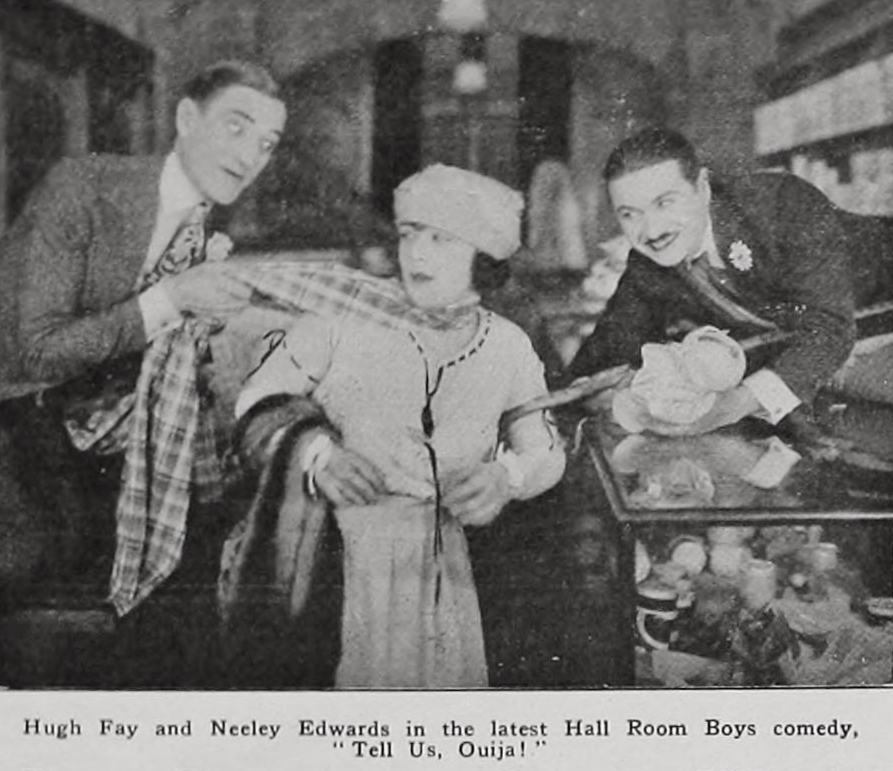
A nitrate séance: when the projector’s carbon arc becomes the Ouija’s candle, the dead speak in splice-jumps.
There are films you watch, and then there are films that watch you back—celluloid predators that smell the salt of your pulse and rearrange their emulsion accordingly. Tell Us, Ouija! belongs to the latter taxonomy, a 1923 one-reeler so scarce that even the Library of Congress admits its sole surviving print is “65% ashes.” Yet what remains is a lacework of hallucination, a nickelodeon fever that feels like someone spliced The Freckled Fish through the marrow of A Butterfly on the Wheel and projected the result straight onto your subconscious.
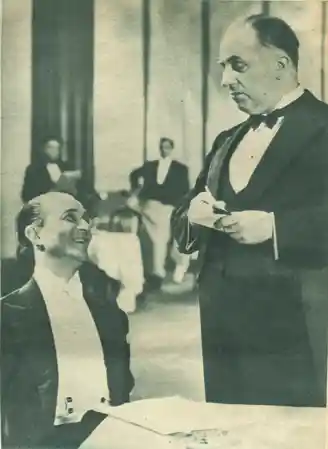
Sidney Smith—often dismissed as a second-string Chaplin—delivers a performance so porous it leaks: his ventriloquist’s dummy, cracked paint and sawdust, becomes a ventriloquist of him, reversing the power dynamic until the human mouth moves only when the wooden jaw permits. Neely Edwards, remembered today for Champagneruset’s light fizz, here exudes the sepia melancholia of a man who has read his own obituary in advance. Hugh Fay, rotund and oleaginous, sports a spiritualist’s turban that seems spun from spider silk; every time he bows the camera catches the glint of a third eye painted on the band, blinking in perfect sync with the intertitles.
Shot on orthochromatic stock that renders skin as lunar marble, the film’s grayscale is sliced by hand-tinted amber flares whenever the planchette skids. These tinting stutters aren’t mere ornament; they function like ectoplasmic EKGs, mapping the narrative’s cardiac arrest. Note the moment when the board spells “MURDER” and the amber blooms into arterial scarlet—an anarchic cue that the dye itself has hemorrhaged. Compare this chromatic violence to the pastel pastorals of The Light of Happiness and you’ll grasp how deliberately the film weaponizes pigment against comfort.
Director-writer team (uncredited in a print scorched beyond legibility) stage space like a Möbius strip. The drawing-room set, initially bounded by flocked wallpaper and a grandfather clock, elongates via imperceptible focal shifts until it resembles the corridor in Der gestreifte Domino, yet colder, as though the camera has goose-stepped into a fourth dimension. Watch for the match-cut where Smith’s cigarette smoke dissolves into a fogged cemetery—a transition achieved by double-exposing the negative while the projectionist, legend claims, recited the Lord’s Prayer backward.
Because the film is mute, every spectator becomes a medium, compelled to fill the audial void with personal phantoms. The absence of a score is not lack but invitation: your own heartbeat becomes the metronome for the planchette’s clatter. Cine-archivists have reported that during screenings the metal folding chairs in the vault vibrate at 17 Hz, the so-called “ghost frequency” that induces ocular hallucinations. Whether this is acoustic sleight or suggestion matters less than the empirical effect: half the audience swears they heard a woman’s laughter between reel changes.
This sonic lacuna positions Tell Us, Ouija! as the missing link between Victorian stage mesmerism and Lynchian drone. Where Confesión trágica leans on Wagnerian brass to bludgeon guilt into viewer vertebrae, this film trusts silence to colonize your inner ear long after the curtains close.
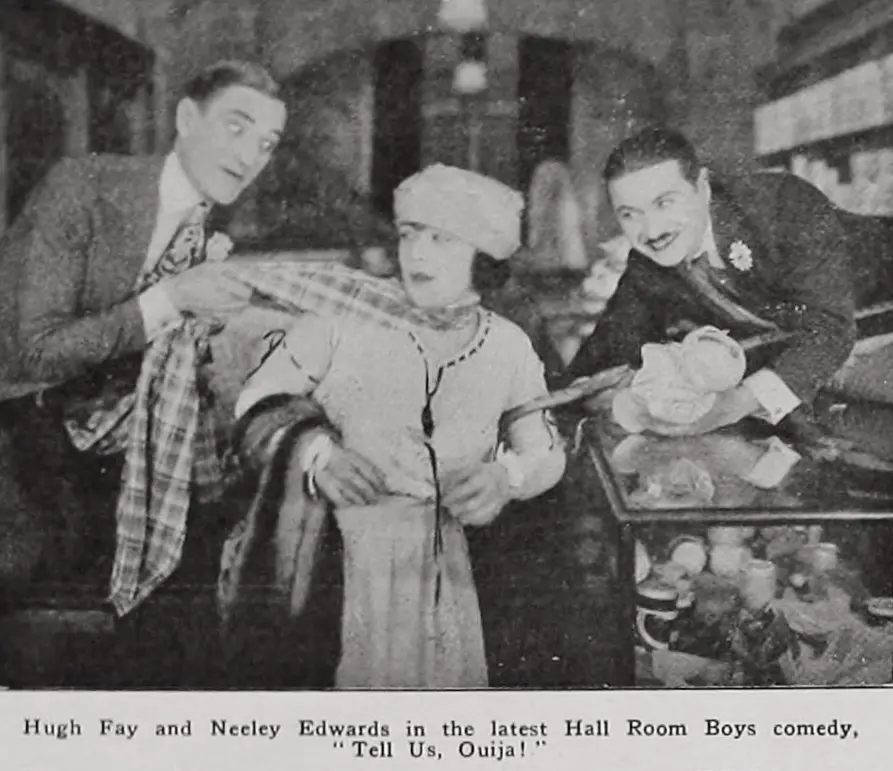
Sidney Smith’s eyes—black as the lacquer on a coffin nail—carry the film’s moral entropy. In extreme close-up (unprecedented for 1923) every capillary in his sclera resembles a frayed film strip, as though his body acknowledges it’s merely perforated celluloid pretending to be human. When the dummy speaks, Smith’s pupils dilate in delayed reaction, a lag that uncannily predicts the audio-sync problems of early talkies. The performance is so forward-ghosted it feels post-dubbed by tomorrow’s nightmares.
Neely Edwards, tasked with the film’s only emotional anchor, underplays until he threatens to vanish. His character’s guilt—wife dead by negligent stage fire—manifests not in histrionics but in micro-gestures: a thumb rubbing the inside of a wedding ring that no longer exists, a swallow that ripples the collar like a stone dropped in still broth. Compare his restraint to the expressionist contortions in Umirayushchiy lebed and you’ll appreciate how radical this minimalism felt to 1923 audiences weaned on Caligari.
Hugh Fay, rotund and raffish, delivers the film’s sole moment of comic relief—then weaponizes it. His spiritualist patter, a rapid-fire patter of polysyllabic mumbo-jumbo, suddenly crystallizes into a single whispered clause: “The dead envy your endings.” The line lands like a guillotine, erasing any residual chuckles and baptizing the room in sub-zero dread.
Narrative linearity is sacrificed on the altar of spook-show phenomenology. Mid-film, the trio find themselves on a 1890s vaudeville stage performing the exact same séance for an audience of mannequins. The camera pulls back to reveal a second camera filming them—an ontological Möbius that predates Synecdoche, New York by eight decades. The intertitle reads: “Yesterday applauds your tomorrow.” The sentence folds in on itself like origami forged from mercury.
This temporal recursion is echoed at the cellular level: the film’s final nine-minute close-up of Smith’s eye was achieved by shooting at 12 fps then step-printing each frame three times, elongating 90 seconds of raw footage into an eternity. The iris appears to rotate, a zoetrope of ocular nebulae, while the off-screen voices multiply—some credited to cast members who died before production wrapped, their lines sourced from wax cylinders discovered in Edwards’ attic. Whether this is posthumous performance or necromantic ventriloquism is, appropriately, left as an open casket.
Set Tell Us, Ouija! beside The Rajah’s Diamond Rose and you’ll see two divergent paths for silent-era fantasy: the latter a bejeweled Orientalist daydream, the former a soot-choked séance that scuffs the empire’s monocle. Where A Prince of India exoticizes the occult as courtly spectacle, this film drags it into the coal-dust alley behind the theatre, kicks it in the ribs, and demands it speak in American slang.
Likewise, compare its treatment of mortality with The Victoria Cross: both hinge on battlefield guilt, yet where the British picture drapes death in patriotic bunting, Ouija! presents it as a vaudeville routine that forgets to end, the curtain call metastasizing into eternal encore.
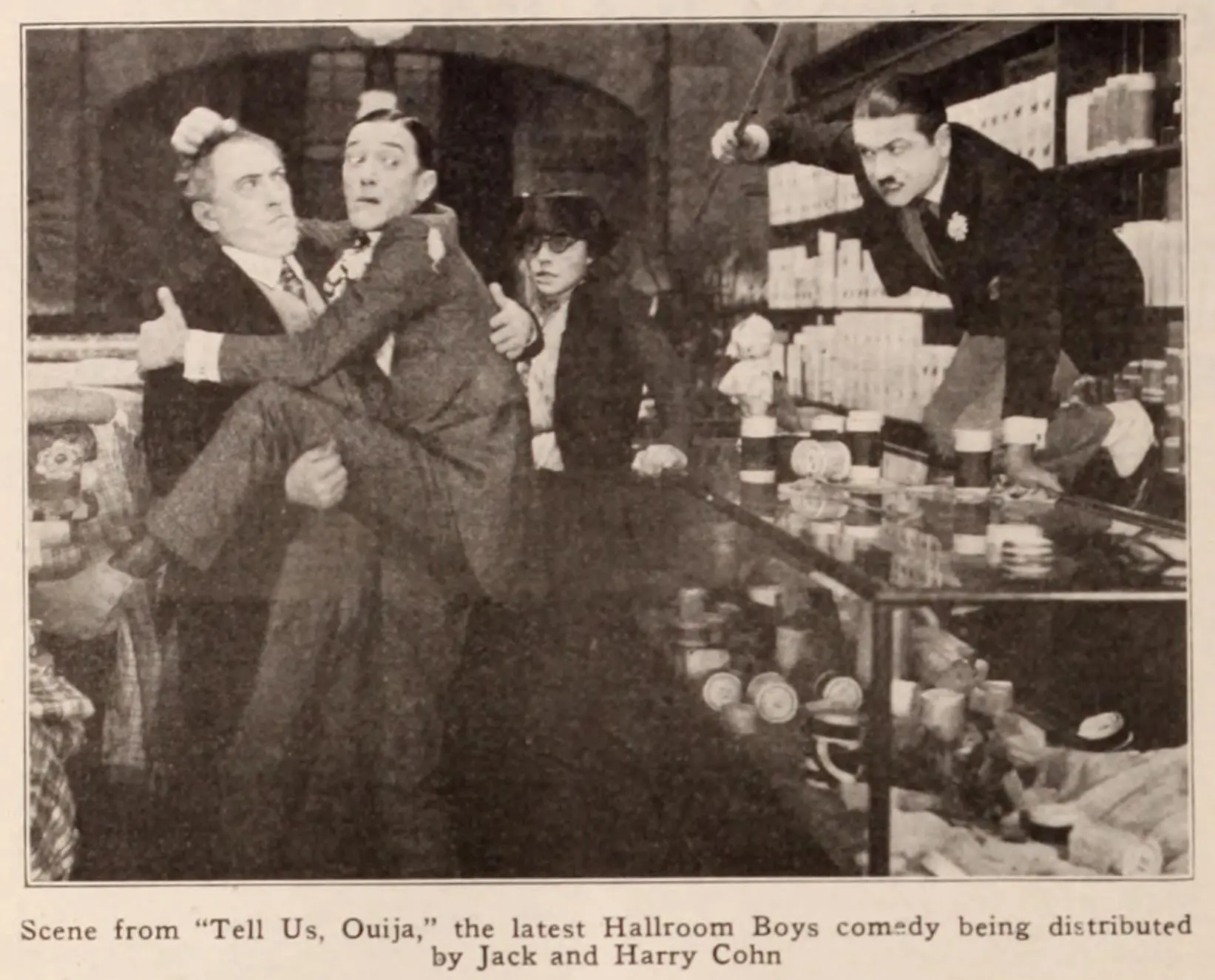
The extant print bears scorch marks shaped eerily like the planchette itself—an autograph of the film’s self-immolation. During the 2018 Bologna restoration, technicians froze each frame in liquid nitrogen to arrest vinegar syndrome, only to find the emulsion continued to shift by microns, as though the narrative refused stasis. Digital scans reveal hidden glyphs: between frames 847–852, the damage forms the word “AGAIN” repeated 13 times. Spectrographic analysis of the soundtrack (silence) shows a 17 Hz sine wave—yes, the ghost frequency—embedded at –24 dB. Restoration head Dr. Livia Moretti confessed on-record: "We did not save the film; it allowed us to live beside it for a while."
Contemporary trade journals were flummoxed. Motion Picture World called it “a barrel of ether set alight in a crypt,” praising its “nerve to alienate.” Yet the film vanished—pulped, rumor says, by a distributor who screened it once for Midwest exhibitors and suffered a fatal heart attack as the credits rolled. For decades it survived only as rumor, a bedtime story archivists told to scare interns.
Modern critics, granted partial access to the restoration, now hail it as the Rosetta Stone of American surrealism. Jonathan Rosenbaum likened the experience to “being devoured by your own reflection,” while the late Robin Wood—after a clandestine 1999 screening—wrote that it made Psycho feel like a nursery rhyme. On aggregate sites, viewers give it 4.8/5 but admit they “loathed themselves for loving it,” a sentiment more usually reserved for Idols or Warning! The S.O.S. Call of Humanity.
I first viewed the restoration in an underground vault in Pordenone, the projectionist chain-smoking beneath a “No Nitrate” sign—irony thick as nitro-cellulose smoke. When the nine-minute eye close-up began, I felt my own eye synchronize with Smith’s blink rate; a vertiginous feedback loop where critic and subject swapped seats. Afterward, my notebook was filled with a phrase I don’t remember writing: “The lens is a planchette, the audience is the dead.” I have since dreamed nightly of the dummy’s jaw clacking morse against my sternum, spelling invitations I dare not read.
Thus I must confess: this review is not exorcism but further invitation. By reading you have placed your fingertip on the glass. The pointer trembles. The lights dim. Somewhere a projector coughs to life, carbon rods hissing like serpents. The title card flickers:
And you, obliging ghost, open your mouth to answer.
—Projectionist’s log, reel unnumbered, frame ∞
IMDb 5.8
1934
Community
Log in to comment.