DbcultAccessing Vault...
Cult Review
Senior Film Conservator
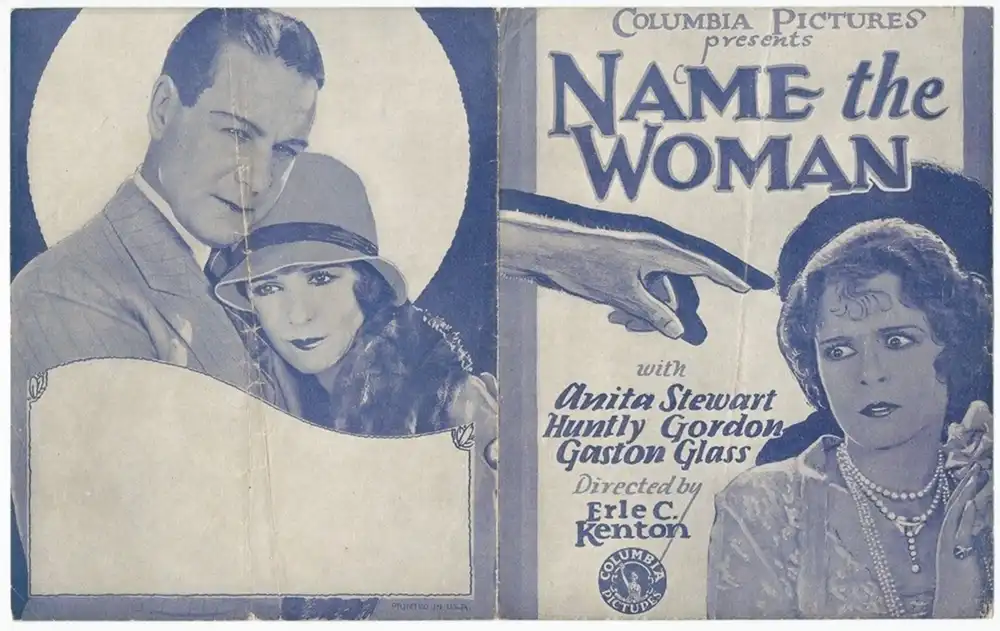
If you are the kind of person who needs a legal thriller to actually follow the rules of law, you should probably skip Name the Woman. It is 1928 filmmaking at its most frantic, right on the edge of the sound era, where the acting is getting a bit more natural but the plots are still stuck in that heavy, Victorian melodrama mode. But if you like watching people in impeccably tailored suits point fingers at each other in cavernous rooms, it’s a decent way to spend an hour.
The whole thing hinges on a gimmick that you see coming from the first ten minutes. Gaston Glass plays the prosecutor, and he’s got that specific silent-movie leading man look—hair that looks like it was painted on and eyes that are maybe a little too heavy on the kohl for a guy working in a government office. He’s trying to solve a murder, and there’s this 'mystery woman' who holds the key. Of course, it’s his wife, played by Anita Stewart. The way the movie handles her hiding her identity is almost funny. She just kind of turns her head slightly or stands in a shadow, and apparently, that’s enough to fool everyone who knows her.
There is a scene early on where Anita Stewart is waiting in a hallway, and the lighting is genuinely strange. The shadows are stretched out so far they look like teeth. It doesn’t really match the mood of the scene—she’s just supposed to be nervous—but it looks cool. It reminded me a bit of the heavy atmosphere in Judgment of the Storm, where the environment feels like it's trying to swallow the actors whole. Here, it just feels like the cinematographer was bored and wanted to play with the lamps.
One thing that really stuck out to me was the background actors in the courtroom. Usually, in these old Columbia pictures, the extras are just kind of there, but in this one, they look genuinely exhausted. There’s a guy in the third row of the gallery who spent an entire three-minute sequence just rubbing his temples. I found myself watching him more than the main trial. It gives the whole thing this weird, lived-in feeling, like the trial has actually been going on for fourteen hours and everyone just wants to go home and have a drink.
Anita Stewart is the main draw here, obviously. She was a huge star, and you can see why, even if the material is beneath her. She has this way of clutching her collar that feels like a choreographed dance move. There’s a moment where she’s confronted with a piece of evidence—a glove, I think—and the camera zooms in so fast it’s almost jarring. Her reaction is so big, so physical, that it almost feels like she’s trying to break the frame. It’s not 'good' acting by modern standards, but it’s incredibly watchable. It’s a lot more intense than the stuff you see in something like The Other's Sins, where the drama feels a bit more muted and polite.
The pacing is where the movie starts to trip over its own feet. The first act moves fast, setting up the murder and the stakes, but once we get into the trial, everything slows down to a crawl. We get intertitle after intertitle of legal jargon that doesn't really matter. You can almost feel the movie trying to convince you that the legal procedure is the most important part, when all we really want is to see the husband realize he’s accidental ruining his own life. There’s a long stretch where Gaston Glass just paces back and forth, and the editing is so repetitive that I thought for a second the film had looped. It’s about twenty seconds of him walking left, then twenty seconds of him walking right, with no cutaways to the jury.
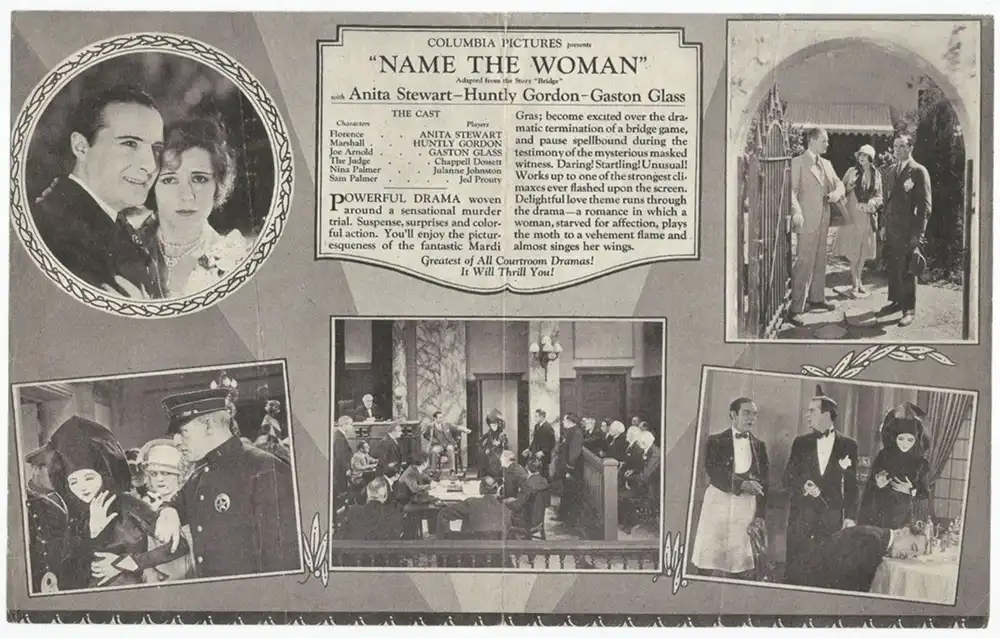
Speaking of the jury, they are barely in the movie. You’d think in a courtroom drama you’d get at least one shot of a shocked juror, but they’re mostly just a blur in the background. It makes the whole trial feel like a private argument between three people that just happens to be taking place in a giant hall.
When the title drop finally happens—the big 'Name the woman!' shout from the gallery—it’s actually handled pretty well. The intertitle is huge, taking up the whole screen. But the reaction shot that follows is a bit of a letdown. Huntley Gordon, who plays the villainous type, just kind of blinks. He looks more like he forgot his keys than like he’s been outed as a murderer. It’s one of those tonal shifts that happens a lot in these late silents; the music (if you’re watching a scored version) is screaming 'CATASTROPHE' but the actors are just looking a bit miffed.
I did like the costume design for Stewart. Her hats are ridiculous. There is one that looks like a velvet satellite dish. It’s supposed to be high fashion, I assume, but it makes it even harder to believe that no one recognizes her. You’d recognize that hat from three miles away in a fog. It’s the kind of weird visual detail that makes these b-movies from the 20s so much fun to dig through. They weren't trying to be realistic; they were trying to be big.
Is it a masterpiece? No. It’s not even the best thing Erle C. Kenton ever did. But there’s a sincerity to it that’s hard to find now. Even when the plot is nonsensical—like the way the murder weapon is handled, or the fact that the prosecutor doesn't recognize his wife's voice—the movie commits to it 100%. It doesn't have that wink-at-the-camera irony that ruins a lot of modern attempts at melodrama. It’s much more earnest than something like The Man in the Saddle, which feels a bit more calculated in its beats.
The ending is rushed, as they usually are. Everything gets wrapped up in about two minutes of frantic gesturing and a very quick embrace. It leaves you feeling a bit like you’ve just run a marathon only to find out the finish line was actually a mile back. But for those sixty-some minutes, it’s a fascinating look at a studio trying to make a prestige picture on a budget, relying on the sheer charisma of its leading lady to paper over the holes in the script. If you’ve got an hour and you want to see some top-tier 1920s pouting, you could do a lot worse.
IMDb —
1934
Community
Log in to comment.