DbcultAccessing Vault...
Cult Review
Senior Film Conservator
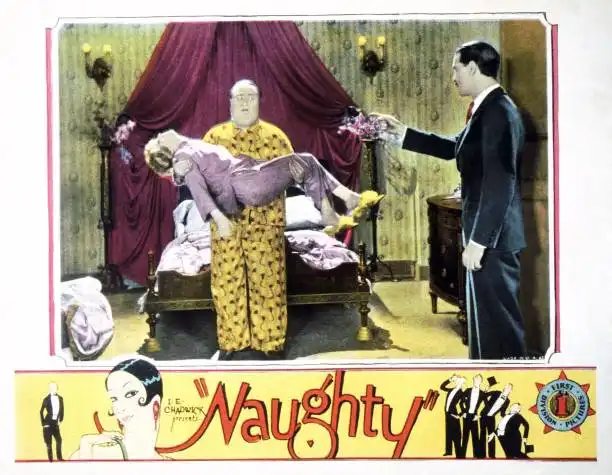
Naughty is a film that fails to live up to the promise of its title. If you are looking for a daring exploration of 1920s rebellion, you won't find it here. This is a standard-issue studio comedy that feels remarkably safe, even by the standards of 1927. It is a film for those who want to see the mechanics of late-silent era comedy without the spark of genius found in the works of Lloyd or Keaton. If you find repetitive schoolyard pranks tedious, this will be a difficult sit.
Only for those with a specific interest in Pauline Garon or the broader output of Hampton Del Ruth. For the casual viewer, Naughty offers very little that hasn't been done better elsewhere. It lacks the sharp wit of the era's best social satires and relies too heavily on Garon’s ability to make funny faces to carry a thin script. It is a passable distraction, but it never reaches the level of a must-see.
This film works because: Pauline Garon possesses a frantic, almost desperate energy that keeps the screen moving even when the plot stalls. Her physical commitment to the role of the disruptive student provides the film's only real sparks of life.
This film fails because: The script is a collection of recycled gags that feel old-fashioned for 1927. The central romance between Garon and John Harron lacks any discernible chemistry, making the stakes feel non-existent.
You should watch it if: You have already exhausted the major silent comedies and are looking for a deep-cut performance from a secondary star of the era.
By 1927, the "rebellious flapper" trope was already starting to show its age. Naughty attempts to capitalize on this trend but does so with a script that feels like it was written a decade earlier. The film treats the idea of a girl being slightly loud or disruptive as the height of scandal. There is a scene early on where Garon’s character disrupts a formal dinner that is clearly meant to be a comedic highlight, but the timing is sluggish. The reactions of the supporting cast are so exaggerated that the humor evaporates before the punchline even lands.
The direction by Hampton Del Ruth is surprisingly static. Given his background in the more chaotic world of Keystone, one might expect a faster pace. Instead, the camera lingers on mediocre setups for far too long. The film feels like it is waiting for the audience to catch up to jokes that weren't that funny to begin with. Compared to a film like La La Lucille, which manages to balance its absurdity with a bit more structural integrity, Naughty feels like a series of loosely connected skits.
Pauline Garon is doing the heavy lifting here. She has a way of using her entire body to convey a sense of barely contained chaos. It is a shame the material doesn't match her effort. She is frequently paired with John Harron, who is essentially a piece of driftwood in this film. Harron provides no friction for Garon to play against, resulting in romantic scenes that are as dry as dust. A comedy like this needs a strong foil, and Harron isn't it.
Walter Hiers appears in a supporting capacity, and while he is a reliable presence in these types of films—much like in Walter Tells the Tale—his inclusion feels like a desperate attempt to inject some professional slapstick into a sagging narrative. Hiers does his usual bit, but it feels disconnected from Garon’s more manic energy. The two styles of comedy don't mesh; they just compete for space on the screen.
The middle act of the film takes place in a finishing school, a setting that has been mined for comedy since the dawn of the medium. Naughty adds nothing new to the subgenre. The strict headmistress, the gossiping classmates, and the secret nighttime escapades are all present and accounted for. The problem is the lack of escalation. A good comedy builds its tension until it explodes; Naughty just simmers at a low, lukewarm temperature. The "pranks" Garon pulls are toothless. It is difficult to care about her rebellion when the consequences are so mild.
Visually, the film is uninspired. The sets are flat and the lighting is functional at best. There is no attempt to use the camera to enhance the comedy. We are simply observers of a stage-bound performance. In an era where cinematography was becoming increasingly fluid and expressive, this film feels like a step backward. It is a utilitarian production through and through.
Pros:
Cons:
Naughty is a forgettable entry in the late-silent era. It isn't a disaster, but it is a chore. It relies entirely on Pauline Garon’s charm to mask a total lack of substance. If you are a fan of the era, you might find some value in her performance, but don't expect to remember much of the film an hour after the credits roll. It’s a film that tries to be a firecracker but ends up being a damp squib.
IMDb 6
1920
Community
Log in to comment.