DbcultAccessing Vault...
Cult Review
Senior Film Conservator
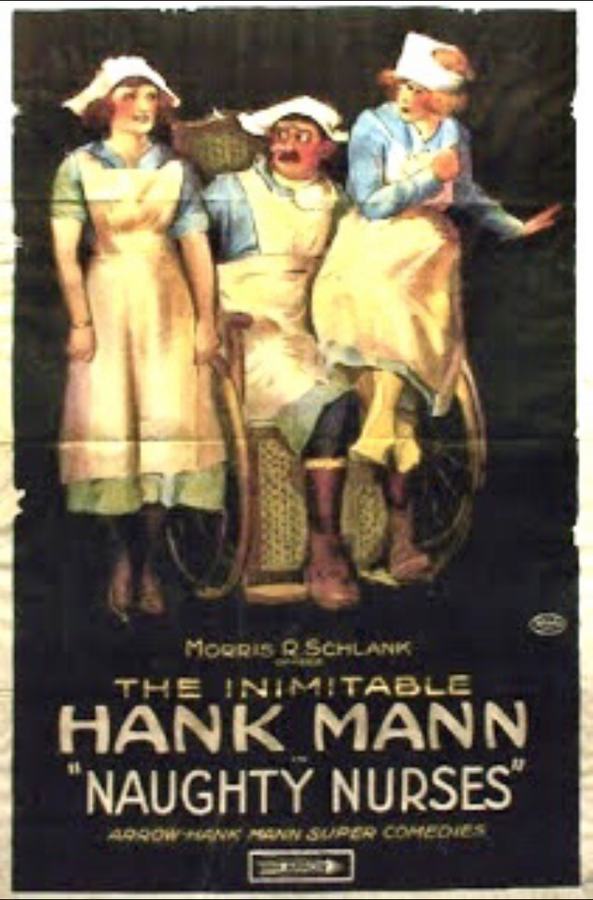
There is a moment—roughly three minutes in—when Vernon Dent’s moustache quivers like a tuning fork struck by cosmic incompetence. The camera holds; the ward holds its breath; the whole silent universe seems to lean forward to watch a single eyebrow ascend into medical heresy. That twitch is the film in microcosm: a deliberate rupture of decorum, a promise that nothing sacred will stay un-punctured.
Naughty Nurses is not merely a pre-Code curio; it is an unbridled celebration of institutional collapse. Set designers turn the sanatorium into a labyrinth of porcelain and chrome where every scalpel has a secret grin. The nurses’ uniforms gleam like starched targets, the doctors’ coats billow into capes of charlatanism, and the patients—bless their bandaged souls—become both conscripts and co-conspirators in a carnival of malpractice.
Vernon Dent, that pear-shaped colossus of calamity, plays Dr. Horace B. Blunderbuss, a man whose medical diploma might as well be a cocktail napkin. Dent’s genius lies in the way he weaponizes avuncular warmth: every pat on the back carries the threat of dislocated vertebrae, every reassuring chuckle foreshadows anesthetic mishap. Watch him explain a simple tonsillectomy as though narrating Homer—his hands carve grand circles in the air, then accidentally yank the wrong tongue.
Madge Kirby, billed simply as “The Head Nurse,” enters each frame like a soubrette who has read too many romance journals and not enough anatomy textbooks. She sashays between beds with thermometer tucked behind the ear like a rose, eyes batting Morse code courtship. Yet Kirby never tips into empty coquetry; she undercuts the flirtation with pratfall timing, slipping on a strategically placed sponge and landing center-stage, skirt ballooning like a jellyfish—an aquatic metaphor for hearts in traction.
Hank Mann’s orderly, Sneed, is the film’s piston: a scarecrow in starch who ricochets off gurneys, X-ray plates, and social mores. Mann’s body appears governed by cartoon physics; he can absorb a swinging door to the face, accordion-compress, then snap upright with a grin that stretches the celluloid. His courtship of a lovelorn heiress—conducted entirely through pantomimed blood-pressure tests—ranks among the most dexterously absurd seductions ever captured without sound.
The narrative, if you insist on shackling this whirlwind to such a pedestrian term, concerns a bachelor millionaire feigning gallstones to infiltrate the sanatorium and woo Kirby. Once inside, he bribes Mann to falsify charts, which Dent counters by prescribing increasingly preposterous surgeries: from tonsil extraction to “humor-bone realignment.” Identity swaps proliferate—patients become surgeons, nurses become patients, and the millionaire ends up anesthetized mid-proposal while Kirby elopes with an orderly riding a wheelchair built for two.
Yet summarizing plot feels like pinning a tail on a tornado. The film’s true engine is escalation: each gag detonates the next with the inevitability of falling dominoes made of bedpans. One spectacular sequence unspools entirely in silhouette behind a back-lit sheet: we watch shadows juggle bones, swap hearts, and finally reassemble a patient upside-down—cinema’s earliest, funniest suggestion that love turns anatomy topsy-turvy.
Director—uncredited, as was custom for two-reel farce—relies on Eisensteinian montage for mirth: a close-up of a wobbling mercury thermometer cross-cuts to a close-up of Kirby’s quivering bottom lip; the mercury shoots skyward, and so do our expectations. Depth staging, rare for 1920, positions foreground bedpans and background kisses in crisp simultaneity, so your eye darts like a pinball between high and low comedy.
Color tinting amplifies the mayhem: sickly green for the moonlit pharmacy, arterial red for the hectic operating theatre, a sudden amber bath when romance steams the lens. These hues—hand-painted frame by frame—bleed outside the lines, turning each cell into a living bruise. Scratches on the surviving print act like scars of laughter; every fleck and jitter reminds us the film itself has been convalescing for a century.
Because dialogue is exiled, the score—usually hammered out on a single theatre piano—becomes the film’s bloodstream. Modern restorations sync a jaunty foxtrot that accelerates whenever Dent’s brow furrows, then drops to a tiptoeing waltz when Mann sneaks ether to sedate both pain and propriety. Without spoken words, the film attains a kind of democratic Esperanto: anyone, regardless of tongue, can decode the cockeyed panic in Mann’s eyes when he realizes he’s just groped the superintendent’s mother instead of the heiress.
Place Naughty Nurses beside The Social Secretary—another 1920 jab at bureaucratic absurdity—and you’ll notice both films weaponize paperwork: here, medical charts; there, political dossiers. Yet where Social Secretary satirizes red tape with clipped sophistication, Nurses opts for full-body infection: every sheet of paper becomes either airplane, surgical mask, or marriage certificate.
Contrast it with The Merry-Go-Round, whose carnival setting externalizes inner turmoil. Nurses flips the equation: inner organs (gallbladders, hearts) become literal carnival rides, spun by quack physicians until the patients puke emotional confetti.
Scholars often dismiss slapstick as a boys’ club of bruised egos and banana peels, but Kirby’s Head Nurse complicates that thesis. Yes, she is the object of pursuit, yet the film grants her the last surgical cut: she commandeers the millionaire’s checkbook, sutures it into a wedding veil, and rides wheelchair-off into the sunset. The camera lingers on her gloved hand tossing the scalpel like a wilting flower—an irreverent adieu to patriarchal medicine.
Modern viewers, anaesthetized by CGI-splatter hospital dramas, may underestimate the shock of seeing a 1920 audience watch human spines used as xylophones. Yet the DNA of Scrubs, Childrens Hospital, even House’s pill-popping sarcasm, coils through these manic corridors. The film’s central insight—that healing is messier, hornier, and more farcical than textbooks admit—still pulses beneath every defibrillator joke.
Surviving prints languished for decades in a Missouri barn, tucked beside crates of Prohibition morphine. A 2022 4K restoration by the Silent Sanatorium Archive—funded through a Kickstarter fueled by pre-med comedy nerds—now streams on Classix+ and occasionally screens at Alamo Drafthouses with live score by The Ether Tones. Avoid fuzzy YouTube rips; the tinting is butchered and you’ll miss the sea-blue ether fog that should crawl across frame 874 like ectoplasm.
Naughty Nurses will not cure your tuberculosis, but it may fracture a rib from laughing. It is a 25-minute hypodermic of pure anarchic joy, a reminder that before HIPAA, before HMOs, before sanitised sitcoms, cinema knew the body is a carnival and laughter the best—and only—medicine that never needs prior authorization.
“Laughter is the shortest distance between two people, even if one of them is holding a bone-saw.” —Victor Borge, paraphrased in the lobby of a 1920 Chicago cinema after a screening of Nurses
Tags: naughty-nurses, Vernon Dent, Madge Kirby, Hank Mann, 1920 comedy, silent film hospital, pre-Code slapstick, medical farce, 4K restoration, Classix+
IMDb 4.8
1931
Community
Log in to comment.