DbcultAccessing Vault...
Cult Review
Senior Film Conservator
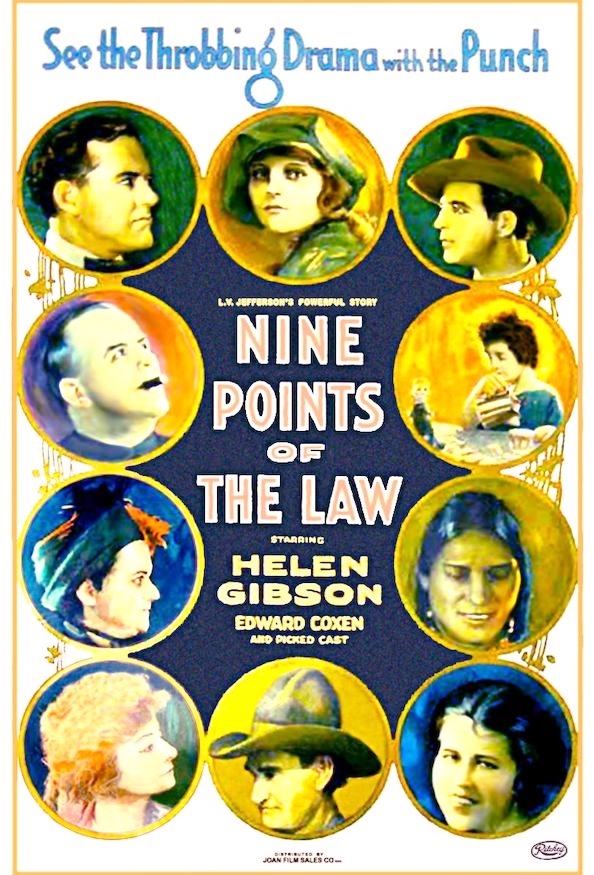
If you’ve been scouring the silents for that razor-thin moment where morality wobbles like a hubcap about to sheer off a speeding Auburn, Nine Points of the Law is your grail.
The picture opens on a barrister’s chambers at dusk—gas-jets guttering, briefs yellowing like old love-letters—yet within three title cards we’re pitched into a nocturnal economy of pawnbrokers, chorus girls, and detectives who seem carved from cigarette smoke. Possession, the film insists, is nine-tenths of the law; the remaining tenth is the void where conscience may—or may not—slip through.
Edward Coxen, all razor-parted angst, pockets a diamond stick-pin belonging to a client whose son faces the gallows. Coxen intends to hock it for one night, square the gambling debts rotting his career, then redeem it at dawn. Instead, the pin spirals through a metropolis that mutates faster than Lon Chaney’s face. Each transfer of custody is a lesson in social physics: the gem’s sparkle clouds judgment, accelerates pulse, rewrites identity. Leo D. Maloney’s copper, trench-coated and implacable, trails the gem as though it were a lit fuse. Aggie Herring’s pawnbroker—equal parts Shylock and seraph—keeps the ledger of human weakness, her prices denominated in secrets. Helen Gibson’s chauffeuse, hired to speed the pin out of town, discovers that pistons and ventricles beat in synchrony when fear is the passenger.
Director L.V. Jefferson (with scenario by Ford Beebe) refuses to let any frame ossify into tableau. Instead he choreographs movement: a motorbike vaults onto a moving flatcar, a courtroom empties in a single lateral pan that feels like a sigh of institutional fatigue. The cumulative effect is urban delirium, a noir before the term existed, a heist sans vaults yet brimming with the same adrenal dread that would later course through High and Dry and The Crime of the Hour.
Shot largely on location around Los Angeles’ Victorian alleyways, the film masks its budgetary leanness with chiaroscuro that would make Eugene Aram jealous. Observe how cinematographer Ross Fisher (borrowing tricks from German imports) lets asphalt sheen double for cobblestone, how a single arc-light transforms a pawnshop grille into the portcullis of some infernal castle. Shadows are not merely absence but negative equity—what the characters owe the night.
Helen Gibson’s stuntwork deserves its own stanza. She clambers over Model-T bonnets, rappels from freight-train ladders, all while the camera glides at ankle height so the city itself seems to somersault. The kineticism predates and arguably surpasses the circus exuberance of Such a Little Queen.
Coxen’s barrister sweats guilt through every pore; watch the way his gloved hand fondles the pin—as though fondling his own excised virtue. Maloney, usually cast as granite-jawed cowpoke, here lets weariness seep through the eyes; his detective is less hunter than existential accountant, tallying human folly. Aggie Herring, veteran of a hundred two-reelers, finds a hushed gravitas in close-up: the slight flare of nostril when she smells profit, the micro-frown when ledger and conscience misalign.
And Gibson—ah, Gibson! She communicates velocity without words: the tilt of her goggles, the forward lurch of her shoulders as she guns the throttle. In a medium where women too often fluttered in parlors, she barrels through the frame like a comet, prefiguring the adrenal heroines of Australia’s Peril.
Though the original score is lost, modern festivals often commission new accompaniments—jagged jazz, detuned ukulele, even glitch-hop. I caught a 16 mm print at Bologna with a trio hammering prepared piano and typewriter; each pawn-ticket close-up was punctuated by the ding! of a carriage return—an aural watermark that made the audience gasp as though collectively stuck by a thumbtack.
Where Nature’s Handiwork aestheticizes redemption through pastoral vistas, Nine Points insists redemption is a metropolitan shell-game. And unlike A Man’s Man, which equates masculinity with stoic endurance, Jefferson’s film presents masculinity as a garment repeatedly pawned and reclaimed, threadbare yet stubbornly reworn.
Modern streamers serve us heist porn where tech wizards swap vaults for server racks. Nine Points reminds us that larceny predates wi-fi; it travels by streetcar, by pawn ticket, by the simple act of looking someone in the eye and lying. The film’s thesis—that ownership is a mirage sustained by collective hallucination—feels eerily akin to crypto busts, NFT flameouts, and the daily renegotiation of who owns whose data.
Moreover, the gender politics sneak up on you. Gibson’s chauffeuse doesn’t merely drive; she steers narrative, engine, and heart. When she finally guns the car onto a pier, scattering gulls like white confetti, she’s not fleeing but reclaiming agency. The shot lasts maybe four seconds, yet it reverberates harder than any 2024 blockbuster’s third-act sacrifice.
Yes, the third act resorts to a convenient confession—scribbled on parchment that flutters into frame like a deus ex parchment. And yes, the intertitles occasionally over-salt the dialogue (“The gem’s facets mirrored his fractured soul…”). But these are quibbles, flecks of lint on an otherwise immaculate waistcoat.
A 4K restoration languishes in rights limbo, though a 2K scan circulates among private archivists. If you haunt cinematheques, petition programmers; this gem deserves Blu-ray, not oblivion. Until then, keep vigil on YouTube—grainy bootlegs surface, vanish, resurface like the diamond itself.
Jefferson and Beebe ask: when ownership is fleeting, what can we truly claim as ours? Their answer—etched in nitrate, flickering like a heartbeat—is both bleak and perversely comforting: perhaps only the chase itself, the adrenal instant before the coin clatters to rooftop stone and reveals which face—virtue or venality—gleams uppermost. Watch Nine Points of the Law and you’ll walk out poorer in certainty, richer in awe, and nursing a sudden urge to count the contents of your pockets.
—a film that proves silence can rattle louder than any vault exploding in Dolby Atmos.
IMDb —
1916
Community
Log in to comment.