DbcultAccessing Vault...
5.9/10
Senior Film Conservator
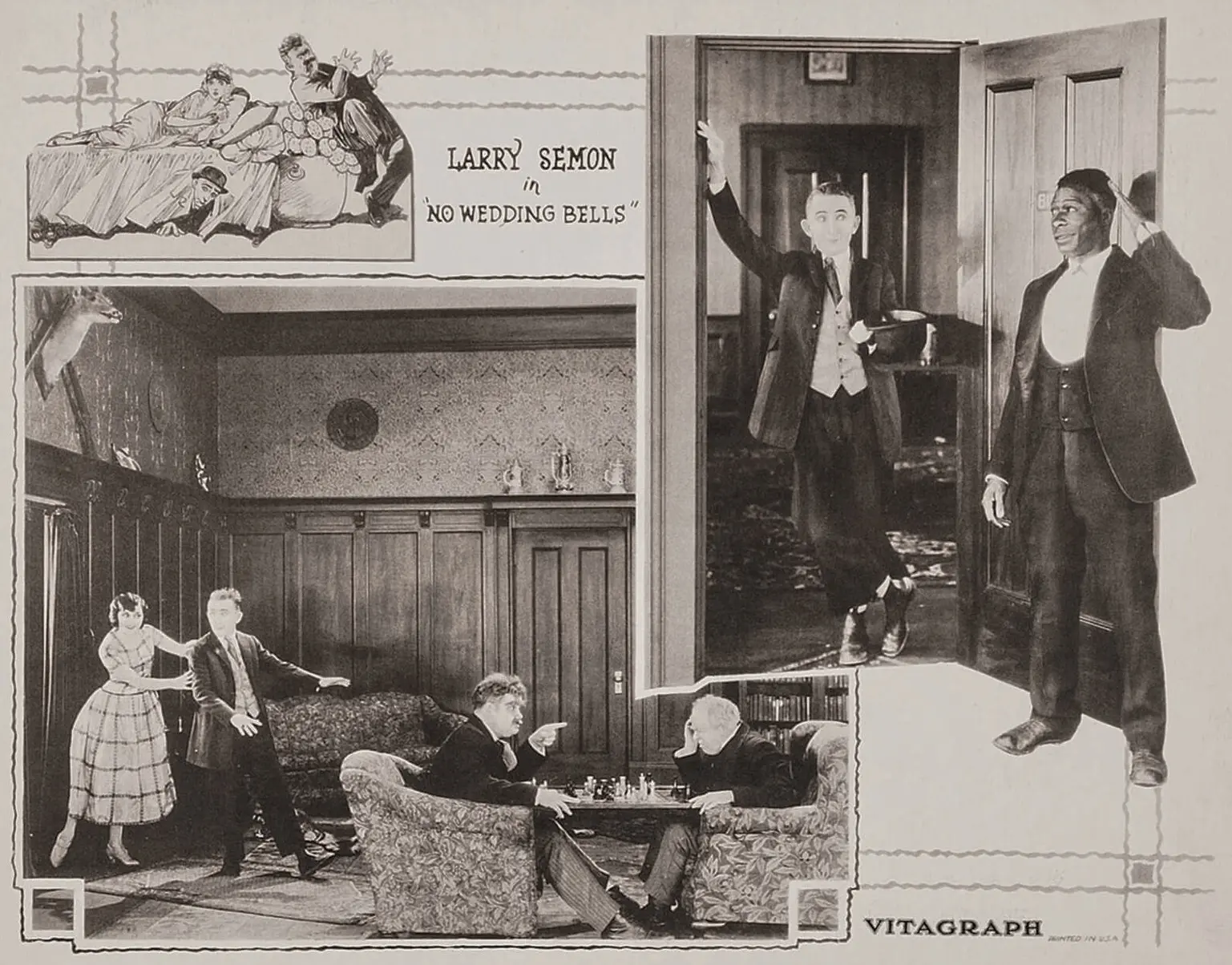
A definitive 5.9/10 rating for a film that redefined the boundaries of cult cinema. No Wedding Bells remains a cornerstone of transgressive art.
Ah, the silent film era! A time when physical comedy reigned supreme, when gags were grand, and when the narrative could twist and turn with the wild abandon of a roller coaster. Among the titans of this golden age, names like Chaplin, Keaton, and Lloyd often spring to mind, but there was another, equally influential, though perhaps less universally celebrated, master of mirth: Larry Semon. His films, often characterized by their relentless pace, elaborate stunts, and a sheer volume of visual gags, offered a unique brand of cinematic mayhem. And nowhere is this more evident than in his 1923 short, 'No Wedding Bells'. This isn't just a film; it's a whirlwind of unadulterated chaos, a testament to Semon's particular genius for crafting narratives that defy logic in the most delightful ways possible.
From the very outset, 'No Wedding Bells' plunges us headfirst into a world where domestic tranquility is a fleeting illusion and romantic proposals are fraught with peril. Our protagonist, Larry (played with characteristic wide-eyed earnestness and boundless physical energy by Semon himself), is a man on a mission: to secure the hand of his beloved. A noble pursuit, one might think, but in Semon's universe, even the simplest romantic gesture can trigger an avalanche of absurdity. The initial encounter with the prospective father-in-law is a masterclass in escalating comedic tension. The father, a figure of formidable temperament and singular focus, finds himself on the cusp of an unprecedented triumph – a chess victory, a feat unheard of in two decades. This seemingly innocuous detail becomes the fulcrum upon which the entire narrative pivots. Larry's ill-timed interruption, his query about marriage cutting through the hallowed silence of the chess match, is met not with paternal blessing, but with a visceral, almost primal, rejection: a swift, unceremonious ejection through the nearest window. It's a gag that sets the tone for the entire film, a clear declaration that logic and decorum have been left at the door, replaced by the glorious anarchy of pure slapstick.
But the familial drama is merely the prelude to a far grander, more outlandish conspiracy. While Larry is busy recovering from his aerial excursion, his sweetheart is whisked away by a nefarious Chinese servant. This isn't just any servant; he's revealed to be the sinister henchman of a shadowy gangster, a villain whose depraved scientific pursuits involve the creation of a potent sleeping potion. His nefarious ambition? To test this soporific concoction on an unsuspecting woman, a truly bizarre and darkly comedic motivation for villainy that only Semon could conjure. The immediate shift from domestic farce to international intrigue, albeit on a micro-scale, is breathtaking in its audacity. It’s a narrative leap that might buckle under the weight of its own preposterousness in a more conventional film, but here, it simply fuels the engine of Semon’s comedic machine. The stakes are instantly, if ludicrously, raised, transforming Larry’s quest from mere romantic aspiration into a heroic rescue mission, albeit one perpetually shadowed by the threat of another window-bound exit.
Larry Semon, as both star and writer, was a force of nature in early cinema. His films often featured elaborate sets, intricate contraptions, and an almost pathological commitment to physical comedy. In 'No Wedding Bells', this commitment is on full display. The film’s structure is less about elegant plotting and more about a relentless succession of gags, each one topping the last in terms of sheer inventiveness and escalating danger. Semon's character, always the bumbling but ultimately triumphant hero, navigates a world designed to thwart him at every turn. His resilience, however, is matched only by his capacity for attracting misfortune. The brilliance of Semon's comedy lies in this very juxtaposition: the earnestness of his character against the utter absurdity of his circumstances. He’s not a graceful dancer like Chaplin, nor a stoic architect of action like Keaton; Semon is a whirlwind, a human pinball ricocheting through a landscape of flying pies, collapsing structures, and improbable escapes.
The cast supporting Semon in 'No Wedding Bells' adds layers to the comedic tapestry. Most notably, we see the unmistakable presence of Oliver Hardy, long before his iconic pairing with Stan Laurel. Here, Hardy typically plays a heavier, more imposing figure, often a foil or a secondary antagonist, or sometimes just another bewildered participant in the surrounding chaos. His early roles, like this one, offer fascinating glimpses into the development of his comedic persona, showcasing his ability to embody authority, even if it’s often undermined by the very situations Semon creates. Spencer Bell, a frequent collaborator with Semon, also brings his distinctive energy to the ensemble, often playing characters who are either accomplices or additional sources of mayhem. Glen Cavender, Lucille Carlisle, and Kathleen Myers round out the cast, each contributing to the film's frenetic energy and helping to populate Semon's bizarre universe with memorable, if often broadly drawn, characters. The dynamic between Semon and his supporting players is key; they are not just background figures but active participants in the comedic ballet, reacting to and often instigating the escalating pandemonium.
The visual language of 'No Wedding Bells' is pure early silent cinema, yet Semon injects it with his unique brand of kinetic energy. The camera is often static, capturing the full scope of the elaborate physical gags, allowing the audience to appreciate the intricate choreography of destruction and escape. There's a certain theatricality to Semon's direction, a sense that each frame is a stage upon which a meticulously planned (or gloriously improvised) comedic set-piece is unfolding. The editing is brisk, ensuring that the pace never slackens, a crucial element for maintaining the audience's engagement in a film that relies so heavily on momentum. The use of practical effects, from the aforementioned window toss to the various collapsing structures and frantic chases, is a testament to the ingenuity of early filmmakers. There’s a raw, visceral quality to these gags that modern CGI-heavy productions often struggle to replicate. It's the tangible impact, the visible effort, that truly sells the humor.
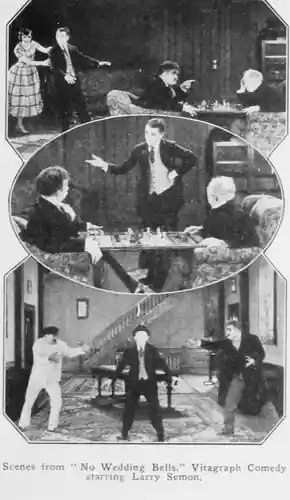
Compared to more character-driven silent comedies, Semon’s work, including 'No Wedding Bells', often leans into spectacle over subtlety. While Chaplin could wring pathos from the simplest gesture, and Keaton could build an emotional narrative through stoic perseverance, Semon pursued a more maximalist approach. His films are less about the inner life of his characters and more about the external forces that conspire against them, and their increasingly elaborate reactions. This isn't a criticism, but rather an observation of a distinct comedic philosophy. Where a film like The Invisible Bond might explore complex human relationships through a dramatic lens, Semon uses every available tool to extract laughter through sheer kinetic energy and audacious visual invention. It's a style that found immense popularity in its day, appealing to audiences who craved pure, unadulterated entertainment, a break from the often melodramatic fare of the era. One might even draw a loose parallel to the ambitious, often sprawling narratives of films like Meg o' the Mountains or The Fairy and the Waif in their scope, though Semon's scope is purely comedic, focused on the breadth of gags rather than dramatic arcs.
The narrative of 'No Wedding Bells', while seemingly simple – boy wants girl, girl gets kidnapped, boy rescues girl – is merely a framework for a continuous barrage of physical comedy. The father’s chess game, for instance, is not just a plot device but a running gag that underscores the absurdity of the domestic sphere. His single-minded obsession elevates a mundane hobby into a comedic obstacle of epic proportions. The gangster’s sleeping potion plot, equally ludicrous, provides the perfect justification for a series of chases, disguises, and narrow escapes. Larry’s journey to rescue his girlfriend is less a direct path and more a meandering, accident-prone odyssey, filled with unexpected detours and increasingly outlandish stunts. This is where Semon truly shines, in his ability to orchestrate sequences of escalating pandemonium, where every object, every character, every environment becomes a potential source of comedic friction or a prop for an elaborate gag.
One cannot discuss Semon without acknowledging his tireless work ethic and his reputation for demanding performances. He was known for his hands-on approach, often directing, writing, and starring in his films. This singular vision undoubtedly contributed to the distinctive Semon style, a style characterized by its relentless pursuit of laughter through any means necessary. While some critics of the time might have found his humor less refined than his contemporaries, there’s an undeniable energy and spectacle to his work that holds up surprisingly well for those who appreciate the raw, unpolished charm of early slapstick. His influence, though perhaps not as widely discussed as others, certainly permeated the comedic landscape, paving the way for future generations of physical comedians and gag writers. The sheer volume of gags per minute in a Semon film is staggering, reflecting a philosophy that believed more was always, unequivocally, more.
The specific moments of hilarity in 'No Wedding Bells' are too numerous to list exhaustively, but they include classic Semon tropes: the elaborate contraptions that inevitably backfire, the frantic chases across rooftops and through crowded streets, and the inventive uses of everyday objects for comedic effect. There's a particular joy in watching Semon's character navigate these perilous situations, his face a canvas of exaggerated expressions, his body a spring-loaded mechanism of improbable movements. Even the threat of the father, lurking in the background, ready to hurl Larry through another window, adds a layer of recurring, self-referential humor that binds the disparate comedic threads together. It’s this meticulous construction of chaos, this careful orchestration of mayhem, that elevates Semon’s work beyond mere silliness. He understood the mechanics of a gag, the rhythm of a chase, and the power of a well-timed pratfall.
In the broader context of silent film, 'No Wedding Bells' serves as an excellent example of the two-reel comedy at its peak. These shorts were the bread and butter of movie theaters, providing quick, potent doses of laughter before the main feature. Semon, with his distinctive approach, ensured that his contributions were anything but forgettable. While a film like An Honest Man might delve into moral complexities, Semon's world is a morally simple one: good guys chase bad guys, and everyone gets covered in flour or falls out of a window along the way. His films are pure escapism, designed to elicit guffaws and provide a momentary reprieve from the realities of life. They are a celebration of the ridiculous, an ode to the power of laughter, and a testament to the boundless creativity of the silent film era.
Ultimately, 'No Wedding Bells' is more than just a historical curiosity; it’s a vibrant, boisterous piece of cinematic history that continues to entertain. It’s a reminder of Larry Semon’s unique contribution to the art of comedy, a testament to his unwavering commitment to physical gags and relentless pacing. For anyone interested in the foundational elements of slapstick, the early career of Oliver Hardy, or simply in experiencing a truly wild ride through the annals of silent film, this short is an absolute must-see. It encapsulates the spirit of an era where imagination knew no bounds and laughter was the universal language, delivered with a forceful, window-shattering flourish. Semon's legacy, though sometimes overshadowed, is indelibly etched in the annals of comedic cinema, and films like this ensure that his particular brand of delightful pandemonium continues to resonate with audiences who appreciate the artistry of a perfectly executed pratfall or an impossibly intricate chase sequence. It’s a film that asks little of its audience except to surrender to its joyous, illogical energy, and in return, it delivers an abundance of genuine, gut-busting laughter.
IMDb —
1924
Community
Log in to comment.