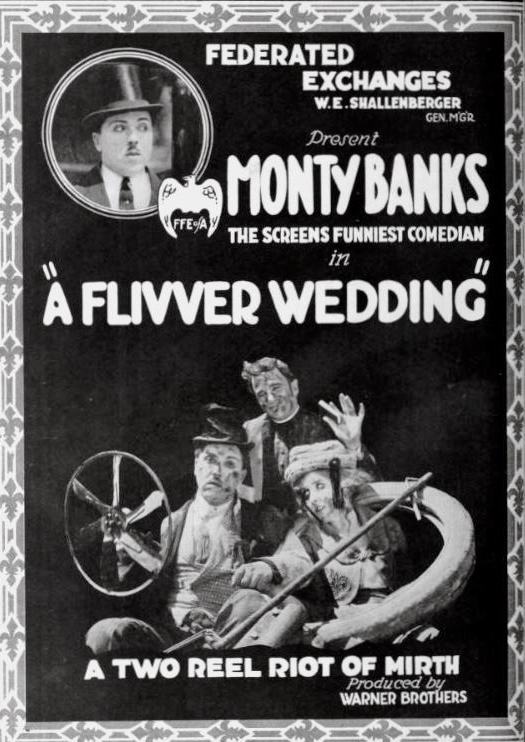
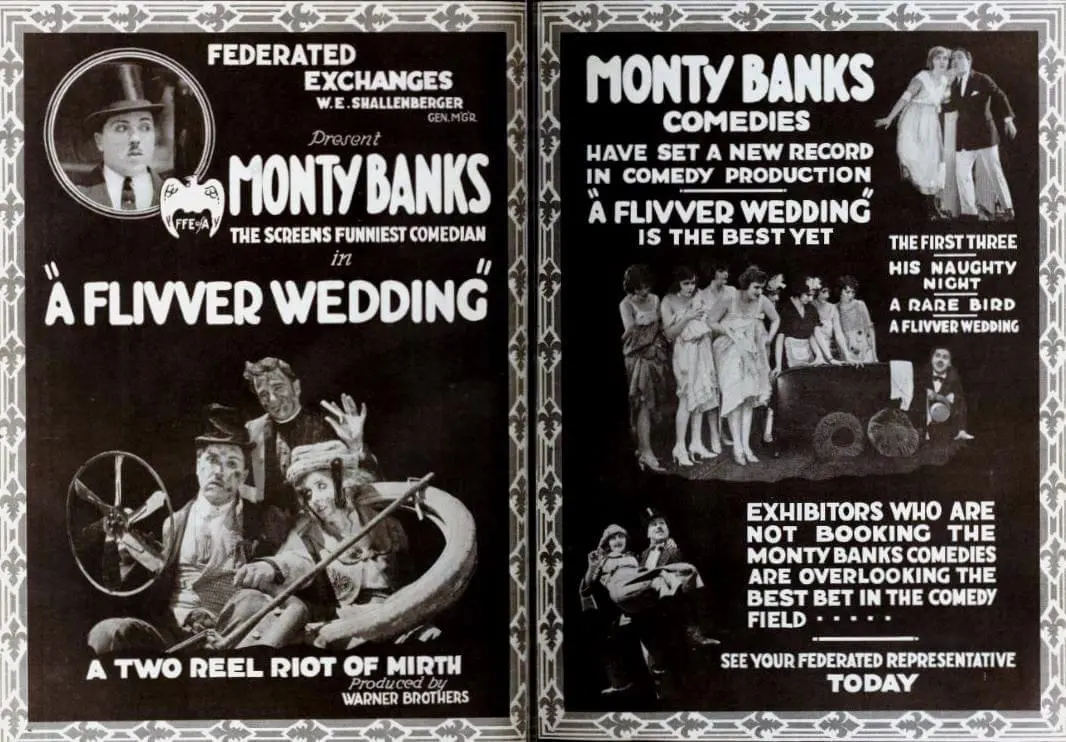
The first thing that strikes you about A Flivver Wedding is the way the title card itself jitters—white letters on black, twitching like a carburetor choking on its own ambition. That tremor is prophecy: every frame of this 1924 one-reeler vibrates with the rattle of pre-Depression America, a country still drunk on Fordist possibility yet nursing the hangover of Victorian courtship rituals.
Director William Blaisdell—better known as a character heavy in Mack Sennett farces—treats the camera like a borrowed shovel. He digs not for psychological nuance but for kinetic topsoil, flinging gags at us with the manic generosity of a farmer sowing seed during a tornado. The plot, nominally a race to halt an unwilling nuptial, is merely the clothesline from which he pegs a week’s wash of pratfalls, double-takes, and vehicular slapstick.
The Flivver as Character
The Model T—nicknamed “flivver” for the sound it makes expiring—emerges as the film’s true star. Its cloth top is patched like a hobo’s coat; its fenders flap like elephant ears. When our unnamed hero (Sidney Smith, channeling a boyish terror) cranks the starter, the car coughs once, twice, then backfires so hard the screen itself seems to jump a sprocket. That auditory violence, rendered visually by a flash-matte of white powder, becomes the film’s heartbeat: every eruption signals another mile closer to the girl, another minute further from respectability.
Compare this to the gleaming death-chariot in Gar el Hama V, where technology is fetishized as imperial extension. Here the flivver is proletarian trickster: half-mule, half-miracle. It stalls on train tracks, floats improbably across a lake, and—best of all—disassembles itself mid-chase, axles rolling away like runaway baguettes. The gag is ontological: how do you pursue the future when your vehicle refuses to remain a vehicle?
The Woman as Moving Target
Florence Gilbert’s ingenue, listed only as “The Girl,” wears a hat the size of a small satellite dish and a look of perpetual mortification. She is being married off to Monty Banks’s cad, a man who enters scenes chest-first, twirling his cane like a gearshift of entitlement. Yet Gilbert refuses to be mere porcelain. In the film’s most subversive blink-and-miss-it beat, she side-steps the wedding kiss by yanking the minister’s Bible upward as a shield; the rival’s lips smack holy leather instead of female skin. The cut is so rapid you’d swear the camera itself is embarrassed.
This micro-revolt anticipates the serial defiances of Beatrice Fairfax Episode 12: Curiosity, though here the rebellion is squeezed into 12 minutes and sanctioned by the alibi of comedy. The Girl never speaks—intertitles do that for her—but her eyes flicker like faulty marquee bulbs, spelling out a Morse of reluctance that feels startlingly modern.
Slapstick as Class Warfare
Silent comedy often works best when stakes are low and props are plenty; A Flivver Wedding obeys that axiom while slyly reminding us that marriage, in 1924, was still a property transfer dressed in orange-blossom perfume. The rival’s tuxedo is a visual ledger: silk lapels, stickpin, spats—every thread announcing liquidity. Our hero’s wardrobe, by contrast, devolves: straw boater crushed, vest buttons popping, trousers banded with rope. The gag economy equates poverty with elasticity: the poorer you are, the more you can stretch, squeeze, survive.
Watch how he commandeers a hay wagon, a roller-skate, even a child’s scooter. Each downgrade mocks the myth of upward mobility. Yet the film refuses pity; it converts scarcity into gymnastic virtuosity. When the flivver’s last wheel rolls off and he balances the chassis on his back like a dung-beetle pushing a chrome carapace, we’re witnessing not defeat but Darwinian adaptation rendered as circus.
Temporal Vertigo
Blaisdell cranks the Keystone tempo—overcranked action projected at near-warp speed—until motion becomes its own punchline. Yet he occasionally drops in a single under-cranked shot: The Girl, seen in medium close-up, lifts her veil at half-speed, the world around her blurred. The effect is heart-stopping: time liquefies, allowing desire to pool in the gutters between frames. Then—snap!—we’re back to 18 fps mayhem, the rupture so abrupt you feel the seats of your soul slam forward.
This temporal whiplash rivals the uncanny freeze-frames in The Man Who Forgot, though here the device is deployed for libidinal stun rather than amnesiac dread. One second of slo-mo buys the film five minutes of empathy; we suddenly grasp that inside every frantic chase is a static core of terror: the fear of being possessed by someone else’s story.
Sound of Silence
Archival prints screened at Pordenone arrived sans cue sheets, so accompanists improvise. At the screening I attended, a percussionist scored the flivver’s backfires with a slap-stick followed by a bass-drum hit damped by newspaper. The sync was accidental—yet each explosion landed so precisely that laughter became involuntary reflex, a Pavlovian drool triggered by rhythm. The film thus teaches us that comedy is not semantic but somatic; joke meaning is a ghost that haunts the marrow of timing.
Contrast this with the Wagnerian bombast of Mit Herz und Hand fürs Vaterland, where every emotion is underlined by leitmotif. Flivver needs no horns to herald its hero; the squeak of a rusty spring suffices. Silence, punctuated by arrhythmic clatter, becomes the film’s native tongue—a reminder that in the mid-’20s the world itself was learning to parse the roar of engines over the hush of pastoral life.
Gendered Cartography
The chase maps a gendered topography: barns, kitchens, church vestries—feminine enclosures—are exited at velocity, while masculine zones (road, courthouse, railroad bridge) are entered with chaotic entitlement. Yet the film’s final gag collapses that binary. The runaway couple, hitched at last, zoom past a sign reading “To Niagara” only to splash into a ford of ankle-deep water. The flivver sinks; they alight and continue on foot, skirts hitched, trousers rolled. The camera cranes up to reveal the sign was a relic—Niagara is still 300 miles. Marriage, the film winks, is not destination but damp footwear.
This anti-climax rhymes with the deflationary endings of Civilian Clothes and Louisiana, though those narratives favor bitter irony over comic bathos. Here the soaking is communal, egalitarian, almost baptismal. The lovers don’t reach the honeymoon; they reach each other, soggy but sovereign.
Colonial Afterimage
A fleeting shot displays a cigar-store Indian toppled during the courthouse brawl. The carved wooden figure lies face-down, breech-clout lifted in undignified surrender. It’s a two-second gag, easily missed, yet it vibrates with the same colonial unconscious that haunts The Daughter of the Don. The film cannot comment on Manifest Destiny—it is too busy chasing yuks—but the image lingers as residue, a reminder that even at 18 fps history’s erasures clatter along in the background.
Restoration & Revelations
Recent 4K restoration by EYE Filmmuseum harvested a Dutch distribution print struck from a second-generation dupe. Silver halide blooming lends moon-surface granularity to night scenes; Gilbert’s cheekbones acquire a topographical majesty. More startling: the discovery of a censored intertitle. In the original U.S. release, a card read: “When a woman says ‘I won’t,’ she’s merely rehearsing her ‘I do.’” The Dutch version replaces it with: “He who forces the heart courts a flat tire on the road of life.” The swap, likely mandated by Netherlands’ Protestant board, retroactively rewrites the film’s sexual politics, shifting blame from female caprice to male coercion. Textual archaeology at 24 frames per second.
Performative Exhaustion
Sidney Smith’s body is a study in kinetic desperation. Note how his knees hyperextend outward when he runs, a gait halfway between Charleston and convulsion. By the final reel the sweat is real; you can see the salt drying in white rivulets across his pancake makeup. Such corporeal expenditure links him to the masochistic clown tradition stretching from Der Galeerensträfling’s galley slaves to An Adventuress’s self-immolating heroines. The difference: Smith’s agony is courtship currency. He suffers because the genre demands the male body be humiliated into worthiness.
Cinematic Afterlife
DNA from Flivver strands can be found in Capra’s It Happened One Night—the newspaper blanket, the hum of roadside America—but also in the nihilistic roadsters of Two-Lane Blacktop. The Model T, once symbol of democratized mobility, morphs into existential hamster wheel. Yet unlike the bleak asphalt of Dos corazones, Blaisdell’s universe insists that if love cannot conquer all, it can at least conquer 45 intermittent horsepower and the occasional skunk.
Critical Verdict
Is A Flivver Wedding a masterpiece? No. Its gags are derivative—Keaton did the wheel-less car first, Lloyd the skyscraper dangle. Its gender politics creak louder than the chassis. Yet it pulses with the improvisatory jazz of a medium still inventing its own grammar. At 22 minutes it is a haiku shouted through a bugle, a speed-run through American anxieties: industrialization, consent, class, mobility. Watch it for the ecstasy of a universe where every backfire is a love-letter, every pothole a plot-twist. Then walk home listening for phantom clanks beneath your own floorboards; that’s history’s engine, still misfiring in the dark.
Rating: 8.2/10 — a rust-speckled gem whose rattling heart keeps time with our own.