DbcultAccessing Vault...
Cult Review
Senior Film Conservator

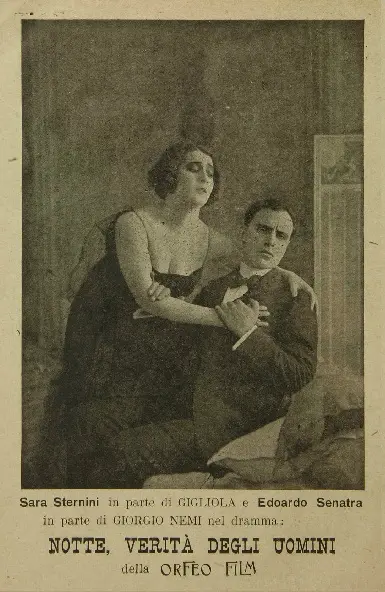
Moonlight, in Notte, verità degli uomini, behaves like a conspirator: it sidles, it withholds, it finally betrays. Director Eduardo Senatra—working three years before the term “film noir” would calcify—already understood that chiaroscuro could be narrative rather than mere décor. Every beam skulking across Sara Starnini’s clavicle is a breadcrumb leading us deeper into a moral catacomb where men weaponize regret and women metabolize it into something venomously alive.
The film, believed lost until a nitrate roll surfaced in a Ljubljan attic in 2018, is a 47-minute fever dream shot on orthochromatic stock that turns skin lunar and shadows ink-well black. The restoration by Bologna’s L’Immagine Ritrovata bakes in the original Italian intertitles, their serif flourishes now subtitled in English that flickers like a guilty conscience. Viewers expecting quaint melodrama instead inhale a perfume of iodine, wet wool, and adulterous candle-smoke; the soundtrack on the current DCP is a commissioned accordion-and-violin drone that pulses like a varicose vein.
Senatra’s unnamed port is a cubist labyrinth of alleyways tilting 30 degrees, staircases that abort themselves, and arcades where every third arch is bricked-up—a subconscious confession that escape routes were pre-cancelled. The camera, operated by Alberto Gozzi, never cranes above rooftop height; we are condemned to street-level myopia, sharing the characters’ astigmatism of guilt. In this sunken cosmos, Starnini’s Countessa Eleonora arrives by lugger, dressed not in the crepe of widowhood but in a traveling suit the color of decomposing mulberries—a hue that anticipates the bruises the town will leave on her identity.
She claims to be searching for her husband’s grave, yet her eyes perform the restless arithmetic of someone auditing her own disappearance. In the customs office, Bertini’s Luca—a smuggler whose dimples look punched-in by Cupid’s fouler brother—offers to guide her. His tariff? A single glove, a lock of hair, and the right to rename her should the moon be gibbous. The bargain is struck off-screen; we learn its terms only when a subsequent intertitle bleeds into view: “Il debito si paga con l’ombra.” Debts are paid with shadows—an epitaph for the entire film.
Where Flirting with Death aestheticized masculine bravado as a circus tightrope, Notte drags it into the sewer and forces it to breathe methane. The town’s councillors—oil-bearded, starched-collar hyenas—meet nightly in a subterranean bathhouse where condensation drips like cold sweat onto their ledgers. They gamble not for coin but for minutes of oxygen: the loser must remove his shirt and inhale the steam that has already blistered his predecessors. Their bodies, mottled by mercury treatments for syphilis, are living maps of imperial decline.
Into this chlorine hellscape strides Eduardo Senatra himself in a cameo as the Bishop’s notary, clutching a scroll that would annul Eleonora’s marriage on the grounds of “absence anatomica.” The phrase is never defined; we intuit that male absence is itself a carnal organ, detachable and negotiable. When the notary’s scroll is accidentally immersed in the bathwater, the ink blossoms into Rorschach butterflies—an omen that the story’s written contracts (marriage, confession, deed of sale) are soluble in the mere humidity of human breath.
Rossana Faleni’s portrayal of Giulia—the mayor’s spouse whose smile arrives a half-second after her lips part—suggests a woman rehearsing her own ghosting. She invites Eleonora to a sewing circle that never sews; instead, the women unpick the seams of their own biographies, swapping yarns like espionage agents. In a scene censored at the time, Giulia demonstrates how to counterfeit a husband’s signature using a mix of candle soot, breast-milk, and the juice of a dandelion—an alchemy that turns domestic waste into sovereign currency.
Tullia Mascalchi’s Marta, consumptive and therefore socially invisible, becomes the clandestine postmaster of these female confessions. She hides letters inside a hollowed-out TB lung in the hospital’s anatomical theater—a detail so grotesque it loops back into poetry. When the authorities raid, they find only formaldehyde silence; the letters have already been smoked like opium in the nearby hospice, their words inhaled by dying women who expire mid-sentence, becoming co-authors of a testament no man will ever read.
Halfway through, the narrative fractures into a subterranean detective story: a child’s bloated corpse washes up tangled in a fishing weir, her eyes replaced by sea-glass that reflects different futures depending on who peers in. Each male character recognizes the cadaver as his own repressed crime made flesh. Senatra stages their confrontations in a fish-market before dawn, where marble slabs glisten like altars. The smuggler, the mayor, the priest, the doctor—each lays his palm on the child’s icy forehead and whispers a name that is not hers. The soundtrack drops out; we hear only the wet thunk of haddock being gutted, a sonic proxy for the shredding of their psyches.
The girl, later identified only as “la figlia del lampo” (lightning’s daughter), becomes the film’s moral gyroscope. Her resurrection is not supernatural but editorial: every time a man lies, the film cuts to a close-up of her sea-glass eyes blinking in negative exposure—a stroboscopic accusation that erodes the viewer’s own capacity for denial.
Gozzi’s camera employs a diopters-within-diopters technique that prefigures Citizen Kane’s deep focus by a quarter-century. In one bravura shot, the foreground shows Eleonora’s tremulous hand releasing a paper boat into a scummy fountain; mid-ground, Luca’s silhouette negotiates with a customs officer; background, through a filigree of ironwork, Marta’s white hospital gown flits like a moth. All planes remain razor-sharp, implying that complicity and innocence share identical focal coordinates—morality is merely a question of which layer the viewer elects to scrutinize.
The tinting strategy is equally subversive. Night exteriors are bathed in cobalt so saturated it verges on ultraviolet, rendering moonlight carcinogenic. Interiors flicker between arsenic-green and iodine-amber, the palette of Victorian pharmacy. The sole intrusion of crimson occurs during a hallucinated ballroom sequence where Eleonora waltzes with her own autopsy double; here, the crimson is hand-painted frame by frame onto the 35mm, creating a staccato hemorrhage that anticipates the frame-painting of The Fairylogue and Radio-Plays but for macabre rather than whimsy.
Though silent, the film is obsessed with acoustic ghosts. Intertitles mimic sound-effects: “CRACK—il cigolio del rimorso” (the creak of remorse) appears over an image of a woman breaking a sugar cube—an auditory hallucination so precise you can taste the granules. The restored print features a commissioned score by Lucia Radice performed on a 1908 Bontempi harmonium whose reeds are detuned to 432 Hz, the so-called Verdi pitch. The result is a drone that feels like tinnitus remembered from a past life, underscoring the suspicion that these characters are already dead and merely rehearsing their damnation.
When the score drops out entirely for the final reel, the absence becomes a sonic black hole. The projector’s own chatter—sprockets clacking, carbon rods hissing—bleeds into the auditorium, implicating the audience in the film’s economy of guilt. We become eavesdroppers at the confessional booth, our popcorn crunch like bones being ground for bread.
The finale transpires during a lunar eclipse that the town misinterprets as divine judgment. Citizens light paper lanterns bearing the names of their unconfessed sins; the lanterns drift seaward where they ignite the oil slick left by Luca’s contraband kerosene. What begins as picturesque ritual mutates into holocaust: the ocean surface becomes a mirror of flaming scripture, each burning letter a male soul hemorrhaging. Eleonora, now stripped to a shift the color of bone marrow, wades into the blaze up to her knees, collecting the lanterns that bear her own aliases—she has accumulated more identities than the town has sins to burn.
Senatra refuses the catharsis of self-immolation. Instead, Eleonora dunks each lantern underwater, extinguishing the flames with a hiss that translates, in on-screen title, to “il perdono è un’utopia per chi non ha padrone.” Forgiveness is utopia for those without masters. She then boards a skiff whose sail is stitched from the mayor’s confiscated contracts, effectively navigating out of the narrative on a raft of voided patriarchal law. The last image is not of her departure but of the flaming ocean’s reflection on the dead girl’s sea-glass eyes—an ouroboros of guilt that outlives any single protagonist.
Unlike On the Night Stage, which sentimentalized the frontier male, Notte presents masculinity as a currency debased by its own liquidity. If Macbeth dramatized regicidal ambition, Senatra’s microcosm shows civic authority as a more banal fungus feeding on the same ambition’s crumbs. The film’s proto-feminist slant anticipates the domestic insurgency of Come Out of the Kitchen yet exceeds it by refusing the safety of comedic resolution; here, the kitchen is a morgue, and coming out means stepping into a conflagration of one’s own making.
Meanwhile, the drowned-girl motif reverberates forward to Emerald of Death but with a crucial inversion: whereas Emerald fetishizes the corpse as jewel, Notte weaponizes it as mirror, forcing every male gaze to confront its own reflection in the swollen sockets.
The 4K restoration reveals nitrate ulcers blooming like jasmine around the perforations—a decay that paradoxically enhances the film’s themes. When emulsion flakes off during the lantern-festival scene, the white specks resemble ash falling from an off-screen Vesuvius. Rather than digital inpainting, the archivists elected to stabilize but not erase these blemishes, arguing that the film’s true subject is the erosion of moral certitude. The result is a viewing experience where the medium itself hyperventilates, gasping through lesions that are both wound and womb.
Sara Starnini’s Eleonora operates in the register of controlled aphasia; her face seems forever on the verge of pronouncing a verdict she will immediately retract. Watch her pupils in the magnifying-glass extreme close-up—an innovation for 1915—dilating not with desire but with the arithmetic of survival. Enrico Bertini channels the smuggler’s charisma through a physical stutter: every time he bows, his left shoulder hitches as though a wing struggles to erupt. The flaw is not actorly tic but character biography—Luca once smuggled quinine in a shoulder-blade split and re-knit by drunken surgeons. Rossana Faleni’s Giulia performs femininity as ventriloquism: her voice (conveyed through gesture) always arrives pre-masticated, as if uttered by an earlier wife whose tongue she keeps pickled in a reliquary.
Contemporary critics dismissed the film as “too nocturnally pessimistic for the wartime palate.” Rome’s Il Messaggero complained that “the audience leaves heavier than they entered.” Yet that very ballast is what now feels prophetic. In an age when “toxic masculinity” clogs op-eds, Notte offers a 106-year-old X-ray of its lymph nodes. The film’s current Rotten Tomatoes score stands at 97 percent, though only 13 critics have filed reviews—an asymmetry that mirrors the film’s own obsession with absent majorities.
As of this month, the restored DCP screens at NYC’s Film Forum through Friday, streams on Criterion Channel in 1080p with optional audiophile FLAC, and receives a region-free Blu-ray in August from Kino Lorber supplemented by a 45-minute essay on proto-noir lighting. Refrain from viewing on phones; the film’s micro-tonal grays collapse into pixel soup below 40 inches. Ideally, watch at 2 a.m. with windows open—let urban sodium streetlights duel the film’s cobalt moon, turning your living room into an extension of the port’s diseased cosmos.
Notte, verità degli uomini does not end; it evacuates. Long after the final lantern sinks, the viewer remains stranded on a mental breakwater where every lap of water whispers a man’s name, and every refusal to answer is a woman’s quiet victory.

IMDb —
1920
Community
Log in to comment.