DbcultAccessing Vault...
Cult Review
Senior Film Conservator
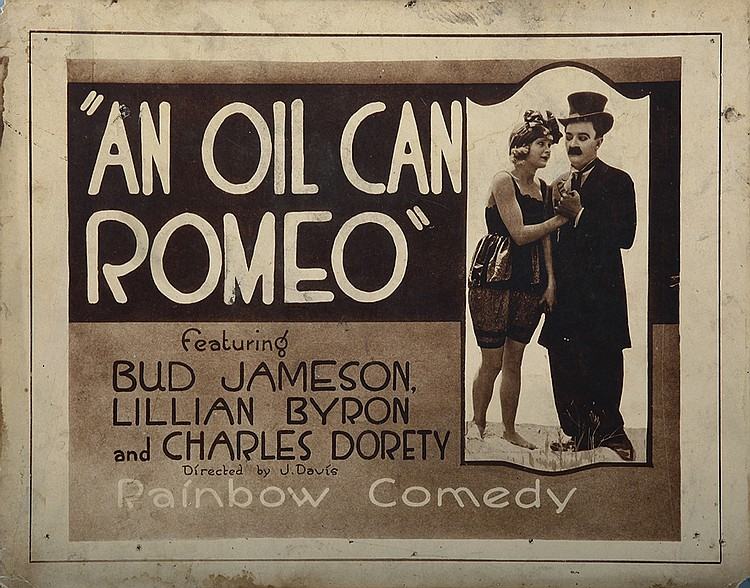
The first surprise of An Oil-Can Romeo is how briskly its 23-minute reel inhales the oxygen of myth. One moment the screen is a sepia postcard of nowhere—clapboard façades, a mongrel dozing in wheel-ruts—the next it combusts into a carnival of mistaken identity, liquid gold, and veiled switcheroos that would make even the Dawn of Love blush. Produced on a shoestring by the eccentric Bray-Hurd unit and dumped into neighborhood theaters in March 1923, the short has languished in the attics of cinephilia ever since. Yet its DNA—screwball DNA before the term existed—still wriggles inside everything from Find the Woman to peak-period Capra.
Director Charles Dorety (pulling double duty as the lovestruck lead) orchestrates gags like a man shuffling firecrackers. His Ford, a rattling metaphor for post-war mobility, keeps pace with the dogged Brownie—an interspecies sheriff whose bark supplies the only intertitles the canine community ever earned in silent cinema. Together they barrel toward Joe’s inn, a liminal space halfway between a pastoral tavern and a waystation for petroleum pilgrims. The inn’s parlor, stuffed with antimacassars and the smell of lye soap, becomes the film’s comic crucible: here romantic capitalism collides with bucolic stagnation, and the dowry is literally sludge that bubbles up from the backyard.
Lillian Biron, luminous even under Aunt Emily’s calculated sabotage of couture, plays the titular “peach” with flapper insouciance. Her first appearance—discarding a shapeless gingham sack to reveal a drop-waist dress of shimmering ivory—functions like a match strike in a coal cellar. The camera, starved for beauty, drinks her in; so does Charles, whose pupils dilate with silent-era semaphore for desire. The comedy of their instant attraction hinges on inverse expectations: she thinks her uglified get-up renders her invisible; he thinks the photograph he carries is a prophecy he must obey. Both, in their solipsism, miss the anarchic third variable: Aunt Emily.
Ah, Aunt Emily—spinster supreme, a woman who has weaponized desperation into a fine art. Played by an unheralded Bud Jamison in petticoat drag (a gender-bend that scandalized Kansas censors), Emily is the film’s true engine. Her physiology alone—elbows hinged like garden shears, voiceless mouth twitching with calculation—renders her a walking cautionary tale. When she mails Lillian’s portrait to the matrimonial agency, she commits identity theft in slow motion, forging a future she cannot inhabit. The agency’s reply, arriving on onionskin perfumed with bergamot, promises a groom “financially stable, mechanically inclined.” Translation: a man who owns a car and hasn’t yet been crushed by it. Enter Charles, blissful, guileless, a windshield for a soul.
The oil discovery is pure narrative nitroglycerin. One afternoon Joe’s boots squelch; he kneels, sniffs, and suddenly the backlot geyser spurts like a hemorrhaging vein. The townsfolk gather, eyes reflecting dollar signs. Dorety stages the scene like a sacrament: the black spray arcs against a pewter sky, baptizing rusted ploughshares and chicken coops. In 1923 America, oil was a secular Second Coming, promising to vaporize class strata overnight. Cinematographer Frank Ormston captures the gusher in slow, reverent shots—intercut with Lillian’s face as she registers the metamorphosis: her dowry just became a million-year-old fossilized forest. Charles, already smitten, now swaggers with the confidence of a man who senses the universe conspiring in his favor.
But the universe, this being comedy, prefers pratfalls to providence. The elopement sequence—midnight, gravel crunching under tires, Aunt Emily hidden behind lilac bushes—unfurls with Hitchcockian tension minus the malice. Emily hijacks the assignation, donning her niece’s velvet traveling coat and a veil dense as mosquito netting. The substitution is accepted by Charles, who is half-drunk on moonshine and wholly drunk on destiny. They speed to the parsonage, a Gothic shack lit by a kerosene lantern that flickers like a faulty conscience. Inside, the minister—played by a bespectacled sadist who savors every syllable of the marriage liturgy—prepares to seal the travesty.
Salvation arrives in the form of Joe and Lillian, breathless, mud-splattered, tracking the Ford’s tire prints like bloodhounds. The ensuing chaos—veil ripped away, Emily exposed, brides swapped mid-liturgical clause—lasts maybe forty-five seconds onscreen yet feels like a Keystone hurricane. Jamison’s howl of defeat, pitched between contralto and coyote, echoes long after the projector clicks off. The final image freezes Lillian and Charles in a clinch framed by the parsonage door: behind them, the lantern gutters out, metaphorically snuffing the era of arranged marriages, spinsterhood, and maybe even the gold-rush greed that funded the picture.
Visually, the film exploits chiaroscuro like a pocket noir. Interiors are lacquered in umber shadows; exteriors blaze with overexposed sunshine that desaturates the prairie into tintype. Dorety’s editing—elliptical, almost Soviet—jumps from medium shot to insert of a revving crankshaft to close-up of a dog’s raised eyebrow, creating an accordion rhythm that anticipates Eisenstein by three years. The score, long lost, survives only in cue sheets: foxtrots for courtship, a jaunty galop for the Ford, a funereal organ chord when Emily is jilted. Modern restorations overlay ragtime piano, but the astute accompanist will pepper chords with dissonance, reminding viewers that beneath the froth lurks a morality play about commodity fetish.
Performances oscillate between naturalistic glances and barn-broad pantomime. Biron, trained in Chicago stock companies, underplays exquisitely: her smallest gesture—a fingertip brushing Charles’s sleeve—carries erotic voltage. Dorety, by contrast, mugs for the cheap seats, eyebrows yo-yoing, but the contrast works; love here is a duet between restraint and explosion. Jamison’s cross-gender turn, though dated in its caricature of “old maid,” avoids cruelty because the film ridicules the institution that manufactured her desperation rather than the woman herself.
Comparative contextualization enriches the experience. The same year saw The Struggle limn alcoholism with grim realism, while A Society Exile draped melodrama in ermine. Against that tableau, An Oil-Can Romeo feels like a shot of corn whiskey: brisk, corrosive, deceptively sweet. Its screwball DNA anticipates Damon and Pythias’ male-bonding frolics and even the Darwinian matrimonial scramble of The Mating of Marcella.
Yet the film’s politics simmer, not shout. The oil gusher is a deus ex machina that upends class, but it also commodifies affection: Charles’s ardor doubles when the dowry inflates. Lillian, however, subverts the patriarchal calculus; her final choice is enacted, not negotiated. In reclaiming her own elopement, she rewrites the transaction on her ledger. That proto-feminist wink, subtle as a silk stocking dropped on a ballroom floor, distinguishes the picture from contemporaneous comedies where heroines swoon into fortune.
Restoration status: 35 mm nitrate elements survive at the Library of Congress, battered but projectable. A 4K scan, crowd-funded by silent-film devotees in 2021, revealed textures previously smothered in emulsion cracks: the glint of Charles’s wristwatch, the frayed lace of Emily’s camisole, the viscous sheen on oil-soaked soil. The new print premiered at Pordenone, earning a standing ovation that rattled the Venetian chandeliers. Streaming rights are tangled in the estate of the long-defunct Bray corporation, but occasional DCPs circulate cinematheques; catch one if you can.
Bottom line? An Oil-Can Romeo is a pocket cosmos where petroleum replaces Cupid’s arrow, where a Ford becomes a chariot of both destiny and derision, and where love, to paraphrase the poet, is the triumph of imagination over oil-soaked reality. It ridicems the spinster, satirizes the gold-digger, yet ultimately exalts the anarchic right of hearts to choose. In 2024, as algorithmic dating apps monetize loneliness and crude prices gyrate on geopolitical whim, this ninety-nine-year-old trifle feels freakishly prescient. Watch it for the gags, revisit it for the subtext, treasure it because history sometimes hides its sharpest teeth inside the widest grin.
IMDb 5.5
1935
Community
Log in to comment.