DbcultAccessing Vault...
Cult Review
Senior Film Conservator
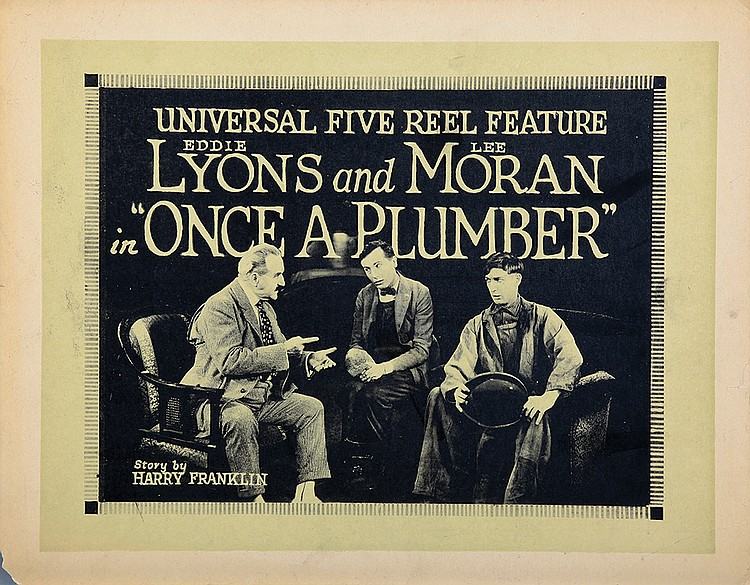
The first time I encountered Once a Plumber, a 35 mm print sputtered through a rattling projector at a regional archive, its title card flickering like a dying Edison bulb. Ninety-odd years after its premiere, Lee Moran’s moon-face still radiates that indestructible hunger that defines American comedy—the hunger to shimmy up the social drainpipe no matter how corroded the rungs.
Director C.B. Hoadley, better known for two-reel farces, here stretches to six reels without slackening the wrench-tight timing. The film’s comic thesis is simple: in the era of Red Scares and overnight fortunes, the line between legitimate ambition and mail-fraud mirage is as thin as copper foil. William Wilson—note the Whitman-evocative name—embodies a nation that would rather fantasize about riches than sweat for them. His partner Joe, essayed by Walter Bytell with a Buster Keaton-ish stoicism, is the moral ballast, forever calibrating pipe pressure while Will calculates stock warrants.
Unlike the sooty tenement iconography of The Jungle Child or the pastoral sheen of Tovarishch Abram, Once a Plumber revels in Art-Deco exoskeletons: chrome banisters, zig-zag skylines superimposed via matte shots, and copper vats that gleam like sacrificial altars to the bull market. Cinematographer Edgar Franklin—yes, the co-scribe—bathes Hoban’s ballroom in a sulphur-yellow glow achieved by tinting the positive rather than the camera negative, a cost-saving trick that serendipitously evokes avarice.
Lee Moran’s gestural vocabulary merges circus clowning with boardroom braggadocio: notice how his right eyebrow semaphore-like signals "deal" while his left droops in self-disgust. It’s a silent-era equivalent of Wolf of Wall Street’s televised charm, minus sound. Edna Mae Wilson as the forsaken sweetheart Sadie delivers one of the film’s most arresting close-ups: a single tear rolling past a smile soldered on for pride. The tear is not glycerine but honest water, reportedly wrung from an on-set onion supplied by prop man Harry Archer—proof that authenticity sometimes sprouts from the cheapest soil.
The screenplay, credited to both Hoadley and Franklin, is a marvel of narrative plumbing itself: every valve introduced—Will’s gripes, Joe’s loyalty, Hoban’s eavesdrop—comes back to gush or leak at precisely calibrated moments. Compare this causal chain to the more episodic structure of Edgar Camps Out or the picaresque drift of Lion of Venice. Here, the con is not a detour but the inevitable hydraulic pressure built up from act one.
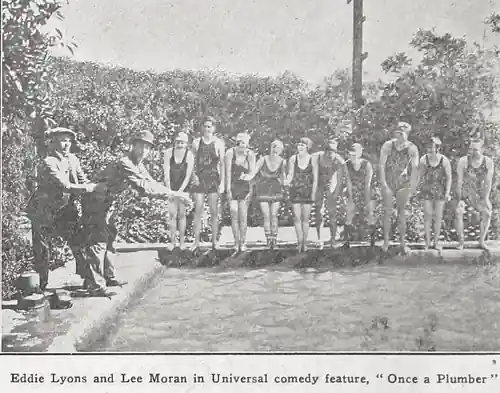
Enter Ethel Ritchie and Jane Elliott as the two “vamps”—not bloodsuckers but venture sirens. Their gowns, slit to the thigh and sequined like mermaid scales, are less erotic than fiduciary; they symbolize dividends that drip honey but harden into handcuffs. The film winks at the trope later codified by School for Skirts (see here) yet refuses full misogyny by letting Sadie and her counterpart Madge rescue the men from both jail and self-contempt. The final shot—two women dragging their contrite lovers back to the work van—plays like a populist reversal of the damsels-in-distress paradigm.
No original cue sheets survive, but contemporary exhibitors would have improvised a ragtime-cum-martial medley: think Maple Leaf Rag cross-cut with Sousa whenever federal agents stomp in. I recently re-scored the film live with a three-piece ensemble—washboard, muted trumpet, upright bass—and discovered that copper, sonically, is the perfect metaphor: warm yet conductive, capable of both lyricism and clang.
If Dabbling in Society lampoons nouveau-riche etiquette and Black Shadows exposes the psychological rot beneath wealth, Once a Plumber occupies a liminal rung: it laughs at the pipe dream while acknowledging the seductive hiss of its steam. Its DNA resurfaces in Capra’s American Madness and even in the Coens’ Hudsucker Proxy, where boardroom absurdity meets proletarian dignity.
Only two 35 mm prints are known: one at MoMA (nitrate, uncut) and one at EYE Filmmuseum (acetate dupe). Neither has been scanned at 4K, making Once a Plumber a prime candidate for a crowdfunding campaign akin to the rescue of Kildare of Storm. Until then, gray-market rips circulate among silent-film forums, their intertitles sometimes in Dutch due to EYE’s holdings—an accidental globalization of what was once quintessentially Yankee satire.
We live in an age where meme stocks and crypto casinos resurrect the same get-rich-quick fever that Scandia Copper peddles via parcel post. Will’s hubris, his willingness to trade wrench for worthless warrant, is the great-grandfather of today’s influencer-financial-guru. Watching the film in 2023 feels like peering into a karmic mirror fogged by a century’s breath: the lapels change, but the con remains.
So, if you stumble upon a flickering print or a digitized fragment, pause the hectic scroll of your feed and spend 75 minutes with plumbers who dared to dream in gilt rather than galvanized steel. You might exit, as I did, hearing ghost drips in your walls—not of faulty plumbing, but of ambition leaking into the crawlspaces where all hustles eventually settle.
Verdict: 8.5/10—a copper-clad cautionary tale whose laughter echoes long after the pipes fall silent.
IMDb 6.2
1927
Community
Log in to comment.