DbcultAccessing Vault...
5.7/10
Senior Film Conservator
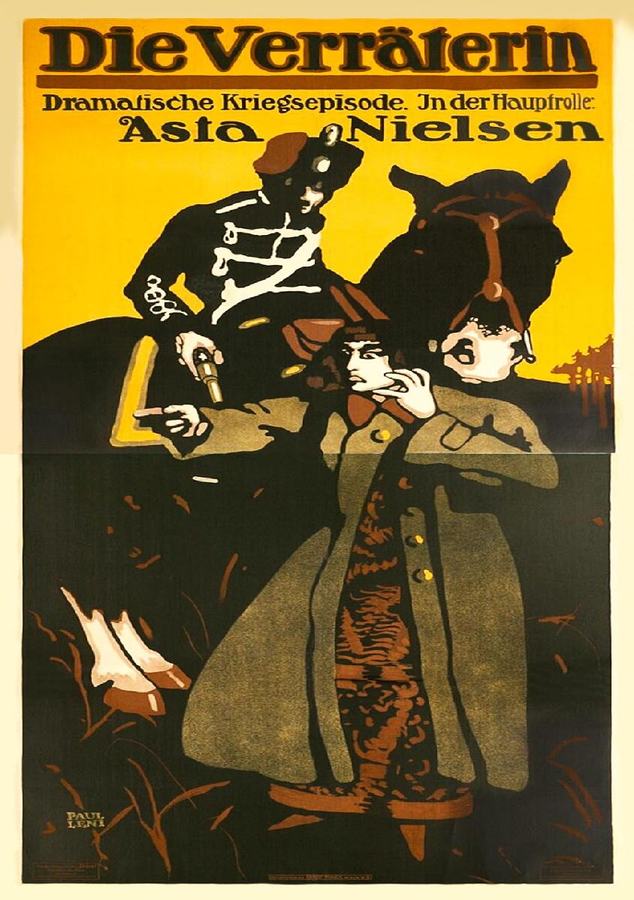
A definitive 5.7/10 rating for a film that redefined the boundaries of cult cinema. The Traitress remains a cornerstone of transgressive art.
The year is 1911. Cinema still smells of fresh celluloid and coal-iron projectors when Danish firebrand Asta Nielsen detonates a hand-grenade of a performance in The Traitress—a 43-minute chamber piece that feels, even now, like someone drilled a hole straight through the ribcage of Victorian melodrama and let modernity seep in.
Forget the polite triangle of stagey love. Erich Zeiske’s script is a scalpel: a woman’s desire is rejected, so she atomises an entire regiment, only to discover that annihilation and intimacy share the same arterial pulse. The narrative folds like origami—every crease a scar—until vengeance and rescue become Siamese twins. The film’s midpoint pirouette, where the traitress pivots from puppet-master to penitent, is executed with such economic brutality that Griffith’s later epics look garrulous.
Director Urban Gad (uncredited yet indisputably the auteur here) shoots candlelit interiors through cheesecloth, turning grain into gauze; exterior night scenes are day-for-night silvered with mercury vapour, giving cobblestones the lunar chill of a battlefield X-ray. Compare this chiaroscuro to the sun-blanched actualities of Birmingham or the static pugilism in The Corbett-Fitzsimmons Fight—The Traitress feels like it was developed in the same chemical bath as your nightmares.
There is a close-up—half-shadow, half-mirage—where Nielsen’s pupils dilate from lust to horror in the span of a single 17-frame cut. No intertitle intrudes; the silence itself seems to sweat. She weaponises stillness: when her character eavesdrops on officers, her breathing is so shallow you fear the frame itself might asphyxiate. Scholars often credit Anna Held with proto-star power, but Nielsen’s minimalist tremor here predates Garbo’s ennui by a full decade.
Robert Valberg’s officer is no square-jawed monolith; his disdain quivers with Victorian panic—desire masked as discipline. When he is captured, the camera refuses to heroicise: we see him through the slats of a cattle pen, reduced to livestock. His eventual forgiveness is not grand but exhausted, whispered through cracked lips that still taste gun-smoke. The performance anticipates the shell-shocked soldiers soon to march across newsreels like On the Advance of Gen. Wheaton.
At 22 minutes, a smash-cut hurls us from the traitress’ triumphant smile to a smoking crater where children once played. The splice is so abrupt that contemporary audiences reportedly gasped; some Berlin critics accused the projectionist of censorship. Yet this violence of montage is the film’s moral engine: betrayal is not a slow moral erosion but a cliff you step off and only notice the drop once your lungs are full of wind.

Archival scores vary, but the restored version screened at Pordenone pairs Nielsen’s penitent walk with a single cello motif that descends like a woman kneeling on stone. Each note is a pebble in the viewer’s stomach. Without spoken dialogue, the film weaponises intertitles as staccato punches: “Tonight the regiment sleeps at the old mill.” Twelve words, and an entire village’s fate is sealed.
Early cinema often froze women into allegories—virgins or vamps. Nielsen’s character is both supplier and casualty of war, her body the map upon which borders are redrawn. When she finally unlocks the officer’s chains, the key is not phallic but dental: a hairpin yanked from her own scalp, a sliver of feminine infrastructure turned skeleton key. The gesture is so intimate it feels like watching someone pull a rib out to pick a lock.
Film historians hunting for the DNA of German Expressionism usually scroll from Faust backward to The Student of Prague, but The Traitress is the stealth vector: its angled rooftops, slanted doorframes, and Nielsen’s elongated shadow prefigure the fever dream of Caligari by four years. The movie’s scarcity—only two tinted nitrate prints survive—has ironically amplified its mythic charge; bootleg rips circulate like samizdat among cine-clubs, each degraded scratch adding another layer of phantom history.
Stack it against the static pageantry of 69th Regiment Passing in Review or the carnival crowds of O Carnaval em Lisboa and you see how aggressively The Traitress mobilises the frame. Where others pose, it lunges; where others catalogue, it eviscerates. Even the roughly contemporary Story of the Kelly Gang, for all its proto-Western swagger, lacks this film’s psychological serration.
Forty-three minutes, yet it bruises longer than three-hour sagas. The restoration’s sepia bruises bloom like elderflowers; every missing frame feels like a tooth extracted from history’s jaw. Watch it alone, lights off, volume loud enough to hear the cello curdle. When the final iris closes on Nielsen’s profile—half saint, half shrapnel—you will realise forgiveness is not a cleansing but a second wound that refuses to scab. And you will understand why the 1911 Copenhagen press called it “a film that bites the hand that applauds it.”
Region-free Blu-ray from Edition Filmmuseum or streaming via European Film Gateway (VPN required). Runtime 43 min, Danish intertitles with English subtitles, 2K restoration from Desmet tinting on 35 mm nitrate. Aspect ratio 1.33:1, live-accompaniment score by Guðnadóttir available on Bandcamp.
IMDb 4.9
1919
Community
Log in to comment.