DbcultAccessing Vault...
Cult Review
Senior Film Conservator
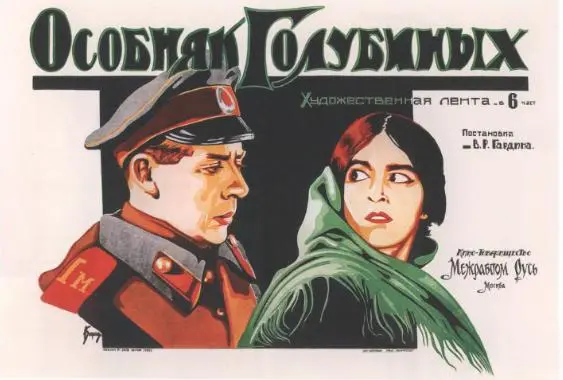
There are films that merely tell a story, and then there are those that sing a mournful, haunting elegy for a world irrevocably lost. Nathan Zarkhi's "Osobnyak Golubinykh" (The Golubinykh Mansion), a cinematic artifact from the turbulent crucible of early Soviet Russia, belongs firmly to the latter category. This isn't just a motion picture; it's a meticulously preserved whisper from the past, an intricate examination of the human spirit grappling with seismic societal shifts. Long overshadowed by more overtly propagandist works of its era, "Osobnyak Golubinykh" emerges, upon re-evaluation, as a profound, psychologically nuanced drama, a testament to the enduring power of narrative when stripped to its bare, expressive essence. It’s a film that demands active engagement, inviting viewers not just to watch, but to feel the dust of history settle upon their own understanding of change and legacy.
The film plunges us headlong into the decaying grandeur of the titular Golubinykh Mansion, a once-resplendent edifice now standing as a skeletal monument to aristocratic decadence and the brutal efficiency of revolution. Here, nestled amongst the ghosts of gilded ballrooms and hushed libraries, we find Anya Golubina, portrayed with a breathtaking blend of vulnerability and nascent defiance by Aleksandra Kartseva. Anya is not merely a character; she is the living embodiment of a crossroads, a young woman caught precariously between the spectral grip of her family's opulent, often morally compromised, past and the stark, unforgiving realities of the new Bolshevik order. Her existence within the mansion is a perpetual dance with shadows, a solitary vigil amidst the remnants of a vanished world.
Zarkhi's screenplay masterfully constructs Anya's internal and external conflicts. Her initial objective appears simple: to preserve some shred of her family's dignity and perhaps, more practically, to secure her own precarious position in a society that views her lineage with suspicion. However, this seemingly straightforward goal rapidly unravels into a complex quest for truth when she stumbles upon a trove of hidden letters and journals. These aren't just dusty relics; they are fragments of a deeply buried scandal, a clandestine affair involving her revered grandfather and a young, impoverished seamstress, culminating in a child whose existence was meticulously erased from family records to safeguard the Golubinykh name. This revelation shatters Anya's idealized perception of her ancestors, forcing her to confront the hypocrisy and cruelty that often underpinned the very 'honor' her family so fiercely guarded.
Adding layers of external pressure to Anya's personal turmoil is the arrival of Comrade Volkov, chillingly embodied by Andrey Fayt. Volkov is not merely a bureaucrat; he is the personification of the new regime's opportunism, a man whose revolutionary fervor is thinly veiled by personal ambition. He views the mansion not as a historical site but as a resource to be exploited, its secrets as leverage, and Anya herself as a relic to be either re-educated or discarded. Fayt’s portrayal is a study in quiet menace, his eyes conveying a chilling blend of ideological conviction and predatory calculation. His presence creates a palpable sense of dread, a constant threat hanging over Anya’s fragile existence.
Amidst this psychological and political maelstrom, Anya finds an unexpected ally, or perhaps, a complex confidant, in Boris, played with understated intensity by Andrei Gorchilin. Boris is a young, idealistic revolutionary, deeply committed to the new order but not entirely devoid of empathy or intellectual curiosity. His interactions with Anya are fraught with ideological tension and burgeoning mutual respect, offering a nuanced exploration of human connection transcending class divides. Their debates, though silent, resonate with the larger philosophical clashes of the era, questioning the true meaning of justice, progress, and humanity. V. Lyalin, in a smaller but impactful role, portrays a more rigid, dogmatic party official, contrasting sharply with Boris's nuanced approach and further highlighting the ideological spectrum within the revolutionary movement.
The power of "Osobnyak Golubinykh" rests heavily on the shoulders of its exceptional cast, who, through gesture, expression, and nuanced physicality, convey a depth of emotion that transcends the absence of spoken dialogue. Aleksandra Kartseva’s Anya is a revelation. Her face, a canvas of shifting emotions, communicates fear, anger, hope, and ultimately, a quiet resolve that is profoundly moving. She doesn't just act the part; she inhabits Anya's skin, making her internal struggles palpable. One particular scene, where Anya discovers the hidden letters, is a masterclass in silent acting, her initial disbelief slowly morphing into a potent cocktail of grief and righteous indignation, all without a single intertitle to guide the audience explicitly.
Andrey Fayt's Comrade Volkov is equally captivating, albeit in a chillingly different manner. Fayt eschews overt villainy for something far more insidious: a detached, almost clinical ambition. His performance is a stark reminder that the greatest threats often come not from cartoonish evil, but from individuals convinced of their own rectitude, regardless of the human cost. The subtle shifts in his gaze, the slight curl of a lip, or the way he carries himself – a blend of bureaucratic authority and simmering contempt – are enough to make him a truly memorable antagonist.
Andrei Gorchilin brings a much-needed humanistic touch as Boris. His portrayal balances revolutionary zeal with genuine curiosity and a nascent empathy for Anya's plight. The unspoken tension and intellectual sparring between Kartseva and Gorchilin are among the film's most compelling elements, proving that powerful chemistry doesn't require words. The supporting cast also delivers memorable turns. G.K. Volkonskaya and Nina Li, as the elderly, long-suffering servants of the mansion, provide a poignant counterpoint to the central drama, their weary faces reflecting generations of silent observation and loyalty. Georgi Bobynin, Aleksandr Gromov, and Nikolay Vishnyak, in their various roles as family remnants and new officials, each contribute to the rich tapestry of a society in flux, their performances adding texture and verisimilitude to Zarkhi's world.
While the specific director is not listed, the visual storytelling of "Osobnyak Golubinykh" is nothing short of poetic. The cinematography, likely a collaborative effort of its time, uses stark contrasts between light and shadow to amplify the film's thematic concerns. The mansion itself is a character, its decaying grandeur captured in sweeping wide shots that emphasize its isolation and its diminishing relevance. Close-ups are reserved for moments of intense emotional revelation, drawing the viewer into the characters' inner worlds. The use of chiaroscuro is particularly effective
IMDb —
1931
Community
Log in to comment.