DbcultAccessing Vault...
4.7/10
Senior Film Conservator
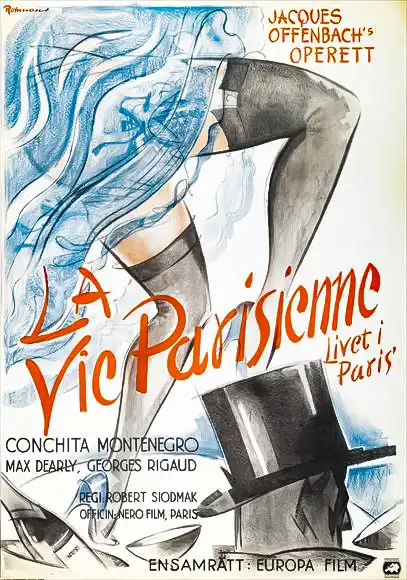
A definitive 4.7/10 rating for a film that redefined the boundaries of cult cinema. Parisian Life remains a cornerstone of transgressive art.
Is this worth watching today? If you’re the kind of person who enjoys finding dusty old reels of operetta comedies or if you just have a thing for the way 1930s movies make everything look like a giant, sparkly wedding cake, then yeah. It’s a fun sit.
Who would enjoy it? People who like farce and don't mind when everyone talks a little too fast. Who will hate it? Anyone who needs 'gritty realism' or hates it when people break into song about champagne and late nights.
I went into this mostly because I saw Emeric Pressburger was one of the writers. You know, the guy from the Archers? It’s wild to see his early stuff before he became a legend. You can see little flashes of that wit, even if it’s buried under a lot of fluff.
The movie starts in 1900. It’s all very Belle Époque and loud. Mendoza, played by Max Dearly, is this rich Brazillian guy who is basically living his best life in Paris. He’s obsessed with this actress who is the star of a show called 'La Vie Parisienne'.
Max Dearly has this great energy. He’s got these twinkling eyes that make you feel like he’s about to pull a prank on the entire audience. It reminds me of the energy in The Yankee Señor, just with more French hats and less dust.
Then we jump forward 35 years. It’s 1935, and Mendoza is back. But now he’s got a son who is—and I cannot stress this enough—a total buzzkill. His son is this puritanical guy who thinks Paris is a pit of sin and won't let his own daughter marry the guy she loves.
There is this one scene where the son is sitting there looking all grumpy while everyone else is trying to be 'Parisian.' It’s actually kind of funny because he looks so out of place. It’s like putting a goth at a beach party.
The whole plot is basically a conspiracy. Mendoza and the old actress’s friends decide they’re going to 'convert' the son to the Parisian lifestyle. It’s basically 1930s 'gaslighting' but for a good cause? They want him to drink, dance, and stop being such a wet blanket.
I noticed a weird thing with the sound in the mid-section. There’s a moment where a door closes, but the sound of the 'thud' happens like half a second too late. It’s those little 1930s technical hiccups that I actually find really charming. It reminds you that real people were standing there with big wooden booms.
Speaking of the cast, William Hartnell is in this! Yes, the first Doctor Who. He’s so young here it’s almost distracting. He’s got this sharp face and you can see that intensity he’d have later on, even though he’s just part of the ensemble here.
The music is all Offenback—wait, Offenbach (typo, sorry). It’s very catchy. There’s a scene where they’re all singing in a cafe and the camera does this slow pan that feels very high-budget for the time. It’s much more polished than something like Heads Up which felt a bit more clunky to me.
The 'conversion' of the son happens pretty fast. One minute he’s scowling, and the next he’s basically the life of the party. It’s not exactly deep character development, but this isn't that kind of movie. It’s a movie where problems are solved by champagne.
I did find the granddaughter’s subplot a bit thin. She’s engaged to a Frenchman, and they’re cute, but I kept wanting the movie to go back to the old people. The older actors just seem to be having so much more fun with the material.
There's a bit of a tangent I have to mention: the way they portray 'Brazil' in the dialogue. It’s very much that 1930s idea of 'South America' being this place where everyone is just fabulously wealthy and spends their time traveling to Europe to throw money around. It’s a total fantasy, but it fits the vibe.
The sets are actually pretty impressive. The 1900 scenes feel distinct from the 1935 scenes, mostly through the lighting. The earlier stuff feels warmer, almost hazy, while the 1935 stuff is sharper and more 'modern' (for the time). It’s better looking than The White Devil, which had a similar European flair but felt a bit darker.
I did wonder why Mendoza’s son turned out so boring. They never really explain it. Maybe he just had to rebel against his dad’s partying? It’s a classic trope, the rebellious boring kid.
One shot lingered a bit too long on a plate of food. I don't know why. It was just a plate of what looked like cold chicken. Maybe the cinematographer was hungry? It’s these weird little moments that make me love watching these old films.
Is it a masterpiece? No. But it’s got spirit. It feels like a movie made by people who actually liked Paris and liked the idea of old people showing the young ones how to live. It’s messy and the pacing is a bit all over the place, but it’s never boring.
If you see it on a streaming service or a late-night TV channel, don't skip it. Just don't expect it to change your life. It’s just a nice time with some good tunes and a lot of very fancy outfits. 🥂
It’s definitely better than some of the other fluff from that era, like Swifty, which just didn't have the same heart. Parisian Life actually cares about its characters, even if they are a bit one-dimensional.
IMDb 7.4
1937
Community
Log in to comment.