DbcultAccessing Vault...
Cult Review
Senior Film Conservator
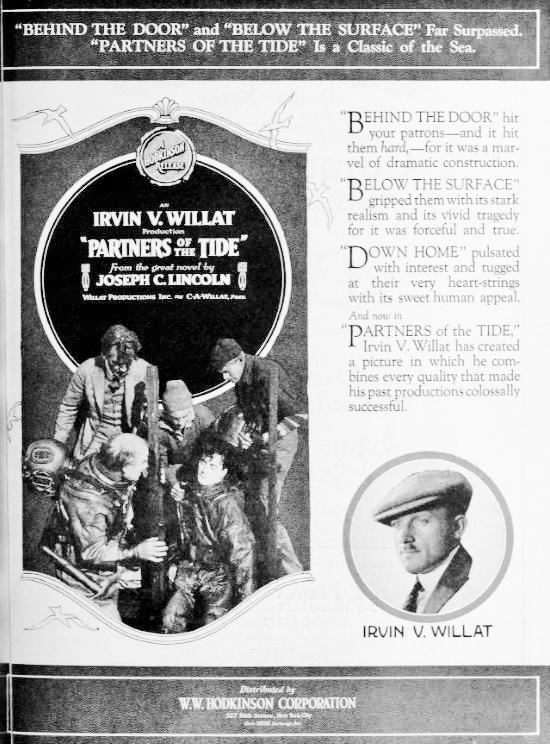
Partners of the Tide emerges from the golden age of silent cinema as a testament to the power of visual narrative. In a landscape often dominated by grandiose gestures, this 1925 melodrama distinguishes itself through its surgical precision in crafting tension. Writer Joseph C. Lincoln's adaptation, under Irvin Willat's direction, transforms a simple insurance fraud plot into a layered exploration of trust and sacrifice.
The film opens with a remarkable sequence that establishes the Allen sisters' guardianship of young Bradley Nickerson (J.P. Lockney). Through carefully composed shots of the nursery and the adjacent Baker home, Willat visualizes the fragile balance between order and chaos that defines the film's central conflict. Lockney's performance as the adopted heir is a masterclass in silent acting, conveying a lifetime of unspoken yearning through micro-expressions that shift from childhood curiosity to adult resolve.
When the Thomas Doane enters the narrative fifteen years later, it becomes more than a ship—it is a character in its own right. The way Willat frames the vessel against stormy horizons echoes the internal tempests of his protagonists. The first sabotage attempt, though foiled, establishes a rhythm of danger that accelerates toward the climactic fire. This escalation is not merely mechanical; it reflects the moral decay of the antagonists and the hardening of Bradley's resolve.
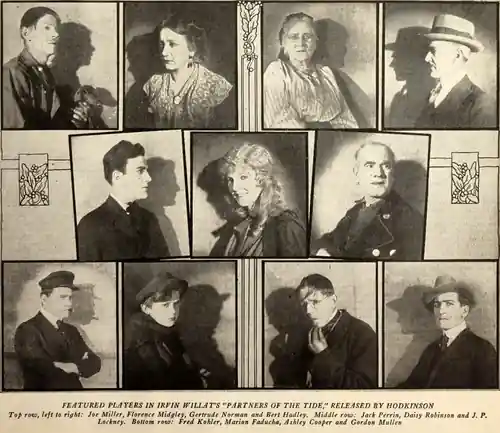
Gertrude Norman's portrayal of Gussie Baker deserves particular attention. Her character arc—from wide-eyed neighbor girl to the rescuer in the final act—is etched in subtle body language. Note how her posture shifts from tentative to assertive as she rows out to save Bradley, a visual metaphor for her evolving agency. The chemistry between Norman and Lockney simmers beneath the surface until the final act, where it erupts in a sequence of pure cinematic poetry.
The film's most audacious choice lies in its treatment of Sam Hammond (Bert Hadley). Rather than a one-dimensional villain, Hammond is presented as a man trapped by his own passions. His tampering with Bradley's diving gear is not just an act of sabotage but a desperate attempt to control his fate in a world where he's constantly second-guest. This nuance elevates the film beyond standard thriller tropes.
Technically, Partners of the Tide showcases remarkable sophistication. The use of shadow and light in the underwater sequences—though constrained by era-appropriate technology—creates an otherworldly tension. The burning ship sequence, shot with a rotating camera to simulate chaos, remains one of the most effective uses of visual disorientation in pre-code cinema. These technical achievements are all the more impressive considering the film's relatively modest budget.
Comparisons to contemporaneous works like The Hidden Hand (1925) are inevitable, but Partners of the Tide distinguishes itself through its focus on character psychology over external plot twists. Unlike the more conventionally structured The Midnight Wedding (1925), this film rewards viewers who pay attention to the subtext in every glance and gesture. The final act's resolution, where Gussie's rescue is framed in a series of long takes, feels less like a plot resolution and more like a philosophical statement about human connection.
What makes Partners of the Tide particularly fascinating is its treatment of insurance fraud as both a literal and metaphorical device. The Thomas Doane's insurance policy becomes a symbol of the characters' attempts to control the future through financial instruments, a theme that resonates with eerie prescience in our modern era of risk management. This thematic depth elevates what could have been a simple thriller into a commentary on human fallibility.
The film's pacing deserves special mention. Willat employs a deliberate rhythm that allows the audience to absorb the emotional weight of each scene. This is most evident in the second act, where the investigation into the wreck becomes a series of carefully constructed set pieces. Each dive, each examination of the wreckage, is presented with a clinical precision that mirrors Bradley's growing obsession with uncovering the truth.
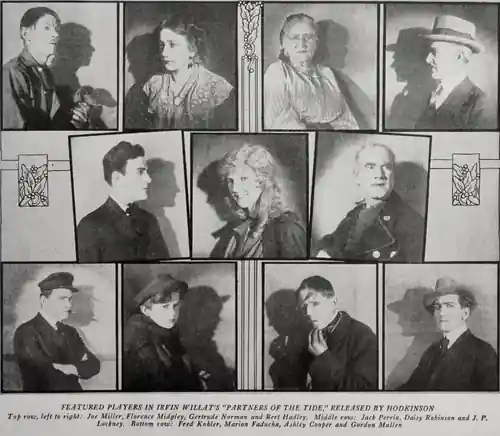
Partners of the Tide also showcases the remarkable capabilities of its supporting cast. Daisy Jefferson as one of the Allen sisters delivers a performance that is both warm and enigmatic, while Joe Miller as the loyal first mate grounds the film with his no-nonsense demeanor. These characterizations are not mere window dressing; they form an intricate web of relationships that drives the narrative forward.
One might draw parallels between this film and later works like The House of Mirth (2000) in its treatment of social class and moral compromise. Yet Partners of the Tide maintains its unique identity through its maritime setting. The sea becomes both a character and a force of nature, reflecting the inner turmoil of the protagonists. This environmental symbolism is particularly effective in the final act, where the raging fire on the wreck mirrors the emotional climax of the story.
The film's score (though lost to time) must have played a crucial role in shaping the audience's emotional response. In silent cinema, music was the primary tool for guiding viewers through complex narratives. The absence of any existing recordings is a tragedy, but contemporary reviews suggest that the score masterfully balanced suspense with sentimentality.
Perhaps the most enduring legacy of Partners of the Tide is its demonstration of how much can be achieved with minimal dialogue. In an age where visual literacy is often overshadowed by sound and color, this film remains a masterclass in economy of expression. Every gesture, every camera movement, contributes to the overall narrative without a single wasted frame.
In conclusion, Partners of the Tide stands as a quietly revolutionary work in the silent film canon. It challenges the misconception that silent cinema was merely a precursor to modern filmmaking, instead proving that visual storytelling can achieve profound emotional resonance without a single word. For contemporary filmmakers exploring visual narrative techniques, this film remains an essential study in tension-building through composition, performance, and structural pacing.
IMDb 6.1
1934
Community
Log in to comment.