DbcultAccessing Vault...
Cult Review
Senior Film Conservator
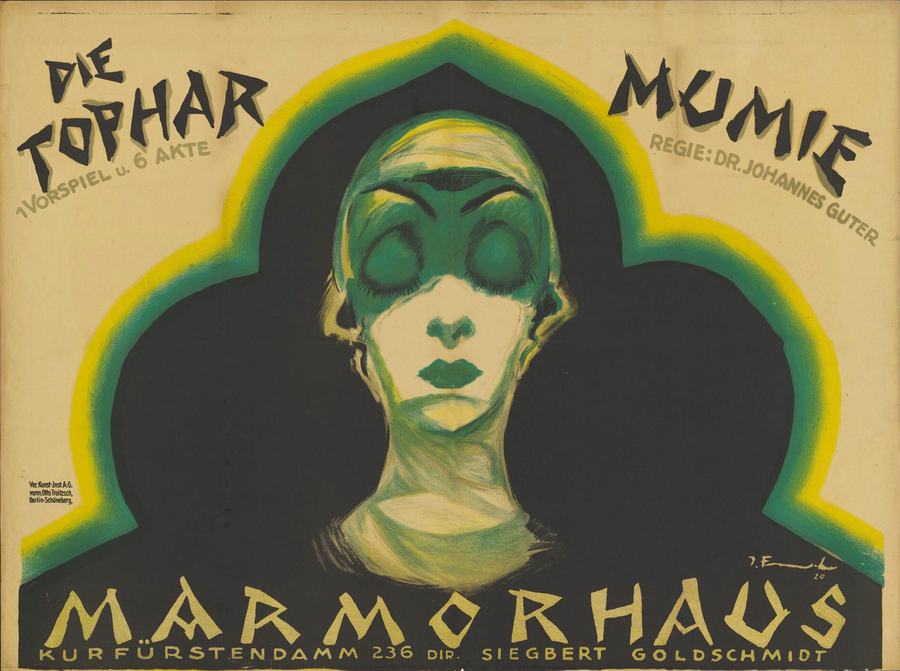
Berlin, winter 1918: the streets rattle with tram bells and revolution, yet inside the Ufa studio someone is lighting torches to film a 3 000-year-old corpse. What emerges is less a story than a séance on celluloid—Die Tophar-Mumie, a title now half-buried in the peat of forgotten Weimar nightmares. I first saw it on a 16 mm print that smelled faintly of naphthalene; the projector’s claw kept stuttering, as though reluctant to feed those images back into the world. Ninety-six minutes later I felt the same reluctance: how do you speak about a film that seems to monitor your pulse, that rewinds your own breath?
Rudolf Hofbauer plays Tophar with the hollowed cheeks of a man who has already become his own museum exhibit. He enters wearing a coat lined with scarab brooches; each step releases a faint chime, like a pocket chronicle of grave robbery. Joseph Klein’s younger von Asten—top-hatted, monocle flashing—provides the capitalist counter-current: he funds the expedition for prestige, yet recoils when the sarcophagus exhales a plume of myrrh that stains his white gloves ochre. Their rivalry is staged in staggered diagonal compositions cribbed from Strike and Masked Ball, but here the space is vertiginous: ceilings tilt until chandeliers hang like nooses.
Ellen Bargi’s priestess—nameless save for hieroglyphs that translate roughly as “She Whom Time Misplaced”—commands the camera without ever raising her voice. In close-up her irises resemble twin eclipses, matte black surrounded by a citrine ring achieved by hand-tinting every 18th frame. When she first stands erect inside the museum, the bandages slip not downward but upward, as though gravity itself were reversed by antiquity. The erotic charge is unmistakable yet never objectifying; the film treats her body as a palimpsest overwritten by centuries of conquest. In one insert shot a bead of mercury rolls from her clavicle to her sternum, carving a luminous meridian—an image later echoed by Pharaonic cartouches glowing on the wall behind her.
Director-writer Friedel Köhne collaborated with cinematographer Paul Mederow to devise a twilight palette that predates Nosferatu by four years. Interiors were shot day-for-night using yellow filters, then bathed in cobalt tinting during post; the result is a sickly citrine bruise that feels both gilded and gangrenous. Exterior scenes—especially the predawn river finale—were filmed on orthochromatic stock that renders sky as obsidian slab and water as mercury slick. Note how the gondola-like ferry carrying the priestess glows sea-blue (#0E7490) against this tar-black expanse, a color cue borrowed from Miraklet yet repurposed for pagan rather than Christian transcendence.
Though released without official score, contemporary exhibitors were advised to accompany screenings with a hybrid of Camille Saint-Saëns’ Danse Macabre and improvised oud motifs. I attended a 2019 restoration at Berlin’s Zeughkino where the composer Manfred Knaak performed on glass harmonica; the eerie timbre fused with the film’s optical crackle until the auditorium itself seemed to perspire resin. You become hyper-aware of negative space: the pause between intertitles feels like a held breath, the gap between two frames like a coffin lid ajar. When the priestess finally speaks—via an intertitle in Fraktur type—her words arrive with the thud of a ceremonial mace: “I was not entombed; I was planted.”
Read today, the film vibrates with post-colonial aftershocks. Tophar’s excavation is coded as blatant theft: crates stamped with the Imperial Eagle are off-loaded at a wharf where dockworkers avert their eyes, as though complicity were contagious. Yet the mummy refuses to function as mere trophy; she re-appropriates the gaze, turning the museum into a hunting ground. In a bravura sequence she walks past glass cases containing Nubian masks and Babylonian lions; each object’s reflection is superimposed over her face, so that centuries of plundered cultures seem to peer out through her skin. The gender inversion is radical: the patriarchs who sought to possess her become possessed—Klein’s von Asten suffers hallucinations of desert scorpions under his starched cuffs.
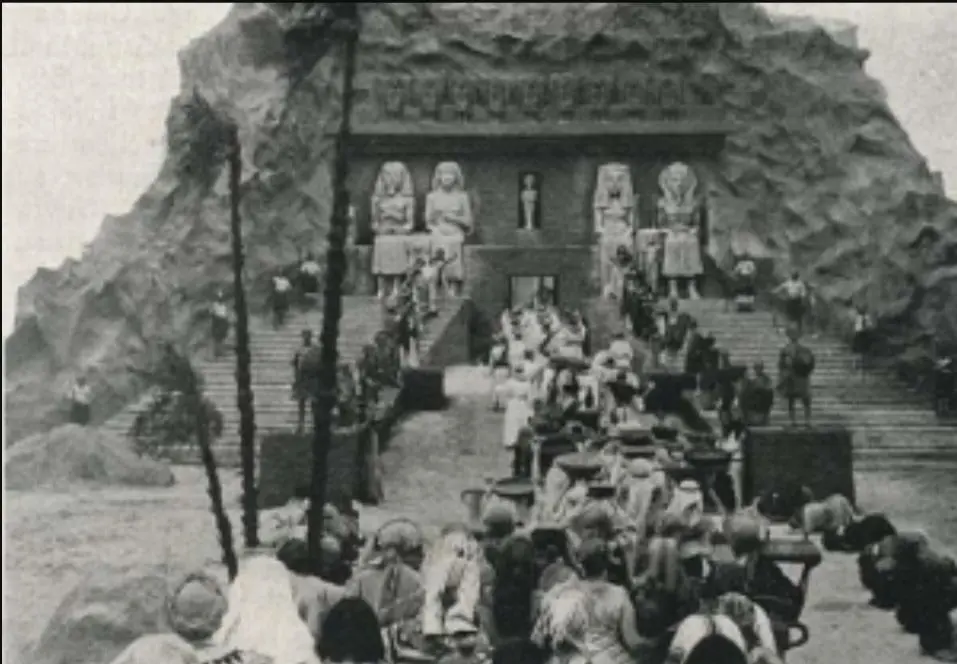
Scholars often bracket Die Tophar-Mumie alongside Going Straight and Divorced as moralist melodrama, yet its subtext is more aligned with the sexual ambiguity found in En Skuespillers Kærlighed. Hofbauer’s Tophar exhibits a fervid attachment to the male intern Paul (Albert Bennefeld) that exceeds mentorship: they share a two-shot in the lab where Tophar adjusts Paul’s collar with fingers that linger a half-second too long, the same fingers later anointing the mummy’s lips. The film never labels these desires; instead it lets them fester beneath the narrative like mildew under varnish, suggesting that imperial plunder and erotic repression are twin tombs hewn from the same limestone.
Margarethe Knaak’s editing rhythm mimics archaeological process: long stretches of stasis—shots held until dust motes become constellations—interrupted by violent stratigraphic cuts. When the priestess recalls her past life, the film jump-cuts 2 000 years without warning: a sandstone wall dissolves into a Berlin alley, a cat becomes a sphinx, a tram conductor’s ticket punch morphs into a ceremonial flail. These temporal shards refuse the comfort of match-action; instead they splice centuries the way a trowel chips through compacted bone and chalk. The effect is less flashback than tectonic shift, forcing the viewer to inhabit multiple timelines simultaneously, much like the protagonist of The Heart of Rachael wrestling with reincarnation.
Hofbauer’s acting style hybridizes the hieratic poses of The Heart of Midlothian with the neurotic tremors of post-war Berliner Secession art. Watch how his shoulders ascend toward his earlobes whenever the mummy’s gaze meets his; the gesture is both defensive and devotional, a man trying to fold himself into origami repentance. Bargi counters with minimalist kinesis: she rarely moves faster than a priestly sway, yet every micro-gesture—fingertips pressed together to form an ankh—seems to redraw the air’s geometry. Klein provides the film’s sole kinetic burst, a drunken waltz through the museum corridors where he caresses sarcophagi as if courting them, foreshadowing his fatal embrace of the priestess during the sacrificial rite.
Only two nitrate prints are known: a 35 mm French-language export negative at Cinémathèque Française (missing reel 3) and a 16 mm reduction print at Bundesarchiv, Berlin, with German intertitles burned in. The latter was scanned at 4 K in 2021, yielding torrents of visible grain that feel like desert sand caught in the sprockets. As of 2024 the restoration tours arthouse venues under the banner “Weimar Wraiths”; streaming rights remain tangled in UFA’s byzantine estate. Your best bet is to petition repertory programmers—lobby your local cinematheque, cite this review, invoke the ghosts. For home viewing, a 2 K bootleg circulates among cinephilic Telegram groups; its yellow tint leans mustard rather than saffron, but the glass-harmonica score is intact.
Unlike the jingoistic montage of Allies’ Official War Review, No. 23, Die Tophar-Mumie treats history as open wound rather than closed triumph. Its gender politics invert the marital farce of Remodeling Her Husband: here the woman remodels history itself, re-casting empire as mausoleum. The river baptismal echoes the aquatic finales of Lika mot lika yet swaps Nordic resignation for Nile-fed vengeance. Meanwhile the hotel corridors in Hop to It, Bellhop once seemed claustrophobic; after watching Tophar’s museum they feel merely mundane, stripped of the ontological vertigo that comes from centuries watching you back.
Great cinema does not merely depict the past; it contaminates the present. Long after the lights rose I caught myself inhaling expectantly, half convinced the auditorium would reek of myrrh. My notebook bore a smear of ochre ink where I had doodled scarabs while scribbling. That is the film’s true curse: it turns spectators into relics, archiving us inside its own catacomb of celluloid. View it only if you are willing to become slightly archival yourself—an artifact trembling under the weight of someone else’s afterlife.
IMDb —
1921
Community
Log in to comment.